
Nintendo's Growing Sales vs. Profit Margins Under Pressure: Assessing Long-Term Profitability in a Saturated Gaming Market
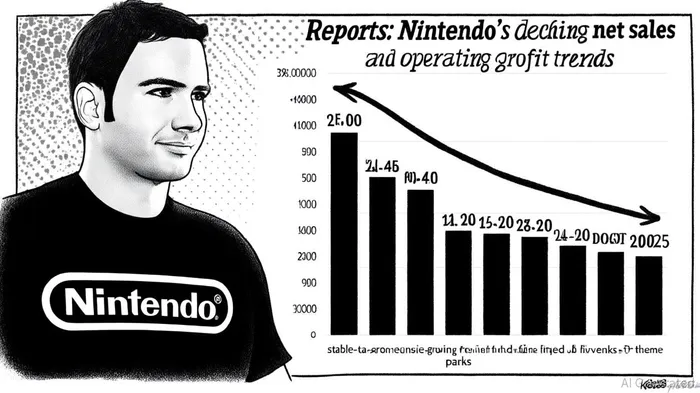
Nintendo has long been a titan in the gaming industry, but its 2025 financials tell a story of growing sales coexisting with shrinking profit margins. While the company's net sales for the fiscal year ending March 31, 2025, , . This divergence between revenue and profitability raises critical questions for investors: Can Nintendo sustain its market position in a saturated gaming landscape, and will its strategic pivots offset margin pressures?
The Sales Story: Diversification and IP Power
Nintendo's ability to grow sales despite a maturing Switch lifecycle hinges on its iconic intellectual property (IP) and diversified revenue streams. The Super Mario Bros. Movie, , directly boosted Universal's Super Nintendo World attractions, . Meanwhile, Nintendo's own theme parks and merchandise sales have become a “hidden engine” of growth, .
The Switch's 150 million-unit sales milestone also underscores Nintendo's unique value proposition. Unlike competitors like SonySONY-- and MicrosoftMSFT--, which rely heavily on cutting-edge hardware, Nintendo's “good enough” strategy—prioritizing creative design over raw power—has kept the Switch affordable and accessible, appealing to multigenerational audiences [3]. However, this approach has its limits. As the Switch nears the end of its lifecycle, , .
Profit Margins Under Siege: Aging Hardware and Rising Costs
The real challenge lies in Nintendo's shrinking margins. , a trend driven by three key factors:
1. Aging Hardware: The Switch's declining hardware sales (down 31.2% in 2025) have forced Nintendo to discount units, squeezing gross margins.
2. Rising Development Costs, and Nintendo's focus on high-quality, IP-driven games (e.g., : Tears of the Kingdom) has increased R&D expenses [6].
3. Competitive Pressures. , its offerings lag in features like cloud gaming and cross-platform play.
Strategic Moves: Can the Switch 2 and IP Expansion Save Nintendo?
Nintendo's 2025–2026 roadmap hinges on two pillars: a next-gen console and aggressive IP monetization. The upcoming Switch 2, expected to retain hybrid functionality while addressing performance gaps, could reverse hardware sales trends. , . However, success depends on Nintendo's ability to differentiate the Switch 2 from Sony's PS5 Pro and Microsoft's cloud-based Xbox.
Simultaneously, Nintendo is doubling down on its IP. Plans for a film and a -themed Super Nintendo World expansion aim to replicate the Super Mario magic [2]. These ventures could diversify revenue further, but they also carry risks. For example, , .
Long-Term Outlook: A Balancing Act
Nintendo's long-term profitability will depend on its ability to balance innovation with cost control. While its IP-driven model offers a moat against competitors, the company must address weaknesses in online services and mobile gaming—segments where rivals like Tencent and EAEA-- have captured significant market share [7]. Additionally, U.S. .
For investors, the key takeaway is this: Nintendo's sales growth is real, but its profit margins are fragile. The Switch 2 and IP expansion present compelling opportunities, but execution risks remain high. As the gaming industry shifts toward cloud gaming and , Nintendo's “good enough” philosophy may need to evolve—or risk being left behind.





Comentarios
Aún no hay comentarios