
Nikkei Futures Dislocation: Arbitrage Opportunities and Sentiment Shifts in October 2025
The Nikkei 225, Japan's benchmark equity index, has entered a period of pronounced dislocation between its spot price and futures contracts in October 2025. This divergence, driven by shifting monetary policy, divergent global macroeconomic signals, and evolving investor positioning, has created both risks and opportunities for arbitrageurs.
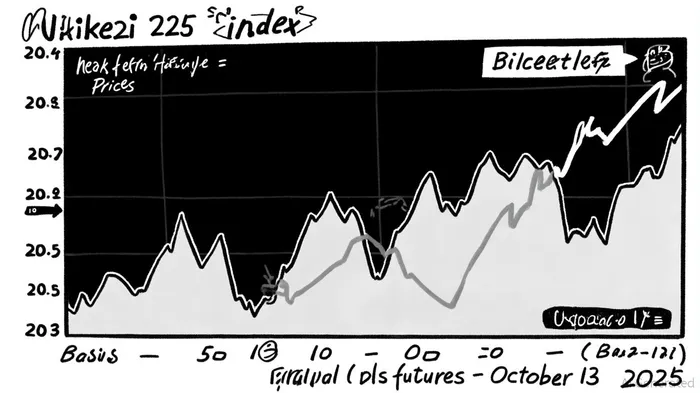
Current Dislocation Metrics: A Negative Basis and Cost-of-Carry Imbalance
As of October 13, 2025, the Nikkei 225 spot index closed at 45,769.50, while the nearest futures contract traded at 45,207.5, resulting in a negative basis of -2,881.3, according to Yahoo Finance historical data. This backwardation (futures below spot) contrasts with the typical contango observed in equity indices, where futures premiums reflect the cost of carry. The anomaly suggests a market where short-term hedging demand or dividend expectations outweigh financing costs.
The cost-of-carry framework reveals further asymmetry. The average dividend yield for Nikkei 225 constituents in 2025 stands at 1.72%, with high-yield components like Mitsui O.S.K. Lines (7.83%) and Pacific Metals (7.79%) skewing the distribution, according to the DividendPedia dividend calendar. Meanwhile, implied financing rates for October 2025 hover near 1.88%, slightly outpacing dividend yields, according to Nikkei Indexes archives. This marginal cost differential should theoretically support a small contango, yet the market's backwardation implies stronger near-term demand for physical shares-possibly from index fund inflows or dividend harvesting strategies.
Arbitrage Opportunities: Exploiting Basis Mispricing
The current negative basis presents two primary arbitrage avenues:
1. Cash-and-Carry Arbitrage (Short-Term): Investors could short the spot index (via ETFs or physical shares) and go long the futures contract, profiting as the basis narrows. With the basis at -2,881.3, this trade assumes the futures will converge toward the spot by expiration. However, transaction costs (estimated at 0.1–0.2% of notional value) and dividend timing risks must be factored in, according to an FXLeaders analysis.
2. Reverse Cash-and-Carry (Long-Term): Conversely, if the backwardation persists beyond expiration, investors might buy the spot and sell futures, locking in the discount. This strategy hinges on the assumption that the index will underperform expectations, a scenario supported by a Seeking Alpha article describing recent technical breakdowns below key support levels.
Market Sentiment: Cautious Bullishness Amid Structural Uncertainty
Investor sentiment for the Nikkei 225 remains mixed. On one hand, technical indicators suggest a bullish bias: the RSI (73.14) near overbought territory and a strong ADX (31.07) signal momentum, per the Investing.com scoreboard. On the other, macroeconomic headwinds loom. Japan's recent 25-basis-point rate hike by the Bank of Japan and weak U.S. employment data (4.3% unemployment rate) have created a volatile backdrop, as noted in a TitanFX analysis.
Put/call ratios and positioning data further complicate the picture. While the Nikkei 225 has surged 28% since April 2025, trailing only South Korea's KOSPI, analysts note rising 30-year JGB yields (up 45 bps) and export risks under new U.S. tariffs, according to an Investing.com analysis. These factors suggest a fragile equilibrium, where positive earnings upgrades for Japanese stocks clash with recessionary fears in the U.S.
Risks and Conclusion
The arbitrage landscape for Nikkei 225 futures hinges on three critical variables:
- Policy Uncertainty: A surprise shift in BOJ policy or Fed rate expectations could widen the basis.
- Dividend Timing: The index's high-yield components may trigger short-term basis adjustments ahead of ex-dividend dates.
- Sentiment Reversals: A breakdown below the 41,505.30 support level could trigger a wave of stop-loss orders, accelerating dislocation, according to the Investing.com index page.
For now, the market appears in a transitional phase. Traders with a short-term horizon may capitalize on the negative basis, while longer-term investors should monitor macroeconomic catalysts. As one analyst aptly noted, "The Nikkei 225 is a barometer of global risk appetite-and October 2025 has proven to be a volatile gauge indeed," observed in a Traders Union article.







Comentarios
Aún no hay comentarios