
Nike's Supply Chain Juggernaut: Navigating Tariffs to Maintain Dominance in Footwear and Apparel
The U.S. trade landscape has become a minefield for global brands, but NikeNKE-- (NKE) is proving it can turn tariffs into terrain. With U.S. tariffs on Chinese imports soaring to 58% in 2025—a toxic mix of Section 301 duties, fentanyl penalties, and reciprocal taxes—the company's decade-long supply chain diversification strategy is now its lifeline. Investors must ask: Can Nike sustain its margin discipline amid these pressures, and what does its manufacturing pivot mean for long-term market dominance?
The Tariff Tsunami: Costs Soar, but Flexibility Rules
The math is brutal for goods originating in China. Footwear and apparel face a layered tariff structure totaling 58.3% (Section 301: 25% + Fentanyl: 20% + Reciprocal: 10% + MFN: 3.3%), while Vietnam, Indonesia, and Thailand escape with minimal duties (3–8% MFN). This creates a stark cost differential: producing in China adds $1.16 to every $2 item before it even leaves the dock.
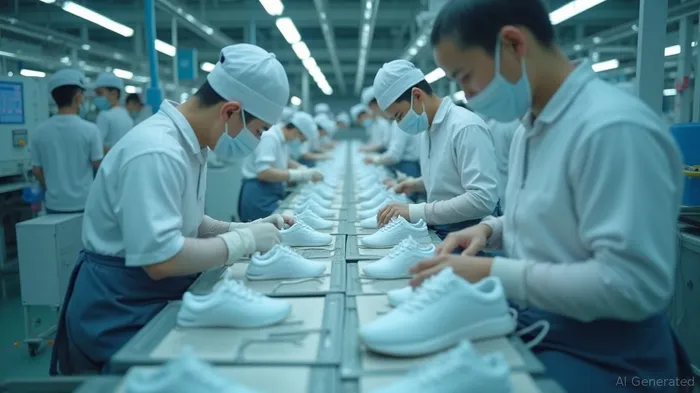
Nike's response? A strategic retreat from China, shifting 50% of footwear production to Vietnam by 2025. This move isn't just about avoiding tariffs—it's a cold calculus of labor costs ($302/month in Vietnam vs. $750/month in China) and geopolitical risk mitigation. While China still handles 16% of U.S. footwear imports (down from 40% in 2018), its role is increasingly limited to complex processes like high-end sneaker manufacturing.
Margin Mitigation: Pricing Power vs. Consumer Pain
The Yale Budget Lab estimates U.S. consumers now pay 31% more for Nike shoes due to tariffs, but the brand's pricing discipline has kept margins intact. Nike's 64.3% gross margin in Q1 2025 (vs. 61% in 2020) suggests it's successfully passing costs to premium buyers. However, this hinges on exclusivity and brand loyalty—both of which face tests as lower-income households absorb $1,100 annual losses from tariff-driven inflation.
The key to sustaining margins lies in automation and regional specialization. Vietnam's factories now use AI-driven quality control systems, while Indonesia focuses on fabric production. This vertical integration reduces reliance on Chinese suppliers and cuts lead times—a critical edge in fast-fashion's "speed-to-market" race.
Market Share: The Double-Edged Sword of Tariffs
Nike's shift has solidified its 38% global footwear market share, but rivals are not idle. Adidas (ADS.DE) has invested $3 billion in Southeast Asia factories since 2020, while Puma is leveraging Indonesia's lower labor costs. The question is: Can Nike's brand equity withstand aggressive discounting by competitors?
The answer so far is yes—premiumization is Nike's armor. Its direct-to-consumer sales (45% of revenue) and digital-first strategies (e.g., NIKE App) create sticky customer relationships. Meanwhile, its "China+1" model—maintaining a toehold in China while expanding in Vietnam/Thailand—buffers against sudden supply shocks.
Investment Thesis: Three Scenarios for 2025–2027
1. Tariffs Remain Elevated (Status Quo)
- Outcome: Nike's dominance grows. With 50% of production in low-tariff zones, its cost base stays competitive.
- Risk: Vietnam's rising labor costs (3.6% annual growth) could erode savings.
- Investor Play: Buy NKENKE-- for its pricing power and scale. Target 2025 EPS of $4.20, up 12% YoY.
2. U.S.-China Trade Truce (Reduced Tariffs)
- Outcome: Nike gains flexibility to rebalance production. Lower tariffs on China could revive some manufacturing there, boosting margins further.
- Caveat: A truce might embolden competitors to undercut pricing.
- Investor Play: Short-term volatility, but long-term NKE remains a buy.
3. New Tariff Fronts (e.g., Vietnam or Indonesia)
- Outcome: Margins compress as tariffs spread to Southeast Asia. Nike's "China+1" becomes "China+Many," requiring costly new factories in the Philippines or Mexico.
- Investor Play: Hedge with call options on NKE or pivot to diversified apparel stocks like PVHPVH-- (PVH).
Conclusion: Nike's Lead Is Wider Than It Looks
Nike's supply chain overhaul isn't just about tariffs—it's a masterclass in geopolitical hedging. Its 2025 production matrix (50% Vietnam, 16% China, 12% Indonesia/Thailand) gives it the agility to thrive regardless of trade winds. While short-term tariff fluctuations will shake share prices, investors should focus on Nike's structural advantages: brand equity, automation-driven efficiency, and a global footprint that leaves no region unexploited.
For now, hold NKE. Its 2025 dividend yield of 1.2% may seem modest, but the stock's 15% average annualized return since 2020 suggests the runway is still long. Just watch for signs of margin pressure—if gross margins dip below 62%, it's time to reassess.
The next decade will belong to the brands that turn supply chain complexity into a weapon. Nike's already loaded.





Comentarios
Aún no hay comentarios