
Nike's Strategic Shift: Navigating Tariffs and Consumer Sentiment for Long-Term Profitability
Nike's recent fiscal fourth-quarter results revealed a 12% sales decline and an 86% net income drop, yet its stock surged 15% post-earnings—a market nod to its bold strategy to reconfigure supply chains and pricing in the face of escalating tariffs. This article dissects how Nike's shift from China-centric production, coupled with selective price hikes, positions it as a resilient player in a tariff-riddled, slowing global economy.
The Production Pivot: Balancing Tariffs and Demand
Nike aims to reduce China's share of U.S. footwear imports from 16% to the “high single-digit range” by fiscal 2026, while expanding production in Vietnam, the Philippines, and other Southeast Asian nations. This move targets tariff mitigation—U.S. duties on Chinese imports had soared to 30%, adding an estimated $1 billion in annual costs.
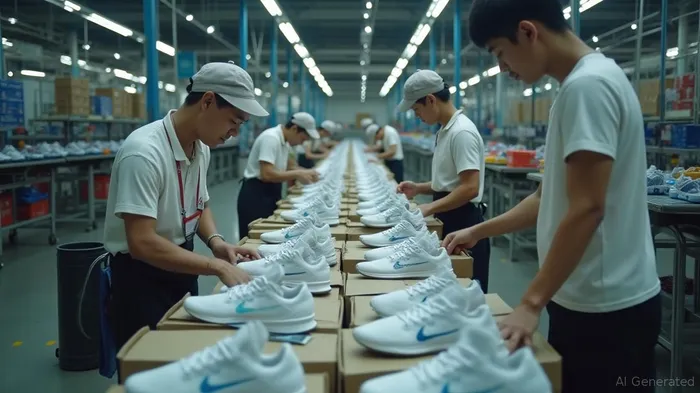
The Philippines emerges as a strategic hub, offering lower proposed tariffs (17–18% vs. Vietnam's 10%) but requiring infrastructure investments. Meanwhile, Vietnam—still producing nearly half of Nike's footwear—faces capacity constraints, prompting gradual diversification.
This geographic reshuffling is paired with a “surgical” pricing strategy: premium performance footwear like the Air Zoom Pegasus saw $5–$10 hikes, while iconic styles (e.g., Air Force 1) remain untouched to preserve brand loyalty. CFO Matthew Friend noted these moves aim to offset tariff costs without alienating price-sensitive buyers.
Market Sentiment: A Vote of Confidence in Nike's Playbook
The stock's 15% pre-market jump post-earnings underscores investor faith in Nike's ability to navigate headwinds. Analysts highlight its focus on high-margin performance products (e.g., running shoes, which grew 3% in North America) and its disciplined inventory clearance—liquidating older styles to make room for demand-driven lines.
Despite a 10% annual revenue drop to $46.3 billion, Nike's gross margin held at 40.3% in Q4, aided by automation in Vietnamese factories and cost cuts. The company's “Win Now” initiative—focusing on core sports categories and DTC channels—appears to be stabilizing its course.
Risks on the Horizon: Can NikeNKE-- Weather the Storm?
While the strategy is compelling, three risks loom large:
- Economic Anxiety and Demand Slump: A slowing economy could crimp discretionary spending, particularly on premium footwear. Nike's 26% drop in digital sales signals vulnerability here.
- Brand Saturation: Over-reliance on legacy styles risks dilution, especially as competitors like On Running and LululemonLULU-- gain traction with niche, agile supply chains.
- Anti-U.S. Sentiment: In China, where sales fell 20%, geopolitical tensions and anti-American consumer sentiment could further hinder recovery.
Why Nike Still Wins in the Long Run
Nike's proactive approach—geographic diversification, premium pricing discipline, and product innovation—positions it to outlast competitors in a fragmented market. Key catalysts include:
- Margin Resilience: A $1 billion tariff cost reduction by 2026 is achievable if production shifts and price hikes materialize.
- First-Mover Advantage: Early moves into the Philippines and partnerships with retailers like AmazonAMZN-- (returning in 2025) could lock in cost efficiencies.
- Brand Equity: Its 50-year dominance in performance footwear remains unmatched, giving it pricing power even in tough times.
Investment Takeaway: Buy for Long-Term Resilience
Nike's stock trades at a P/E of 21x, below its five-year average of 24x—a discount reflecting near-term margin pressures. However, investors with a 2–3 year horizon should consider this a buying opportunity.
Recommendation:
- Buy: For investors prioritizing adaptive retailers in a tariff-driven world. Nike's strategic agility and brand strength justify a position.
- Hold: If your focus is on short-term volatility, as inventory clearance and geopolitical risks remain unresolved.
Nike's story isn't without bumps, but its ability to balance tariff mitigation with consumer demand makes it a standout in an industry where adaptability is survival. The 15% stock surge was no accident—it's a market bet on resilience winning over noise.





Comentarios
Aún no hay comentarios