
Nike’s Strategic Move with Caitlin Clark: A Catalyst for Growth in Women’s Sports and Brand Equity
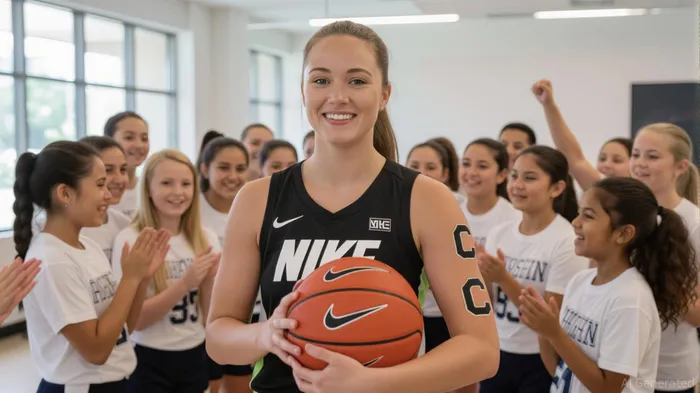
Nike’s partnership with WNBA star Caitlin Clark is not just a marketing stunt—it’s a calculated, high-stakes bet on the future of women’s sports and the explosive potential of the women’s athletic apparel market. By anointing Clark as a signature athlete, NikeNKE-- is leveraging her unprecedented influence to drive brand equity, capture a growing demographic, and position itself at the forefront of a $2.5 billion women’s sports market by 2030 [6]. This move, paired with a broader "Win Now" strategy, could redefine Nike’s fortunes in a segment where it’s already seeing early financial wins.
The Caitlin Clark Effect: A New Era for Women’s Basketball
Clark’s arrival in the WNBA has been nothing short of transformative. Her presence has driven a 31% year-over-year increase in WNBA viewership and a 48% surge in game attendance [1]. The "Caitlin Clark Effect" has also spurred a 500% spike in WNBA merchandise sales through platforms like Fanatics, with Clark’s signature Kobe V Protro sneakers selling out instantly and reselling for over $642—238% above retail [5]. These figures underscore her commercial clout and Nike’s ability to monetize her star power.
Nike’s decision to create a signature line for Clark—featuring a unique interlocking "C" logo and a 2026 shoe launch—positions her as a cultural ambassador for women’s basketball. By aligning with Clark, Nike is not only capitalizing on her individual success but also amplifying the visibility of the WNBA as a whole. This is critical: the league’s expansion to 15 teams by 2026 and a new $2.2 billion media rights deal will further fuel Nike’s growth [2].
Financial Momentum in Women’s Sportswear
The women’s athletic apparel segment has become a lifeline for Nike. While the company’s overall revenue dipped 10% in fiscal 2025, its women’s segment outperformed, with high single-digit apparel growth in Q4 2025 [4]. Clark’s partnership has accelerated this trend. For instance, the "So Win" Super Bowl campaign, which spotlighted female athletes like Clark and A’ja Wilson, drove sellouts of limited-edition products, including Wilson’s "A’One Pink Aura" shoe [1].
Financial analysts project that Clark’s signature shoe alone could generate $150 million in revenue for Nike by 2026 [3]. This is no small number—every additional percentage point of market share in women’s sportswear could translate to $400 million in annual revenue for the brand [3]. Nike’s strategic focus on premium pricing and inventory reduction is already paying off: its women’s training apparel segment grew 8% in Q2 2025, outpacing broader market declines [2].
Brand Equity and Long-Term Value Creation
Nike’s brand strength in women’s sports is unparalleled. According to Brand Finance, Nike holds the highest Brand Strength Index (BSI) in the apparel sector at 94.7 out of 100 [5]. This equity is being reinforced through initiatives like NikeSkims, a joint venture with Kim Kardashian targeting the premium activewear market, and product innovations such as leak-proof sportswear and maternity activewear [4].
The company’s cultural relevance is equally vital. By aligning with athletes like Clark, Nike is tapping into a generation of consumers who value inclusivity and empowerment. The WNBA’s rising popularity—marked by a 23% year-over-year viewership increase in 2025 [1]—has created a fertile ground for Nike to deepen its emotional connection with female athletes and fans. This is not just about selling shoes; it’s about building a legacy.
The Road Ahead: Challenges and Opportunities
While Nike’s strategy is paying dividends, challenges remain. Its market share in women’s sports merchandise dipped below 40% in 2024, as rivals like LululemonLULU-- and Alo Yoga gain traction [5]. However, Nike’s first-mover advantage in signature athlete partnerships and its deep integration with the WNBA give it a unique edge. The company’s recent cost-cutting measures and supply chain diversification also position it to maintain profitability in a volatile market [4].
For investors, the key takeaway is clear: Nike’s partnership with Caitlin Clark is a masterstroke in a sector poised for explosive growth. With women’s sports projected to reach $2.35 billion in global revenue by 2025 [1], Nike’s early bets on female athletes and cultural relevance are likely to compound into long-term value.
Source:
[1] The Caitlin Clark Effect: How the WNBA's Boom is Reshaping Sports Investing [https://www.ainvest.com/news/caitlin-clark-effect-wnba-boom-reshaping-sports-investing-2507/]
[2] Nike's Women's Sportswear Surge: How Star Power and Strategic Moves Fuel Long-Term Growth [https://www.ainvest.com/news/nike-women-sportswear-surge-star-power-strategic-moves-fuel-long-term-growth-2507/]
[3] Nike to get a $150 million boost from Caitlin Clark signature sneaker [https://www.tradingview.com/news/invezz:c2ac4781c094b:0-nike-to-get-a-150-million-boost-from-caitlin-clark-signature-sneaker/]
[4] Nike's Strategic Restructuring and Cost-Cutting Measures [https://www.ainvest.com/news/nike-strategic-restructuring-cost-cutting-measures-erosion-market-share-revenue-2508/]
[5] Nike is strongest apparel brand globally in 2025; Chanel is most valuable [https://brandfinance.com/press-releases/nike-is-strongest-apparel-brand-globally-in-2025-chanel-is-most-valuable]
[6] Women's sports market growth: A $2.5 billion opportunity [https://www.mckinsey.com/industries/technology-media-and-telecommunications/our-insights/closing-the-monetization-gap-in-womens-sports-a-2-point-5-billion-dollar-opportunity]







Comentarios
Aún no hay comentarios