
Nigeria's Oil Sector Reawakening: A New Dawn for Energy Infrastructure Investment
Nigeria, Africa's largest oil producer, is undergoing a profound transformation in its energy sector. The confluence of bold government reforms, surging private investment, and strategic infrastructure projects is redefining the country's role in the global energy landscape. As the nation advances its "Decade of Gas" initiative and seeks to triple crude oil production by 2027, the opportunities for energy infrastructure investment are both vast and compelling.
A Policy Framework for Growth
The foundation for this reawakening lies in the Petroleum Industry Act (PIA) of 2021, which has created a transparent and predictable regulatory environment. According to an Energy in Africa report, the Nigerian Upstream Petroleum Regulatory Commission (NUPRC) approved 28 Field Development Plans (FDPs) in 2025, securing $18.2 billion in fresh investment commitments. These projects are expected to unlock 1.4 billion barrels of oil and 5.4 trillion cubic feet of gas, adding 591,000 barrels of oil per day and 2.1 billion standard cubic feet of gas per day, as noted in a Punch report.
The government's fiscal incentives, such as the Upstream Petroleum Operations Cost Efficiency Incentives Order, have further sweetened the deal for operators. As highlighted by Energy Capital & Power, these reforms have attracted major players like ExxonMobil and ShellSHEL--, which are investing $1.5 billion and acquiring stakes in key assets, respectively. The result? Reuters reported that crude oil production has climbed to 1.7–1.83 million barrels per day, with active drilling rigs increasing from 31 in January 2025 to 50 by July.
Infrastructure as the Catalyst
While upstream activity is surging, Nigeria's infrastructure investments are equally transformative. The Ajaokuta-Kaduna-Kano (AKK) gas pipeline, a 614-kilometer project under a public-private partnership (GPP), exemplifies this shift. Financed by the Bank of China and Sinosure, the pipeline is projected to add 3,600 MW to the national grid, addressing chronic electricity shortages according to an Energy in Africa insight.
Meanwhile, the Dangote Refinery, now at 85% operational capacity, is reducing Nigeria's reliance on imported petroleum products. This $15-billion facility, Africa's largest, is preparing for a public listing on the Nigerian Exchange-a move that could unlock further capital for expansion, per the Olaniwun Ajayi outlook. Complementing this, the rehabilitation of state-owned refineries in Port Harcourt, Warri, and Kaduna by the Nigerian National Petroleum Corporation (NNPC) aims to transform the country into a net exporter of refined products, according to an ALN guide.
The Role of Private Partnerships
Private investment is accelerating through innovative partnerships. AllAfrica covered Shell's $2.4 billion asset sale to the Renaissance Group and ExxonMobil's $10-billion offshore investment in the Owo project, highlighting the confidence of international firms in Nigeria's potential. These deals align with the government's "Project One Million Barrels" initiative, which seeks to boost production beyond 3 million barrels per day - a target Reuters has covered.
The regulatory environment has also streamlined licensing rounds, with 27 of 31 blocks offered in 2024 successfully awarded, as reported by Arise TV. This efficiency, coupled with performance-based tax relief for operators, is attracting a wave of capital to Nigeria's upstream sector.
Challenges and the Path Forward
Despite these strides, challenges persist. Nigeria's electricity sector, for instance, remains constrained by gas shortages and aging infrastructure, with available capacity lagging behind installed capacity, according to an Energy in Africa overview. The 2025 International Energy Agency (IEA) report notes that while renewable energy adoption-particularly solar-is rising, rural electrification remains a critical gap, as discussed in an ENTAS Medium piece.
However, the government's push for decentralized renewable energy projects, including 1.26 GW of mini-grids and standalone solar systems, signals a commitment to diversification. Meanwhile, infrastructure projects like modular refineries and community-based microgrids are essential to reducing dependency on imports and fostering local energy production.
Conclusion
Nigeria's oil sector is no longer a sleeping giant but a dynamic engine of growth. For investors, the combination of policy clarity, infrastructure development, and strategic partnerships presents a unique window of opportunity. While challenges like pipeline vandalism and energy access disparities remain, the momentum generated by 2025's reforms and projects offers a clear path forward.
As the country advances its energy transition, the message is unmistakable: Nigeria is open for business-and the rewards for those who invest in its infrastructure renaissance could be substantial. 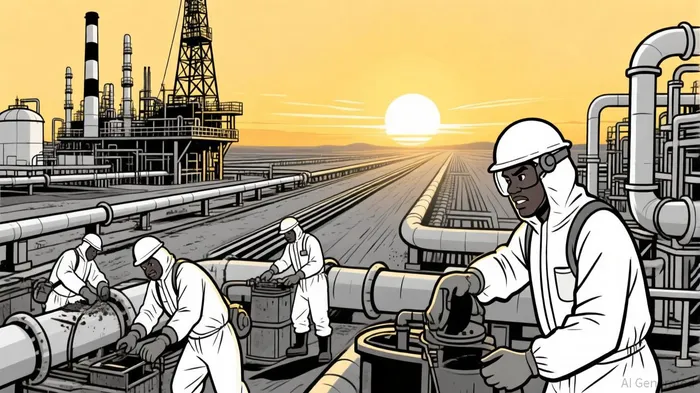





Comentarios
Aún no hay comentarios