
Nigeria's Digital Infrastructure: Seizing Growth in a 50%-Connected Market
Nigeria's digital infrastructure is at a pivotal inflection point. As of November 2025, broadband penetration has reached 50.58%, a 5 percentage-point increase from January 2025, while monthly internet data usage hit a record 1.24 million terabytes-driven by mobile adoption, streaming, and online learning according to data. These figures underscore a market with immense latent demand, even as the National Broadband Plan 2020–2025's 70% target remains unmet. For investors, this 50%-connected Nigeria presents a compelling case for strategic capital deployment in telecom and tech infrastructure, where growth is accelerating but challenges persist.
The 4G/5G Expansion: A Goldilocks Opportunity
Nigeria's 4G network now covers 60% of the country, with 5G launching in major cities. However, 5G adoption lags, serving only 3% of internet subscribers (4 million users), due to high device costs and infrastructure vulnerabilities according to analysis. This gap creates a dual opportunity:
1. 4G Expansion: Operators can capitalize on the existing 60% coverage to deepen rural and urban penetration, leveraging Nigeria's 173.5 million telecom subscribers.
2. 5G Readiness: Early-stage investments in 5G infrastructure-such as fiber backbones and small-cell networks-position investors to capture demand as affordability improves. The Federal Ministry of Communications' 90,000-km fiber backbone project is a critical enabler here according to market reports.
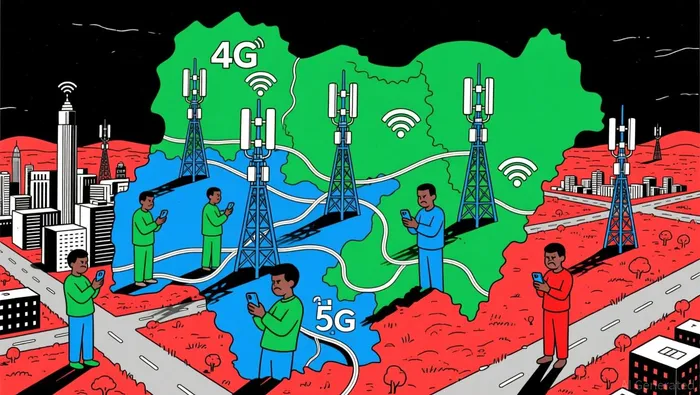
Yet, scaling 4G/5G requires navigating high operating costs and currency fluctuations, which inflate equipment prices. Partnerships with global manufacturers to produce affordable 5G-compatible devices could mitigate this according to industry analysis.
Last-Mile Connectivity: Bridging the Divide
Nigeria's digital divide remains stark. To address this, the government approved the deployment of 4,000 new telecom towers to expand rural connectivity according to government updates. This initiative aligns with the National Broadband Plan's 70% target, but success hinges on infrastructure-sharing agreements to reduce costs and accelerate deployment.
Mobile money adoption further amplifies the potential. Platforms like MTN's MoMo now serve 5.5 million active wallets, demonstrating how financial inclusion can drive connectivity according to market research. Investors in last-mile solutions-such as solar-powered micro-towers or community Wi-Fi hubs-can tap into this synergy, particularly in underserved regions.
Local Smartphone Production: A $10 Billion Untapped Market
Smartphone penetration in Nigeria is projected to reach 65% by 2025, creating a $10 billion market according to industry analysis. While imports dominate, rising demand for 5G-compatible devices and currency volatility make local production increasingly attractive.
Investments in local manufacturing could reduce reliance on imported hardware and create jobs. However, this requires addressing bottlenecks like high electricity costs and supply-chain inefficiencies. Collaborations with global OEMs (e.g., Tecno, Infinix) to establish assembly plants in Nigeria could unlock this potential, mirroring models in Vietnam and India.
Challenges: Vandalism, Policy, and Profitability
Despite the upside, Nigeria's digital infrastructure faces headwinds:
- Infrastructure Vulnerabilities: Vandalism and theft of telecom equipment remain persistent, increasing operational costs according to reports.
- Regulatory Uncertainty: The NCC's evolving spectrum policies and licensing requirements create friction for new entrants.
- Currency Fluctuations: The naira's depreciation raises the cost of imported equipment, squeezing margins.
Investors must prioritize partnerships with local stakeholders and advocate for policy reforms, such as tax incentives for infrastructure projects and anti-vandalism task forces.
Conclusion: A Market in Motion
Nigeria's 50.58% broadband penetration and 1.24 million terabytes of monthly data usage are not just metrics-they are signals of a market in motion. For investors, the path forward lies in balancing ambition with pragmatism:
- Short-Term: Target 4G expansion and last-mile connectivity projects with clear ROI timelines.
- Long-Term: Position for 5G and local smartphone production as affordability improves.
The risks are real, but so is the reward. In a country where 50% connectivity is the floor, not the ceiling, the next decade could redefine Africa's digital landscape.







Comentarios
Aún no hay comentarios