
Nifty Above 26,200; Sensex Today Trades Higher
Sector leadership broadened beyond metals, banks, and consumer durables to include energy and IT. Analysts noted that the 26,200 level on the Nifty now serves as a key resistance point, with a sustained break potentially unlocking the index's September 2024 all-time high.
Yet the optimism carries caveats. has recently signaled caution about swift rate cuts amid mixed U.S. economic data, while geopolitical tensions and oil price volatility remain headwinds. For now, however, the combination of policy easing and global sentiment appears to be outweighing these risks.
Policy Tailwinds and Sectoral Growth Engines
India's equity markets staged a notable rebound recently, driven partly by a global "Santa Claus rally" and robust domestic institutional buying, . , fueled by falling crude oil prices and expectations of near-term central bank action on interest rates. While geopolitical tensions and oil price swings linger as risks, domestic investors stepped in strongly, .
Policy reforms aim to sustain this momentum. Recent measures by the RBI and SEBI, including relaxed forex norms, revised (ECB) limits, and enhanced liquidity rules for (REITs) and Infrastructure Investment Trusts (InvITs), are designed to stabilize the market and attract foreign capital. These changes build on domestic investor strength, , .
Pro-growth fiscal and monetary stimulus is also underway. The government implemented a major (GST) overhaul alongside RBI actions, according to market analysis. Sectors like autos, FMCG, insurance, , . However, near-term market volatility remains a concern due to lingering global tariff uncertainties and the slow pace of corporate earnings recovery.
Analysts project that corporate profits will only start to turn around significantly in late 2025 or 2026, . This recovery timeline tempers immediate optimism. While policy tailwinds and domestic buying provide a floor, . The coming months will test whether these reforms and sector-specific catalysts can overcome persistent macro headwinds like U.S. tariffs and currency weakness.
Rally Durability Assessment
India's equity rally scaling Nifty 26,200 hinges on several fragile positives. A "Santa Claus rebound" followed three days of declines, lifted by hopes for December Fed and RBI rate cuts, cheaper crude oil, and domestic institutional buying. , according to market data.
Policy support faces real implementation delays. , , leaving near-term performance vulnerable to tariff shocks and currency weakness. Even with sectoral gains in autos and healthcare, market gains remain disconnected from fundamentals.
Valuation pressure looms as the Nifty premium above 26,200 may not withstand FII profit-taking. , creating a structural imbalance. Geopolitical frictions and crude price swings add volatility risk, especially if rate cut expectations falter. .
Catalysts and Scenario Implications
Looking ahead, several near-term inflection points could reshape the Indian equity landscape. The December meetings of the U.S. Federal Reserve and the Reserve Bank of India stand as critical catalysts. , . . However, Fed Chair Powell's caution regarding mixed U.S. economic data introduces lingering uncertainty, suggesting the path to rate cuts may not be straightforward.
Geopolitical developments could also swing market sentiment dramatically. . Conversely, U.S. , . These headwinds have already constrained investor confidence in 2024, despite pro-growth measures like GST reforms.
Technically, . 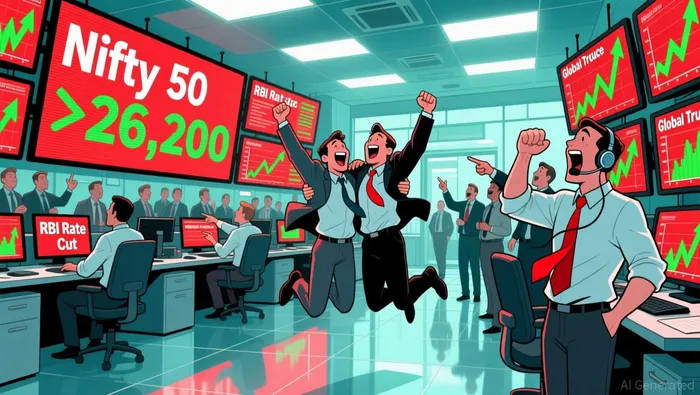 The market's recent strength-led by metals, banks, . Still, these gains face real countervailing pressures. , . .







Comentarios
Aún no hay comentarios