
NFT Market Volatility and Strategic Adaptation: Assessing Web3 Investment Viability in a Prolonged Downturn
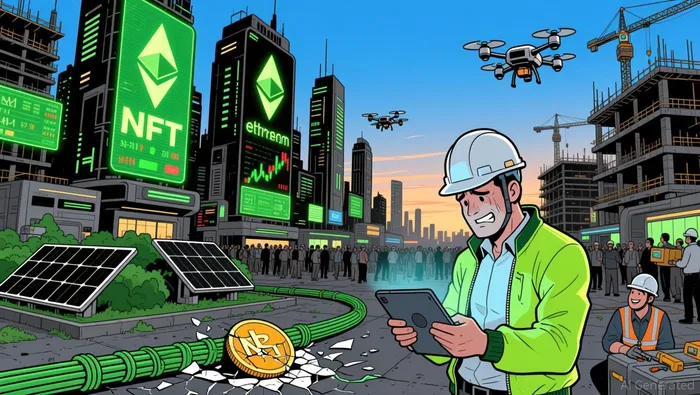
The NFT market in 2025 has become a microcosm of the broader crypto industry's transition from speculative frenzy to infrastructure-driven maturity. Total annual trading volume for NFTs contracted to $5.5 billion, a stark decline from 2024 levels, while Bitcoin's price volatility-exemplified by the "1011 crash" and a 30% drop from its $126,000 peak-highlighted the fragility of speculative narratives. Yet, amid this turbulence, Web3 infrastructure projects have demonstrated resilience, adapting to macroeconomic shocks and regulatory shifts. This analysis evaluates the viability of investing in Web3 events and infrastructure amid a prolonged downturn, drawing on 2025 case studies and market trends.
Market Dynamics: From Speculation to Institutional Integration
The crypto industry's 2025 trajectory was defined by two competing forces: speculative collapses and institutional infrastructure development. While the total crypto market cap peaked at $4 trillion in Q3 2025, before retreating to $3 trillion by year-end, application-layer platforms like Hyperliquid and Pump captured 90% of network fees, signaling a shift in value distribution from base blockchains to user-facing services. Stablecoins, meanwhile, emerged as a linchpin of the ecosystem, with $46 trillion in nominal flows and $1.25 trillion in monthly adjusted volumes by Q3 2025. The U.S. GENIUS Act's regulatory clarity further accelerated Ethereum-based stablecoin adoption, underscoring the growing institutional appetite for compliance-first infrastructure.
Infrastructure Adaptation: Case Studies in Resilience
The MENA region offers a compelling lens for understanding how Web3 infrastructure adapts to crises. In Türkiye, crypto inflows surged to $878 billion by mid-2025, driven by inflationary pressures and economic instability. Despite this, retail participation waned as regulatory crackdowns and reduced purchasing power stifled grassroots adoption. Conversely, Israel's crypto transaction volumes spiked by 60.4% following the October 2023 geopolitical crisis, illustrating how digital assets serve as a financial refuge during national uncertainty.
Globally, infrastructure projects prioritized compliance and scalability. The European Blockchain Convention and Paris Blockchain Week 2025 emphasized institutional-grade solutions, with compliance-first frameworks becoming a prerequisite for attracting institutional capital. Meanwhile, the GCC's exploration of blockchain-based cross-border payment systems and CBDCs reflected a strategic pivot toward reducing U.S. dollar dependency. These adaptations highlight a broader trend: infrastructure projects that align with regulatory guardrails and real-world utility are outperforming speculative ventures.
Investment Viability: Funding Rounds and ROI in 2025
The 2025 funding landscape for Web3 infrastructure reveals a shift from speculative bets to strategic, data-driven investments. In Türkiye, 62 Web3 startups secured funding, with Metatime raising $25 million and Arf securing $13 million from institutional backers like FTX and UOB. These projects leveraged grants from foundations such as the EthereumETH-- and SolanaSOL-- Foundations, which prioritized open-source infrastructure.
Outside the MENA region, 1,179 Web3 funding rounds were completed in 2025, with 48% classified as strategic or undisclosed. This trend reflects investor caution, as capital increasingly targets projects with clear roadmaps and alignment with macroeconomic realities. For instance, Company Z's adoption of the Web3 Leadership Framework™ yielded a 320% ROI within a year, demonstrating the value of governance innovation. Similarly, gaming platforms like Banger Games and VulcanVerse capitalized on virtual asset ownership, leveraging decentralized infrastructure to create scalable, profitable ecosystems.
Strategic Implications for Investors
The 2025 downturn underscores three key principles for assessing Web3 investments:
1. Regulatory alignment: Projects that integrate compliance-first frameworks (e.g., stablecoin regulations under the GENIUS Act) are better positioned to attract institutional capital.
2. Utility-driven innovation: Infrastructure projects with real-world applications-such as cross-border payments or energy sector blockchain solutions-outperform speculative NFTs.
3. Resilience in crisis: Markets like Türkiye and Israel demonstrate that crypto adoption surges during economic or geopolitical instability, but sustainability requires balancing retail and institutional needs.
Conclusion
While the NFT market's volatility in 2025 has eroded speculative value, the underlying Web3 infrastructure has matured into a resilient asset class. Investors who prioritize compliance, utility, and strategic alignment with macroeconomic trends are likely to outperform in this environment. As the industry transitions from hype to infrastructure, the focus will shift from "hodling" to "building"-a paradigm where long-term viability, not short-term gains, defines success.






Comentarios
Aún no hay comentarios