
NFT Market Resilience and Innovation: Evaluating DX Terminal and Pudgy Penguins as Strategic Investment Opportunities Amid Sector Cooling
The NFT market in 2025 is navigating a pivotal transition. While speculative fervor for digital art has waned, a new wave of utility-driven assets is emerging, anchored in real-world applications like identity verification, education, and cross-industry partnerships. This shift is not without challenges: scams, royalty enforcement gaps, and regulatory scrutiny have dampened speculative activity, pushing the sector toward maturation, according to a DWF Labs report. Yet, within this recalibration lies opportunity. Projects like DX Terminal and Pudgy Penguins are redefining NFT value propositions by prioritizing engagement, cross-chain interoperability, and tangible utility. This analysis evaluates their fundamentals and strategic positioning amid sector cooling, offering insights for investors seeking resilience in a fragmented market.
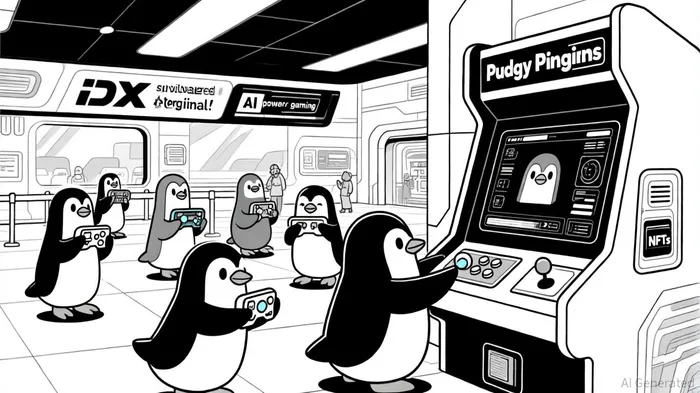
Pudgy Penguins: Bridging Web3 and Mainstream Culture
Pudgy Penguins has emerged as a flagship example of NFTs' potential to transcend digital collectibles and enter mainstream culture. The project's "phygital" model-pairing physical toys with NFTs via QR codes-has unlocked mass-market appeal. By late 2024, these toys generated $13 million in sales through retailers like Walmart and Amazon, introducing 500,000 new users to Web3, according to an OKX analysis. This hybrid approach not only diversifies revenue streams but also mitigates the volatility of purely speculative NFT markets.
The native token, $PENGU, launched on SolanaSOL-- in December 2024, serves as a governance and utility token within the ecosystem. Its integration into platforms like Pengu Clash and Pudgy Party-a mobile battle royale game-has driven demand, while staking incentives and IP licensing further enhance its value proposition, as detailed in the OKX analysis. By Q3 2025, $PENGU's market cap had surged to $781 million, buoyed by strategic expansions into Asia via initiatives like IglooAPAC and partnerships with ICEE and NASCAR, as noted in the DWF Labs report.
Critically, Pudgy PenguinsPENGU-- is addressing sector-wide trust issues. The project's filing for a $PENGU ETF with the SEC signals a commitment to regulatory compliance, while AI-based authenticity tools aim to combat plagiarism and fraud, according to a CryptoNews article. These measures align with broader industry trends toward transparency and institutional adoption.
DX Terminal: Redefining NFT Utility Through AI-Driven Engagement
DX Terminal represents a radical departure from traditional NFT models. Built on the Base network, the project leverages AI to transform NFTs into autonomous agents competing in a retro-futuristic market simulation. Unlike play-to-earn (P2E) models that prioritize financial rewards, DX Terminal focuses on engagement, with in-game currency (WEBCOIN) serving as a purely on-chain metric of status and participation - an approach noted in the DWF Labs research.
This approach has driven explosive growth: in September 2025, DX Terminal recorded 1.27 million transactions-a 1,000% increase from the prior month-and attracted 200,000 unique traders, according to a Coinotag report. While trading volumes remain concentrated on EthereumETH-- and Polygon, the project's success on Base highlights the network's potential as a hub for experimental NFTs, as observed in the DWF Labs report.
DX Terminal's differentiation lies in its ability to attract a new demographic of users who prioritize interactive experiences over speculative gains. By embedding NFTs into AI-driven simulations, the project taps into the growing demand for gamified digital assets, a trend likely to persist as the sector matures, per the Coinotag report.
Investment Implications: Navigating Sector Cooling Through Innovation
The NFT market's cooling phase is not a collapse but a recalibration. Projects that thrive in this environment are those that address systemic challenges while innovating in utility and accessibility. Pudgy Penguins and DX Terminal exemplify this duality:
- Pudgy Penguins mitigates trust issues through regulatory alignment and AI-driven authenticity tools, while its phygital model bridges the gap between Web3 and traditional retail. The project's $PENGU token, with its expanding use cases and institutional partnerships (e.g., Swivul for travel bookings), positions it as a long-term play on mainstream adoption, as detailed in the OKX analysis and the CryptoNews article.
- DX Terminal capitalizes on the sector's shift toward engagement-driven models. By leveraging AI and gamification, it creates a sticky user base less susceptible to market volatility. Its success on Base also underscores the importance of layer-2 networks in scaling NFT utility, as reported by Coinotag.
For investors, both projects offer distinct advantages. Pudgy Penguins' cross-industry partnerships and retail integration provide tangible revenue streams, while DX Terminal's focus on interactive AI agents taps into the future of digital ownership. However, risks remain: regulatory shifts could impact $PENGU's ETF filing, and DX Terminal's reliance on speculative engagement metrics may face scrutiny if user retention falters.
Conclusion
The NFT market's 2025 landscape is defined by resilience through innovation. While speculative activity has cooled, projects like Pudgy Penguins and DX Terminal are redefining value by prioritizing utility, accessibility, and engagement. For investors, these initiatives represent more than speculative bets-they are blueprints for a maturing industry. As the sector continues to evolve, the ability to adapt to regulatory, technological, and cultural shifts will determine long-term success.






Comentarios
Aún no hay comentarios