
NFT Market Correction: A Strategic Inflection Point for Value Investors
The NFT market's dramatic correction in 2025 has created a unique inflection point for value investors. With the global NFT market capitalization plummeting by 46% in November 2025 to $3.5 billion from $6.6 billion, the sector is undergoing a painful but necessary realignment. While this downturn has exposed vulnerabilities in speculative assets and overhyped blockchain ecosystems, it has also revealed opportunities in undervalued NFTs and utility-driven projects. For investors with a long-term horizon, this correction represents a chance to capitalize on mispriced assets and position for the market's eventual recovery.
The Anatomy of the 2025 NFT Correction
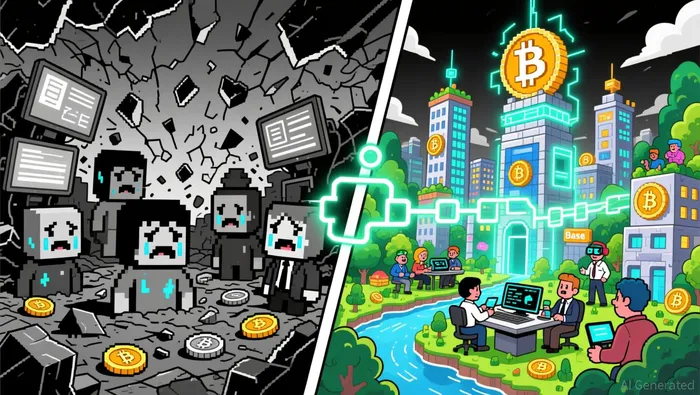
The collapse of the NFT market in late 2025 was not uniform. While blue-chip projects like CryptoPunks and Bored Ape Yacht Club (BAYC) fell by 25.5%, niche and utility-focused collections demonstrated resilience. For instance, BitcoinBTC-- NFTs rose by 9%, and Base NFTs surged by 24%, highlighting the divergent performance across blockchain ecosystems. This divergence underscores a critical shift: the market is moving away from speculative hype toward projects with tangible utility, such as gaming, metaverse integration, and real-world asset tokenization.
The correction has also exposed weaknesses in certain blockchains. BNBBNB-- Chain and Polygon, once NFT powerhouses, saw their market shares drop by 82% and 86%, respectively, as investors fled underperforming ecosystems. Meanwhile, chains like Bitcoin and Base, which offer lower fees and stronger developer ecosystems, have attracted renewed interest. This reallocation of capital signals a maturing market where technical infrastructure and use cases-not just first-mover advantage-determine success.
Identifying Undervalued NFT Assets
Amid the turmoil, several niche collections have emerged as compelling value propositions. Pudgy Penguins, for example, has gained traction as collateral in NFT loans, demonstrating its utility beyond speculative trading according to market analysis. Similarly, Mad Lads and Bitcoin Puppets have leveraged meme culture and physical retail partnerships to maintain community engagement as research shows, a critical factor in sustaining long-term value.
Gaming NFTs also represent a promising frontier. These assets accounted for 38% of NFT transactions in 2025 and are projected to grow to $44.1 billion by 2034 according to industry reports. Projects that integrate play-to-earn mechanics, cross-platform interoperability, and real-world rewards are particularly well-positioned. For instance, NodeMonkes and Bitcoin Puppets have pioneered blockchain-based gaming experiences that blurBLUR-- the lines between virtualVIRTUAL-- and physical economies.
Investors should also consider projects on Solana and Tezos, which offer high throughput and low costs compared to EthereumETH--. These chains have become incubators for innovative NFTs that prioritize scalability and developer-friendly environments (as market data shows). While these projects carry higher risk, their potential for disruption is significant.
Blockchain Ecosystems to Watch
The correction has accelerated a broader trend: the consolidation of value into resilient blockchain ecosystems. Bitcoin, long dismissed as an NFT platform, has seen a 9% rise in NFT activity, driven by Ordinals and other protocols that enable native tokenization. This growth is supported by Bitcoin's robust security and growing institutional adoption, making it a compelling long-term bet.
Base, Ethereum co-founder Vitalik Buterin's Layer 2 solution, has also emerged as a dark horse. Its NFTs surged by 24% in November 2025, fueled by low fees and seamless integration with Ethereum's ecosystem. Base's focus on developer incentives and enterprise partnerships could position it as a key player in the post-correction landscape.
Conversely, chains like BNB Chain and Polygon face existential challenges. Their steep declines in NFT activity reflect a loss of confidence in their ability to innovate. While these ecosystems may recover, investors should approach them with caution until they demonstrate clear value propositions beyond transactional throughput.
Strategic Implications for Value Investors
The 2025 correction has created a buying opportunity for investors who prioritize fundamentals over short-term volatility. Key criteria for identifying undervalued NFTs include:
1. Utility: Projects with real-world applications (e.g., gaming, real estate, intellectual property) are more likely to retain value according to market analysis.
2. Community Engagement: Active, decentralized communities drive long-term adoption and resilience as data shows.
3. Blockchain Infrastructure: Ecosystems with strong technical foundations and developer activity (e.g., Bitcoin, Base) offer better risk-adjusted returns according to industry reports.
However, investors must remain cautious. The market's high volatility and low liquidity for smaller projects mean that even well-researched investments carry significant risk. Diversification across blockchain ecosystems and asset classes is essential.
Conclusion
The NFT market's 2025 correction is not a death knell but a strategic inflection point. By focusing on undervalued assets with utility-driven models and resilient blockchain ecosystems, value investors can position themselves to capitalize on the sector's next phase of growth. As market analysis indicates, the market will stabilize around $600-700 million in annual revenue, the winners will be those who recognize that NFTs are not just digital art but foundational building blocks for the decentralized economy.






Comentarios
Aún no hay comentarios