
The NFT Market Correction: Lessons from Nike's RTFKT Exit
The NFT market's dramatic correction in 2025 has forced even the most prominent players to reassess their digital strategies. Nike's decision to sell its RTFKT subsidiary-a once-celebrated foray into Web3-serves as a case study in strategic reallocation within the digital asset sector. This move, driven by shifting market dynamics, regulatory uncertainty, and evolving consumer behavior, underscores a broader industry trend: the transition from speculative experimentation to disciplined, value-driven innovation.
The NFT Market's Perfect Storm
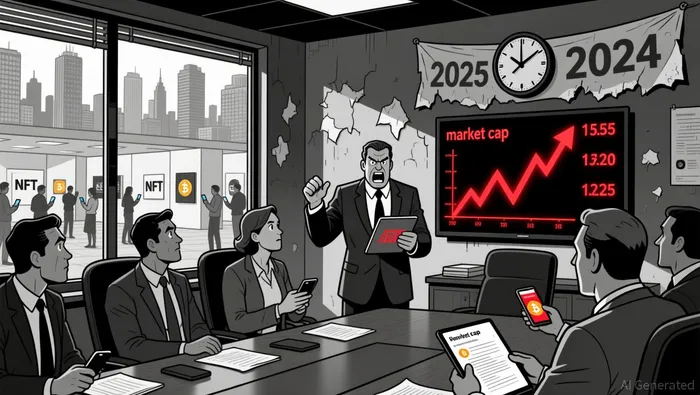
The NFT market's collapse in 2025 was no isolated event. According to a report by CoinSpeaker, the market cap plummeted to $2.78 billion, a 67% decline from the previous year. This correction was fueled by a combination of factors: macroeconomic headwinds, regulatory ambiguity, and a loss of consumer interest in speculative digital assets. For context, major NFT platforms like OpenSea and X2Y2 pivoted to new strategies, while industry events such as NFT Paris and RWA Paris canceled 2026 plans due to waning demand. The result? A market that once promised to redefine digital ownership now faces a reality check.
Nike's RTFKT unit, which pioneered digital fashion and NFTs like Clone X avatars and Cryptokicks, became a casualty of this downturn. Acquired in 2021 under former CEO John Donahoe, RTFKT was initially positioned as a bridge between physical and digital commerce. However, under new CEO Elliott Hill, NikeNKE-- shifted focus to core sports products, exiting the NFT space entirely in December 2025. This pivot aligns with broader corporate trends: companies are now prioritizing partnerships over direct ownership in Web3 initiatives, a strategy that mitigates risk while maintaining innovation pipelines.
Strategic Reallocation: From Ownership to Collaboration
Nike's exit from RTFKT is emblematic of a larger shift in corporate digital strategies. As noted in a 2025 analysis by Bitcoin World, companies are increasingly favoring flexible, project-based collaborations over long-term Web3 investments. This approach allows firms to leverage Web3's creative potential without bearing the full financial and regulatory burden. For example, Nike's decision to sell RTFKT-rather than shutter it outright- suggests a desire to retain intellectual property and brand equity while transferring operational risks to specialized entities.
This trend is not unique to Nike. In 2025, the tokenization of real-world assets (RWA) emerged as a key area of strategic reallocation. Platforms like OndoONDO-- Finance and Maple FinanceSYRUP-- gained traction by offering compliant blockchain solutions for institutional capital, tokenizing assets such as real estate and U.S. Treasuries. Similarly, modular blockchain infrastructure (e.g., CelestiaTIA-- and EigenLayer) reduced costs for startups by enabling shared security and data availability layers. These developments highlight a maturing Web3 ecosystem where infrastructure and compliance take precedence over speculative hype.
Lessons from the RTFKT Exit
Nike's RTFKT exit offers three critical lessons for investors and corporations navigating the digital asset sector:
Regulatory Uncertainty Demands Flexibility The NFT space remains a regulatory gray zone, with U.S. and global policymakers still defining frameworks for digital assets. Nike's decision to divest RTFKT-rather than invest further-reflects a pragmatic response to this uncertainty. As noted in a 2025 GFR Law report, companies are increasingly letting specialized entities navigate complex compliance landscapes. This approach minimizes exposure to potential legal challenges, such as the class-action lawsuit filed against Nike over alleged unregistered securities tied to RTFKT NFTs.
Consumer Behavior Is King The NFT market's collapse was driven by shifting consumer expectations. By 2025, early adopters of digital fashion and virtualVIRTUAL-- collectibles had lost interest in speculative assets, favoring utility-driven use cases like tokenized real estate or AI-integrated blockchain solutions. Nike's pivot to core products-such as its 30% sales drop in Converse during Q4 2025-highlights the importance of aligning digital strategies with tangible consumer demand.
Strategic Reallocation Requires Discipline Nike's exit from RTFKT was not a failure but a recalibration. The company retained its brand equity in digital fashion while redirecting resources to higher-margin ventures. This mirrors broader industry trends: in 2025, over $15 billion was raised for Digital Asset Treasuries (DATs), where public companies acquired cryptocurrencies as treasury reserves. Unlike speculative NFT projects, DATs offer liquidity and mark-to-market pricing, making them a more sustainable allocation for institutional capital.
The Road Ahead
As the NFT market stabilizes, the focus will shift from hype to utility. Institutional adoption of tokenized assets-such as real estate and stablecoins-is projected to grow, with the RWA market expected to reach $16 trillion by 2030. Meanwhile, AI integration and modular blockchain infrastructure will drive efficiency and scalability in Web3 ecosystems. For corporations like Nike, the key to success lies in balancing innovation with risk management, leveraging partnerships to stay ahead of regulatory and market shifts.
In the end, Nike's RTFKT exit is not an end but a beginning. It signals a new era of strategic reallocation, where digital assets are no longer seen as speculative gambles but as tools for value creation in a rapidly evolving landscape.





Comentarios
Aún no hay comentarios