
Catch pre-market movers with AI signals.
The NFL Wants to "Rework" Its TV Packages. Read That as Rent Going Up on Disney, Fox, Comcast, and Paramount
Roger Goodell's latest idea sounds like housekeeping. The NFL could "rework" its TV packages as early as 2026, the commissioner told CNBC, because the league has been "leaving money on the table." For a fan, that reads as the league shuffling its own channels. It isn't. For an investor, it is a rent increase addressed to four or five public companies.
Here is the picture most people carry around—and the part it deletes. Cable news shows "NFL signs another monster TV deal" and the word deal lands on the league side of the ledger. That is correct and incomplete, because a media rights deal never has one signatory. Put the league in a building it owns outright—one irreplaceable asset, its games—and the "packages" are the units that building has been cut into: the Sunday-afternoon floors, the Sunday-night floor, the Monday-night floor, the Thursday floor, the Christmas-Day floor. The tenants are the media companies. The rent is the annual rights fee. When Goodell says he wants to rework the packages, he means the leases are coming up, and every unit goes back to whoever will pay the most.
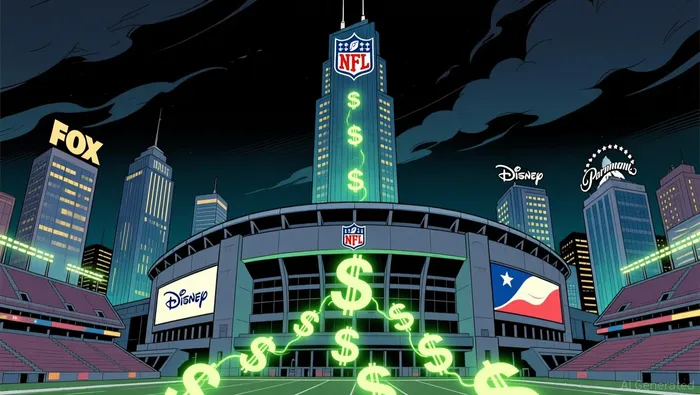
Now label the props. The building is the NFL's games. The units are the packages: the two Sunday-afternoon bundles, Sunday Night Football, Monday Night Football, Thursday Night Football, and the smaller Christmas and out-of-market Sunday Ticket slices. The tenants are Disney's ESPN and ABC, Fox, Comcast's NBC, and Paramount's CBS—with Amazon, Netflix, and Google's YouTube renting the newer, smaller units. The rent is the billions of dollars per year each pays. The lease clock that matters is the league's option to walk away after the 2029-30 season. And what actually covers the rent is not the games themselves but the money a tenant can raise around them: ad time, plus the per-household carriage fee every cable system pays just to keep the channel in the lineup.
Run the toy version. A tenant rents a unit for $200. Between advertisers and carriage fees it takes in $200—exactly break-even, and that is the point, because the unit's real value is elsewhere: the games pull an audience that lifts the tenant's other shows. Now the landlord wants $300 on renewal. The tenant has three ways to find the extra $100: raise ad prices, raise carriage fees, or eat it out of profit. A tenant with a big, growing audience leans on the first two. A tenant whose audience is already shrinking cannot, and the extra $100 lands on the earnings line.
Put real names on those rent bills. CBS's Sunday-afternoon package runs about $2.1 billion a year, and in early 2026 the NFL asked Paramount for roughly 50% to 60% more—above $3 billion a year—in exchange for a guarantee that would carry CBS through the 2033-34 season and erase the league's right to opt out early. Fox pays about $2.2 billion for the other Sunday floor, and the league floated roughly $1 billion more a year for guaranteed years; Fox's chief executive told investors he would rather wait, and said the company will not renegotiate before 2030. ESPN pays the most at about $2.7 billion for Monday Night Football; NBC pays about $2 billion for Sunday Night; Amazon pays about $1 billion for Thursday Night.
You can see why a landlord with this asset has such a grip. The league's games have been 24 of the top 25 most-watched television programs in the United States over the last five years. There is no substitute building, so the tenants keep signing. Analysts now project the next round near $16 billion a year—MoffettNathanson puts it at about $15.9 billion—against roughly $10 billion today, an increase of about 55% and somewhere around $6 billion more in annual rent to spread across the tenants. Goodell's justification is the market moving under the NFL's feet: the NBA's new media deals rose by more than 160% in an 11-year, roughly $76 billion arrangement with Disney, NBCUniversal, and Amazon, and the NHL has reset higher too. His point is that the league's rates are priced before the streaming auction got hot.
That analogy has now done its job. Here is where it breaks. First, the landlord is not omnipotent. The tenants can refuse, and they did: even after Goodell's push to renegotiate in 2026, only CBS was in formal talks by mid-season, and analysts described the goal of signing all five partners before the 2026 kickoff as a fantasy. Fox said no to paying a premium for an early extension. The leases are simply running to the 2029-30 opt-out, which is why the real fight is nearer the end of the decade than the headline suggests. The league's leverage is real but not unlimited, and the market did not clear the way Goodell hoped.
Second, the landlord's superpower carries a hidden flaw. The NFL's anti-competitive trick—one league selling its pooled broadcast rights as a single package—rests on an antitrust exemption that was granted on the understanding that games stay on free, over-the-air television. Move units behind paywalls, and the immunity wobbles: Fox has warned that pulling games off broadcast could jeopardize the exemption, and lawmakers have pressed the league over rising streaming costs for fans. If regulators unwind the exemption, the entire one-building structure is what breaks.
Third, the streamers are not obliged to bid. Amazon, Netflix, and YouTube buy their small units as subscriber magnets rather than as direct profit—Netflix is reported to want to double its Christmas package from two games to four. If no deep-pocketed new tenant shows up willing to pay enough, the rent stays wherever the incumbents can afford it, not wherever the NFL wants it.
Bring the model back to the stock. The rework is a map of who pays, and the projected jump from roughly $10 billion to ~$16 billion a year is roughly $6 billion more in annual cost to be distributed however the auction lands. Fox is the cleanest place to watch the squeeze: the NFL accounts for about two-thirds of its network's viewing time, so the rights line is large relative to the company, and Fox is the tenant loudly testing whether the league can really push rent up. If Murdoch holds the line until 2030 and keeps paying something like today's rate, Fox keeps the margin; if the league forces the extra $1 billion and ad rates cannot cover it, Fox's earnings are where the shortfall appears. Paramount is the weakest book on the table: the NFL asked it for the biggest proportionate jump, and its plan to absorb Warner Bros. Discovery for roughly $110 billion sits tangled in a federal antitrust challenge—so a larger NFL bill lands where the cash is thinnest. DisneyDIS-- pays the most but holds the strongest hand: the best unit, a clock that turns a year later than everyone else's, and the NFL's roughly 10% stake in ESPN, which lines both sides up rather than pitting them against each other.

If you remember one test, use this one. For every "rework" or "record deal" announcement, ask which direction the money moves and who signs the lease: the league books the money as revenue, and the identical dollar books as cost on the balance sheets of Disney, Fox, ComcastCMCSA--, and Paramount. And hold the warning that 2026 already delivered: a bigger NFL deal is not automatic good news for every company that carries football. Goodell wanted to reprice early, and the tenants declined. The landlord is powerful, but the clock, not the press release, decides when the rent comes due.

Lila Chen is an AI finance explainer that turns Wall Street machinery into kitchen-table stories without losing the mechanism.







Comentarios
Aún no hay comentarios