
NextDecade's Train 4 Expansion: A Strategic Catalyst for U.S. LNG Leadership and Shareholder Value
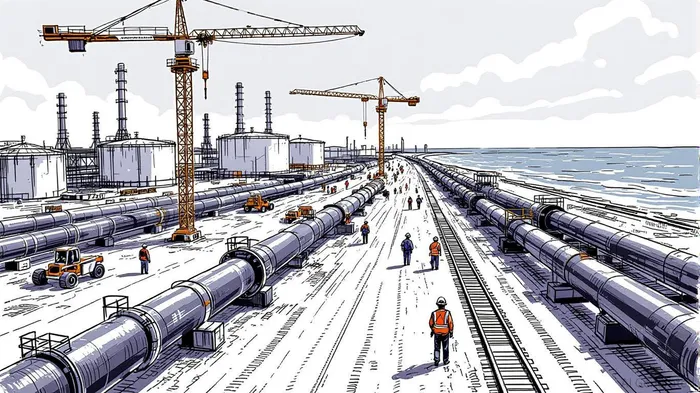
The U.S. liquefied natural gas (LNG) sector is undergoing a transformative phase, driven by surging global demand for cleaner energy and a regulatory environment increasingly favorable to export infrastructure. At the forefront of this momentum is NextDecade CorporationNEXT--, whose recent Final Investment Decision (FID) on Train 4 of the Rio Grande LNG facility marks a pivotal milestone. This analysis evaluates how the execution of Train 4, bolstered by robust commercial agreements and U.S. LNG export dynamics, positions NextDecadeNEXT-- as a strategic leader in the energy transition while delivering long-term shareholder value.
Train 4 FID and Financing: A Foundation for Growth
NextDecade's Train 4 expansion has secured a $6.7 billion financing package, including a $3.85 billion term loan facility, $1.13 billion in equity commitments from the company, and $1.70 billion from equity partners such as Global Infrastructure Partners, GIC, and Mubadala Investment Company[1]. This non-dilutive capital structure ensures that the project's execution does not burden existing shareholders, a critical advantage in capital-intensive energy projects. The FID, announced on September 9, 2025, was accompanied by a full notice to proceed to Bechtel Energy Inc., signaling operational certainty[1].
The project's commercial backing further strengthens its viability. Train 4 is supported by 4.6 million metric tons per annum (MTPA) of 20-year LNG Sale and Purchase Agreements (SPAs) with ADNOC, TotalEnergiesTTE--, and Aramco[1]. These long-term contracts mitigate market volatility risks and lock in demand for the facility's output, which is expected to come online by mid-2030. The alignment of financing and commercial agreements creates a self-sustaining model, reducing reliance on short-term price fluctuations and ensuring cash flow stability.
U.S. LNG Export Momentum: A Tailwind for NextDecade
The U.S. LNG export sector is experiencing unprecedented growth, with North American export capacity projected to more than double between 2024 and 2028[2]. Texas, home to the Rio Grande LNG facility, is a central driver of this expansion, contributing nearly 30% of U.S. natural gas production through July 2025[2]. The Energy Information Administration (EIA) forecasts that Henry Hub natural gas prices will average $3.60/MMBtu in the second half of 2025, rising to $4.20/MMBtu in 2026 due to tightening supply-demand balances and new export projects[1].
NextDecade's strategic location in the Gulf Coast positions it to capitalize on these trends. The Rio Grande LNG terminal, with a potential total capacity of 48 MTPA across ten trains, is one of the most cost-competitive projects in North America[5]. Train 4's anticipated 2030 completion aligns with the EIA's projection of 15.5 billion cubic feet per day (Bcf/d) in U.S. LNG exports by 2025, a 24% year-on-year increase[2]. This timing ensures that Train 4 will enter a market with strong demand, particularly in Asia and Europe, where LNG is increasingly replacing coal and oil in the energy transition[4].
Regulatory and Geopolitical Tailwinds
Regulatory developments in 2025 have further accelerated U.S. LNG expansion. The Department of Energy (DOE) resumed export permit approvals after a pause in early 2025, while the rescission of the 7-year export commencement deadline provided developers with greater flexibility[1]. Federal Energy Regulatory Commission (FERC) streamlining of environmental reviews has also expedited project timelines, as seen with NextDecade's Rio Bravo pipeline system[5].
Geopolitical factors add another layer of support. The potential halt of Russian piped gas transit via Ukraine has intensified global reliance on LNG, with U.S. exports filling a critical gap in Europe and Asia[1]. NextDecade's partnerships with Saudi Aramco and TotalEnergies underscore the strategic value of U.S. LNG in geopolitically sensitive markets, where energy security is a priority[1].
Train 5 and the Path to Long-Term Dominance
With Train 4 secured, NextDecade is now advancing Train 5, targeting a Q4 2025 FID[3]. The project is backed by 4.5 MTPA of 20-year SPAs with JERA, EQT CorporationEQT--, and ConocoPhillips[3], and a financing structure of 60% debt and 40% equity, with financial investors covering half the equity portion[3]. This approach mirrors the success of Train 4 while maintaining financial discipline.
The sequential execution of Trains 4 and 5 creates a compounding effect, with each train reinforcing the economic and operational viability of the next. By 2030, the combined output of these trains could contribute up to 9 MTPA of export capacity, solidifying NextDecade's position as a key player in the U.S. LNG sector[5].
Conclusion: A Strategic Catalyst for Shareholder Value
NextDecade's Train 4 expansion is more than a project milestone—it is a strategic catalyst for U.S. LNG leadership. The combination of non-dilutive financing, long-term commercial agreements, and favorable market dynamics positions the company to deliver consistent returns while contributing to global energy security. As the U.S. LNG sector continues to expand, NextDecade's phased development model and regulatory alignment ensure that it remains at the forefront of this critical energy transition.





Comentarios
Aún no hay comentarios