
NexGen Energy's Patterson Corridor East: A Game-Changing Uranium Expansion in a Strategic Energy Security Sweet Spot
Geological and Exploration Highlights: A High-Grade Powerhouse
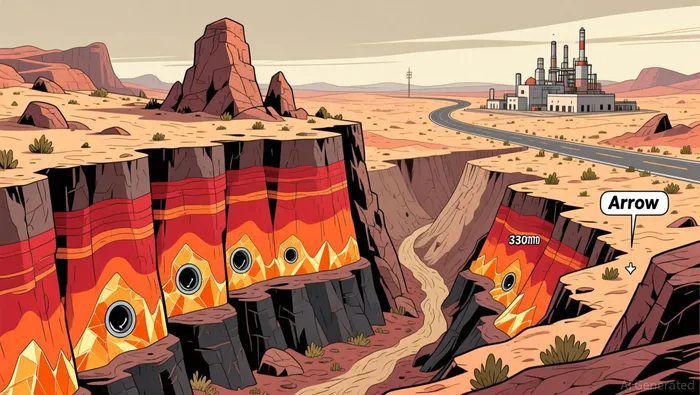
NexGen's PCE project has delivered staggering results, with recent drilling confirming a 330-meter vertical extent of high-grade uranium mineralization. Notable intersections include 8.0 meters at 1.4% U3O8 and 8.5 meters at 1.3% U3O8, while a secondary subdomain revealed a remarkable 0.5 meters at 8.3% U3O8, according to a stock titan report. The mineralized footprint now spans 600 meters along strike and 600 meters vertically, with a high-grade core measuring 210 meters along strike and 335 meters vertically, as noted in the same report. These results mirror the success of NexGen's nearby Arrow deposit, which is nearing final federal approvals and is projected to become the lowest-cost uranium mine globally, as reported in the same report.
The PCE's geological similarity to the Arrow deposit-hosted in competent basement rock-suggests comparable long-term viability and scalability. With a 43,000-meter drilling program underway in 2025, NexGen is poised to further delineate resources, potentially transforming PCE into a standalone project, as noted in the same report.
Strategic Uranium Market Dynamics: Supply Constraints and Decarbonization Demand
The uranium market is at an inflection point. By Q3 2025, the U3O8 spot price had rebounded to $83.18 per pound, driven by declining secondary supply and institutional buying, according to a Nasdaq update. Supply constraints are intensifying: Cameco's revised 2025 guidance and Kazatomprom's 10% production cut for 2026 have exacerbated a global shortfall projected to reach 184 million pounds over the next decade, according to the Nasdaq update. Meanwhile, demand is set to more than double by 2040, fueled by nuclear power expansion and the energy demands of AI-driven data centers, according to the Nasdaq update.
NexGen's PCE project is uniquely positioned to address these dynamics. As a Canadian developer with a 190,000-hectare land package in the Athabasca Basin, NexGen benefits from a jurisdiction known for its stable regulatory environment and world-class resources. The company's focus on low-carbon uranium production aligns with global decarbonization goals, particularly as nations like the U.S. fast-track domestic projects under initiatives such as FAST-41, according to the Nasdaq update.
Decarbonization and Energy Security: NexGen's Broader Impact
Beyond its geological promise, NexGen's work at PCE is part of a larger narrative: nuclear energy's resurgence as a clean, reliable power source. The World Nuclear Association notes that uranium is indispensable for achieving net-zero targets, with nuclear power projected to supply 15% of global electricity by 2050, according to the Nasdaq update. NexGen's CEO, Leigh Curyer, has emphasized that PCE's development will contribute to North America's critical mineral security, reducing reliance on foreign suppliers and supporting domestic nuclear infrastructure, according to a stock titan report.
The project also resonates with institutional investors. In Q2 2025, MMCAP International Inc. SPC increased its stake in NexGen by 91.1%, signaling confidence in the company's exploration and production potential, according to a MarketBeat alert. This surge in interest coincides with broader market trends, including the growth of uranium ETFs and physical uranium funds like the Sprott Physical Uranium Trust, which have amplified price momentum, according to the Nasdaq update.
Investment Outlook: A High-Conviction Play
While NexGen has not yet released official 2025 production guidance for PCE, the project's exploration progress and high-grade results suggest it could become a material contributor to the company's output. The Arrow deposit's anticipated production, combined with PCE's expansion potential, positions NexGen to capitalize on a uranium market expected to see spot prices reach $135–$200 per pound by 2026, according to the Nasdaq update.
For investors, the key risks include regulatory delays and capital intensity, but NexGen's strong balance sheet and strategic partnerships mitigate these concerns. The company's alignment with decarbonization goals and energy security priorities further insulates it from sector-specific volatility.
Conclusion
NexGen Energy's Patterson Corridor East is more than a geological discovery-it is a strategic asset in the global shift toward clean energy. With uranium demand surging and supply tightening, PCE's high-grade potential and NexGen's leadership in the Athabasca Basin make it a standout opportunity for investors seeking exposure to the energy transition. As the world races to balance decarbonization with energy reliability, NexGen's uranium projects are poised to play a foundational role.







Comentarios
Aún no hay comentarios