
Newmont's $439M Orla Stake Sale: Strategic Divestiture or Missed Opportunity?
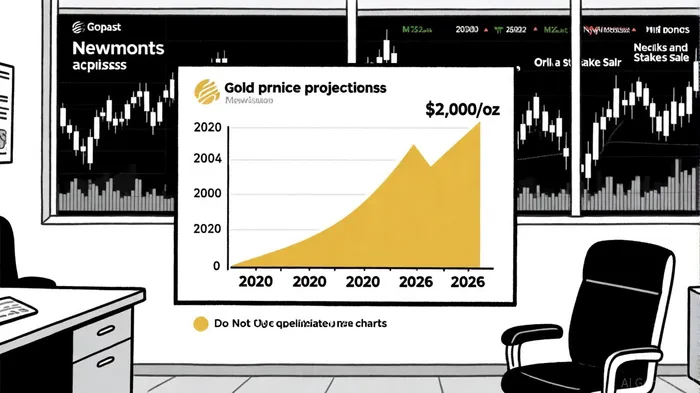
Newmont Corporation's recent $439 million sale of its 13.3% stake in Orla MiningORLA-- has sparked debate over whether the move represents a calculated strategic pivot or a potential misstep in a gold sector poised for growth. As the gold industry navigates a bull market driven by geopolitical uncertainty and central bank demand, the decision to divest a non-core asset must be evaluated through both financial and strategic lenses.
Strategic Rationale: Portfolio Optimization in a High-Cost Environment
Newmont's sale of its Orla stake aligns with its broader strategy to streamline its equity portfolio and unlock liquidity. The transaction, executed at $10.14 per share for 43 million shares, generated gross proceeds of $439 million, contributing to nearly $900 million in after-tax proceeds from 2025 equity divestitures [1]. CEO Tom Palmer emphasized that the move reflects Newmont's commitment to “simplifying equity holdings and freeing up capital for strategic priorities” [2]. This follows the company's $17.14 billion acquisition of Newcrest in 2023, a deal that necessitated a $2 billion cash infusion to reduce debt and refocus on core operations [3].
The decision to divest Orla—alongside the earlier $850 million sale of the Musselwhite gold mine to the same company—highlights Newmont's shift toward prioritizing Tier 1 assets with higher returns. In a sector where operational complexity and capital intensity often dilute shareholder value, such moves are increasingly common. According to a McKinsey analysis, gold companies have historically underperformed broader equity markets until 2020, when surging gold prices and improved cash flows catalyzed a wave of M&A and divestitures [4]. By shedding non-core stakes, NewmontNEM-- aims to consolidate its balance sheet and redirect resources to projects with clearer growth trajectories.
Financial Implications: Liquidity vs. Opportunity Cost
The immediate financial benefits of the Orla sale are clear. The $439 million infusion strengthens Newmont's liquidity position, providing flexibility to fund capital expenditures or return value to shareholders. With J.P. Morgan forecasting gold prices to reach $3,675/oz by late 2025 and $4,000/oz by mid-2026 [5], the timing of the sale appears favorable. Central banks, which have purchased 900 tonnes of gold in 2025 alone [5], are likely to sustain upward pressure on prices, potentially enhancing the value of Newmont's remaining assets.
However, critics argue that the sale may represent a missed opportunity. Orla Mining, now holding the Musselwhite mine, is positioned to benefit from the same tailwinds driving the gold sector. By exiting its stake, Newmont forgoes potential upside from Orla's operational growth. This raises questions about the long-term trade-off between near-term liquidity and exposure to a company that could outperform in a rising gold price environment.
Industry Trends: A Sector Rebalancing for Growth
The gold sector's recent trajectory underscores the strategic logic behind Newmont's decision. Post-2020, gold companies have delivered robust returns, with total shareholder returns (TRS) surging 33% in 2020 compared to a 12% gain for the MSCIMSCI-- World Index [4]. This performance has fueled M&A activity, as firms seek to consolidate fragmented markets and scale operations. Newmont's divestiture program mirrors this trend, with the company leveraging its strong cash flows to reallocate capital to higher-margin projects.
Moreover, the role of gold as a strategic asset remains intact. The World Gold Council highlights its value as a diversifier and hedge against inflation, a dynamic reinforced by central bank purchases and ETF inflows [6]. In this context, Newmont's focus on core assets aligns with industry best practices, as companies prioritize operational efficiency over speculative exposure.
Conclusion: A Calculated Bet on Core Strength
Newmont's Orla stake sale is best viewed as a strategic divestiture rather than a missed opportunity. By exiting a non-core holding, the company has strengthened its balance sheet and positioned itself to capitalize on higher-return projects in a sector primed for growth. While the decision sacrifices potential upside from Orla's operations, the broader industry context—marked by rising gold prices and a shift toward consolidation—suggests that Newmont's focus on liquidity and core assets is a prudent long-term strategy.
As the gold sector continues to evolve, the success of this move will hinge on Newmont's ability to reinvest its proceeds effectively. If the company can leverage its strengthened financial position to fund high-impact projects or acquisitions, the Orla sale will be remembered as a pivotal step in its strategic realignment.





Comentarios
Aún no hay comentarios