
Netskope's IPO Pricing and Market Potential: Strategic Positioning in the Cloud Security Boom
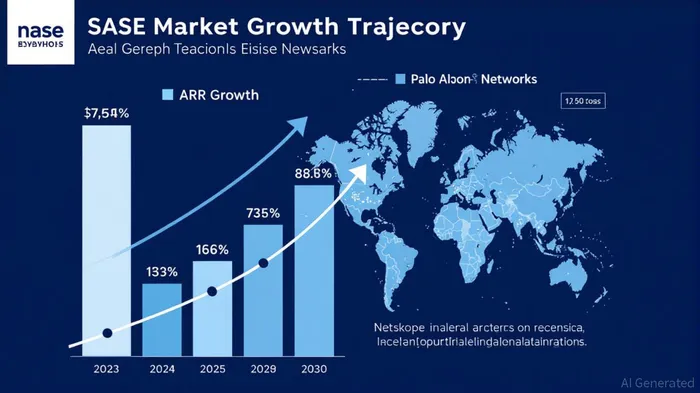
Netskope's upcoming initial public offering (IPO) has ignited significant investor interest, reflecting the growing urgency for cloud security solutions in an AI-driven threat landscape. The company's decision to raise its IPO price range from $15–$17 to $17–$19 per share[1] underscores its strategic positioning in the Secure Access Service Edge (SASE) market, a sector poised for explosive growth. With a potential $7.3 billion market capitalization[5], NetskopeNTSK-- is leveraging its technological innovation and expanding customer base to capitalize on the cloud security boom.
IPO Pricing and Financials: A Balancing Act
Netskope's IPO, set to price on September 17, 2025, and trade under the ticker NTSK[1], is oversubscribed, with underwriters Morgan StanleyMS-- and J.P. Morgan leading the charge[1]. The revised price range—a 12% increase from the initial offering—targets $908 million in proceeds[5], a figure that aligns with the company's 2021 private valuation of $7.5 billion[3]. This pricing reflects investor confidence in the cybersecurity sector, particularly as AI-driven threats and regulatory demands intensify[4].
However, Netskope's financials remain a double-edged sword. While its annual recurring revenue (ARR) has surged to $707 million—a 33% year-over-year increase[4]—the company reported a net loss of $170 million in the first half of 2025[2]. This unprofitability, though improved from a $206.7 million loss in the prior year[3], raises questions about long-term sustainability. For investors, the key will be whether Netskope can convert its strong net retention rate (118%)[4] into profitability without sacrificing growth.
Strategic Positioning in the SASE Market
Netskope's core strength lies in its dominance of the SASE market, a space projected to grow at a 27.2% compound annual rate through 2030[5]. The company's unified platform, Netskope One, integrates secure web gateways, zero-trust access, and AI-driven threat detection into a single solution[5], addressing the fragmented security needs of enterprises transitioning to cloud-first environments. This is further bolstered by SkopeAI, an AI tool adopted by 30% of its customer base for automated threat response[5].
The company's global infrastructure—120+ data centers via the NewEdge network[4]—positions it to serve a diverse clientele, including 30% of the Fortune 100 and 18% of the Forbes Global 2000[4]. This broad adoption is critical in a market where enterprises are increasingly prioritizing scalability and compliance, particularly in regulated sectors like finance and healthcare[4].
Competitive Landscape and Future Plans
Netskope faces stiff competition from established players like CiscoCSCO-- and Palo Alto NetworksPANW--, but its focus on AI integration and customer-centric innovation provides a unique edge. The company plans to use IPO proceeds for tuck-in acquisitions to fill product gaps and expand into emerging markets[4], a strategy that could accelerate its path to profitability. Additionally, Netskope's emphasis on cross-selling to increase wallet share[4] suggests a long-term vision of locking in enterprise clients through comprehensive security ecosystems.
That said, the IPO's success will hinge on Netskope's ability to navigate post-listing volatility. While the cybersecurity sector has outperformed the broader software market[4], the company's unprofitability and reliance on rapid scaling could deter risk-averse investors.
Conclusion: A High-Stakes Bet on the Future of Cybersecurity
Netskope's IPO represents a pivotal moment in the evolution of cloud security. By raising its price range and securing interest from major corporations[1], the company has demonstrated its value proposition in an increasingly digitized world. However, investors must weigh the allure of a $7.3 billion valuation[5] against the realities of sustained losses and a crowded market. For those willing to bet on the SASE boom, Netskope's strategic positioning—coupled with its AI-driven tools and global infrastructure—makes it a compelling, albeit high-risk, opportunity.





Comentarios
Aún no hay comentarios