
Netflix's Strategic Gambit: Assessing the Disney Backup Plan in the Wake of a Warner Bros. Acquisition Shake-Up
The proposed $82.7 billion acquisition of Warner Bros.WBD-- Discovery (WBD) by NetflixNFLX-- represents one of the most audacious strategic moves in the history of the streaming wars. By consolidating WBD's iconic intellectual property (IP)-including DC, Harry Potter, and HBO's prestige content-Netflix aims to redefine its position as a global entertainment powerhouse. However, the deal's viability hinges on a delicate balance of valuation realism, regulatory hurdles, and the ability to outmaneuver competitors like Disney. This analysis evaluates the financial and strategic implications of the acquisition, with a focus on its potential to disrupt Disney's dominance and the risks that could derail Netflix's ambitions.
Valuation Realism: A High-Stakes Bet on Synergies
Netflix's bid for WBDWBD-- implies an enterprise value (EV) of $82.7 billion, translating to an EV-to-revenue multiple of 2.10x and an EV-to-EBITDA multiple of 9.2x based on WBD's 2024 financials according to analysis. These multiples are notably lower than Paramount Skydance's all-cash offer, which valued WBD at 2.76x EV/revenue and 12x EV/EBITDA according to the same analysis. The disparity reflects Netflix's focus on acquiring high-growth streaming and studio assets while excluding WBD's declining linear networks (e.g., CNN, TNT).
The deal's financial rationale rests on projected cost synergies of $2–$3 billion annually by year three post-merger, driven by reduced SG&A expenses and operational efficiencies. Additionally, Netflix anticipates revenue growth from expanded content offerings, which could enhance subscriber retention and pricing power. However, these synergies are contingent on successful integration of WBD's traditional theatrical distribution model with Netflix's direct-to-streamer strategy-a cultural clash that could delay value realization.
 From a risk-adjusted return perspective, Netflix's free cash flow generation and disciplined integration approach are critical. The company assumes $33 billion in WBD's long-term debt, a burden that could strain liquidity if subscriber growth slows or content costs rise according to financial analysis. For context, Netflix's forward P/E ratio of 37.17 as of December 2025 according to market data suggests the market expects robust earnings growth to justify the premium paid for WBD. Yet, this valuation remains elevated compared to Disney's P/E of 18x, highlighting divergent investor sentiment about long-term profitability.
Strategic Implications for Disney: A New Era of Competition
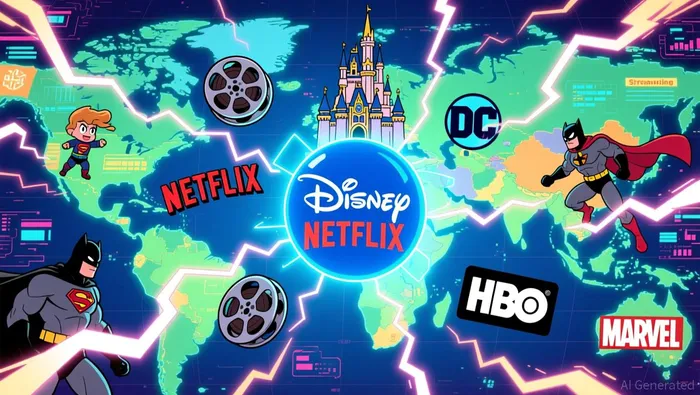
Disney's response to the Netflix-WBD merger must address two key vulnerabilities: its reliance on legacy content and its exposure to market consolidation. While Disney's Marvel and Star Wars franchises remain unparalleled, the acquisition of WBD's DC and Harry Potter universes creates a direct IP rivalry. According to Deadline analysis, the combined Netflix-HBO-Warner Bros. entity could surpass Disney in global content scale, particularly in international markets where WBD's library holds strong appeal.
Disney's strategic countermeasures include accelerating original content production and expanding access to its film archive. For example, the company could leverage its theme park operations and sports division to diversify revenue streams, mitigating streaming-specific risks. Additionally, Disney's lower valuation multiple (18x P/E vs. Netflix's 50.8x) suggests it is undervalued relative to its long-term potential, offering a buffer against subscriber attrition.
However, Disney's success depends on its ability to innovate. The company must avoid over-reliance on its existing "Big Three" (Disney+, Hulu, ESPN+) bundle and instead explore hybrid models that blend streaming with live events or interactive content. Failure to adapt could erode its first-mover advantage, particularly as Netflix's expanded library threatens to attract cord-cutters and casual viewers.
Regulatory and Cultural Risks: The Unseen Obstacles
The deal's approval hinges on navigating regulatory scrutiny. The U.S. Department of Justice has historically opposed media consolidation, and the Trump administration's stance on antitrust enforcement remains uncertain. Netflix's $5.8 billion reverse termination fee-a record for such clauses-signals confidence in regulatory clearance but does not guarantee it according to Reuters reporting.
Cultural integration poses another challenge. WBD's creative-driven ethos clashes with Netflix's data-centric approach to content production. For instance, Warner Bros. has long supported theatrical releases for blockbusters like Barbie and DC films, whereas Netflix favors direct-to-streamer exclusives according to industry analysis. Resolving this tension without alienating key talent or audiences will be critical to preserving WBD's brand equity.
Conclusion: A Pivotal Moment in the Streaming Wars
Netflix's acquisition of WBD is a high-stakes gambit with the potential to reshape the entertainment industry. The deal's valuation realism depends on achieving promised synergies and navigating regulatory hurdles, while its strategic success hinges on outmaneuvering Disney through IP diversification and operational agility. For Disney, the path forward requires a blend of innovation, cost discipline, and a willingness to embrace new formats that align with evolving consumer preferences.
As the streaming wars enter their next phase, the Netflix-WBD merger underscores a broader trend: consolidation is accelerating, and only the most adaptable players will survive. Investors must weigh the risks of overpayment and integration challenges against the long-term rewards of owning a dominant content library in an increasingly fragmented market.







Comentarios
Aún no hay comentarios