
Netflix's Q3 Earnings Outlook and the Impact of 'Stranger Things' Season 5: A Content-Driven Growth Analysis
Netflix's Q3 Earnings Outlook and the Impact of 'Stranger Things' Season 5: A Content-Driven Growth Analysis
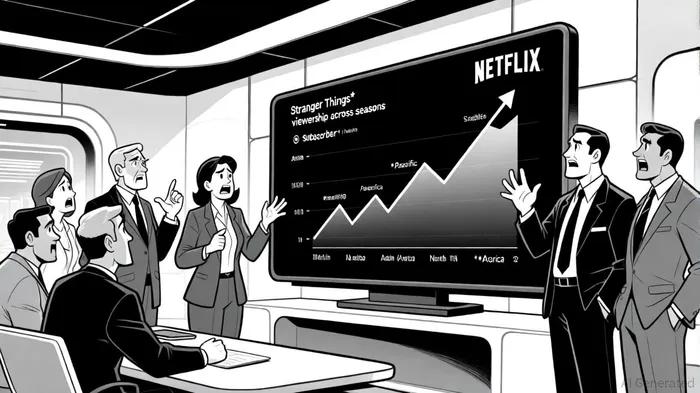
Netflix's Q3 2025 earnings outlook is shaping up to be a pivotal moment for the streaming giant, with analysts and investors closely watching how content-driven strategies-particularly the final season of Stranger Things-translate into subscriber retention and revenue growth. Recent financial forecasts and viewership data suggest a cautiously optimistic narrative, though challenges from market saturation and competitive streaming services loom large.
Earnings Momentum and Analyst Optimism
Analysts have raised their earnings per share (EPS) forecasts for Netflix's Q3 2025, reflecting confidence in the company's ability to leverage its content pipeline. Seaport Res Ptn upgraded its FY2025 EPS estimate to $26.26, with a specific Q3 projection of $6.87 per share, while William Blair's $25.02 FY2025 estimate exceeds the consensus of $24.58, according to a Seaport Res Ptn upgrade. Broader industry expectations align with these figures, anticipating an adjusted profit of $6.88 per share for the quarter, per an industry earnings preview. This upward revision follows Netflix's Q1 2025 results, which delivered $6.61 in EPS, exceeding expectations and reinforcing the company's financial resilience, according to an InvestingSnacks analysis.
The optimism stems from Netflix's aggressive content investments and its ability to monetize its ad-supported tier, which now accounts for 18% of its subscriber base. Ad revenue grew by 12% in Q2 2025 compared to the prior quarter, signaling a successful diversification of revenue streams, according to an Archyde deep dive.
Stranger Things Season 5: A Retention Engine in a Competitive Landscape
The final season of Stranger Things, set to debut in three parts across late 2025 and early 2026, is positioned as a critical driver of subscriber retention. By mid-2025, the series had already accumulated 404.1 million viewing hours across its first four seasons, with Season 4 alone accounting for 135.5 million hours, according to a Fiction Horizon report. The release of Season 5's announcement video-a 250-million-view milestone-surpassed the viewership of Season 4's premiere (140.7 million views), as noted in a PopVerse report.
However, Stranger Things faces stiff competition from other NetflixNFLX-- originals. For instance, Wednesday Season 2 recently overtook Stranger Things Season 4 as the most-watched show on the platform, with 252.1 million views in a 91-day period, The Direct reported in a The Direct report. Despite this, Stranger Things retains a loyal global audience, particularly among 18- to 34-year-olds in the U.S., Brazil, and the U.K., per Flasharc demographics. Analysts argue that the show's multi-part release format-potentially extending engagement over weeks-could mitigate competition and sustain subscriber interest, according to a GameRant analysis.
Regional Dynamics and Market Saturation
While Netflix added 3.8 million global subscribers in Q2 2025, growth in North America has stagnated due to market saturation and competition from Disney+ and Max, as discussed in a Screen Rant analysis. In contrast, Asia-Pacific and Latin America continue to deliver robust gains, driven by expanding internet penetration and localized content. The ad-supported tier's growth further cushions the impact of slower North American performance, with 18% of subscribers now opting for the lower-cost plan, according to the Archyde piece.
The impending conclusion of Stranger Things and Squid Game in 2025, however, raises concerns about long-term retention. Analysts warn that replacing these flagship titles with equally compelling content will be a significant challenge, particularly as streaming rivals like Amazon Prime Video and Disney+ ramp up their original programming, a point also highlighted in the Screen Rant piece.
Strategic Diversification: Live Events and Partnerships
To counterbalance the loss of Stranger Things, Netflix is pivoting toward live events and sports partnerships. Its NFL and WWE streaming deals aim to attract cord-cutters and differentiate its platform in a crowded market, according to an Inside the Magic piece. While these initiatives are still nascent, they represent a strategic shift toward real-time engagement-a domain where Netflix has historically lagged behind competitors like ESPN and Twitch.
Conclusion: Balancing Short-Term Gains and Long-Term Risks
Netflix's Q3 2025 earnings are likely to reflect the immediate tailwinds of Stranger Things Season 5, with analysts projecting EPS in the $6.87–$6.88 range. However, the long-term sustainability of subscriber growth hinges on the company's ability to replicate the success of its flagship titles and adapt to evolving consumer preferences. For investors, the key question remains: Can Netflix's content-driven strategy evolve beyond nostalgia and serialized drama to secure its dominance in a rapidly fragmenting streaming ecosystem?
Historical backtesting of Netflix's stock performance around earnings releases from 2022 to 2025 reveals actionable insights for investors. A simple buy-and-hold strategy executed immediately after earnings reports historically delivered statistically significant excess returns-averaging +2.1-2.5% in the first two trading days, with a ~70% win rate-according to an earnings backtest. While these gains fade after three days, the cumulative 30-day excess return of +8.1% (vs. benchmark +4.7%) suggests that short-term momentum remains a viable edge.





Comentarios
Aún no hay comentarios