
Netflix's Gaming Gambit: Content Diversification as a Catalyst for Subscriber Growth and ARPU Expansion
Netflix's strategic pivot into gaming marks a pivotal evolution in its quest to redefine entertainment. As the streaming giant transitions from a pure-play content provider to a multifaceted entertainment platform, its foray into video games is not merely an experiment but a calculated move to drive sustained subscriber growth and expand Average Revenue Per User (ARPU). By leveraging its massive subscriber base, integrating gaming into its existing ecosystem, and exploring innovative monetization models, NetflixNFLX-- is positioning itself to thrive in a maturing streaming market.
Gaming as a Retention Tool and Revenue Driver
Netflix's gaming strategy is rooted in low-risk, high-reward principles. The company has adopted a mobile-first approach, embedding casual games directly into its app to minimize friction for users while fostering deeper engagement, according to a Monexa analysis. This integration has already yielded impressive metrics: as of Q2 2025, the platform reported 5.5 million daily active users (DAU) for its gaming segment, with over 80 million game downloads, per an Archyde Q2 report. These figures underscore gaming's potential to reduce churn by creating a "stickier" experience, where users return not just for content but for interactive entertainment.
The financial implications are equally compelling. Netflix is testing monetization avenues such as in-game purchases and premium gaming subscriptions, which could significantly boost ARPU, the Monexa analysis suggests. For context, the company's ad-supported tier has already driven a 6% year-over-year increase in ARPM (Average Revenue Per Minute), demonstrating the viability of tiered pricing models, as the Archyde Q2 report shows. By applying similar principles to gaming-offering free-to-play titles with optional paid upgrades-Netflix can monetize its existing user base without alienating price-sensitive customers.
Strategic Acquisitions and Global Appeal
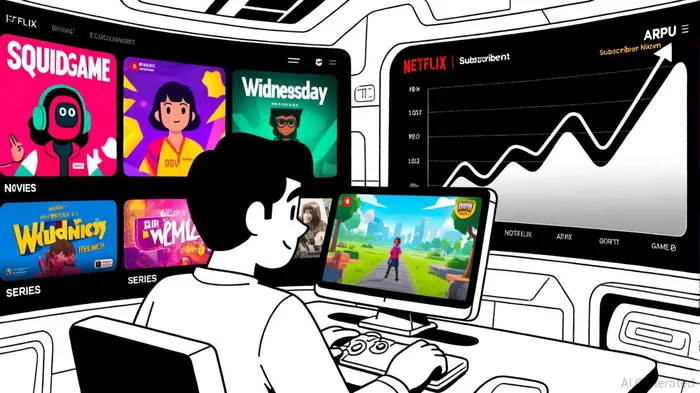
Netflix's gaming ambitions extend beyond casual mobile titles. The company has pursued strategic acquisitions and partnerships to build a robust ecosystem, aiming to create exclusive intellectual property (IP) that complements its existing content library, the Archyde Q2 report notes. For instance, titles like Squid Game and Wednesday are being adapted into interactive experiences, leveraging their global popularity to attract both new and existing subscribers. Non-English language content, which now accounts for over one-third of all viewing, further amplifies this strategy, as gaming can serve as a bridge to engage international audiences, according to a MediaPost article.
This diversification also aligns with Netflix's shift toward mature market growth. With subscriber expansion plateauing in many regions, the focus has turned to maximizing revenue per user. Gaming offers a natural extension of this strategy, as it allows Netflix to upsell premium tiers and explore cross-promotional opportunities. For example, a subscriber might opt for a premium gaming pass to access exclusive Squid Game content, thereby increasing their overall spend on the platform, as the Monexa analysis suggests.
ARPU Trends and Financial Projections
While gaming revenue remains a small portion of Netflix's overall financials, its long-term potential is undeniable. For Q3 2025, the company anticipates revenue of $11.53 billion, driven by strategic price hikes and ad-supported tiers, according to a MarketMinute report. Although ARPU dipped slightly in 2023 compared to 2022, that decline has been offset by the introduction of cheaper ad-supported plans, which have attracted new subscribers without eroding revenue, the MarketMinute report notes. Gaming, with its potential for in-app purchases and tiered monetization, could further stabilize and elevate ARPU in the coming years.
Analysts project that gaming could become a "meaningful contributor" to Netflix's revenue within the next 12–18 months, a conclusion highlighted in the Monexa analysis. This is supported by the platform's 5.1% year-over-year viewership growth in Q3 2025, driven by a strong content slate and the integration of gaming into its broader entertainment offerings, as reported by MediaPost. As gaming matures, it may also serve as a differentiator in a crowded streaming market, where competitors like Disney+ and Amazon Prime Video are struggling to balance content costs with pricing pressures.
Risks and the Road Ahead
Despite its promise, Netflix's gaming venture is not without risks. The market for mobile gaming is highly competitive, with established players like Apple Arcade and Google Stadia already vying for user attention. Additionally, monetizing casual games through in-app purchases requires careful balancing to avoid alienating users. However, Netflix's unique advantage lies in its ability to cross-promote gaming with its existing content, creating a cohesive entertainment experience that rivals cannot easily replicate.
For investors, the key takeaway is clear: Netflix's gaming strategy is a long-term play to future-proof its business. By diversifying its revenue streams and deepening user engagement, the company is laying the groundwork for sustained growth in an increasingly fragmented entertainment landscape.





Comentarios
Aún no hay comentarios