
Netflix's Bear Case Strengthened Amid Structural Pressures and a Disappointing Earnings Outlook
Netflix's stock has lost nearly 30% of its value since June 2025, trading at $91.18 per share as of early January 2026, amid growing concerns over its valuation, strategic risks, and corporate uncertainty. While the company reported strong Q3 2025 results-revenue rose 17.2% to $11.51 billion and net income hit $2.55 billion-its forward-looking metrics and structural challenges have intensified the bear case. Analysts are increasingly skeptical about whether Netflix's premium valuation, currently trading at a forward P/E ratio of 49.35x, justifies its projected earnings growth of 28% in 2025 and 21.9% in 2026.
Strategic Risks: Content Costs, Saturation, and Ad-Tier Scalability
Netflix's business model hinges on massive content investments, with 2025 spending projected at $18 billion. While the company spreads these costs across 301 million users-making a $200 million film cost less than $0.70 per subscriber- this strategy pressures capital expenditures and limits flexibility. The ad-supported tier, now accounting for 55% of new sign-ups, has shown promise but remains a high-growth, unproven segment. Scaling this model risks alienating users if ad loads or content quality compromise the viewing experience.
Market saturation is another looming threat. With 301 million global subscribers, Netflix's growth is slowing in mature markets, while price sensitivity in emerging economies could test customer loyalty. Competitors like Disney+ and Max are also investing heavily in localized content and hybrid ad-free/subscription models, intensifying competition.
Valuation Misalignment: Overpriced for the Long Term?
Despite improved profitability metrics-operating margin at 29.14% and net profit margin at 24.05%-Netflix's gross margin of 48.09% lags behind industry averages, underscoring the drag of content costs. A discounted cash flow analysis suggests the stock is overvalued by 11.5%, with an intrinsic value of $81.63 per share, while Morningstar assigns a 1-star rating, citing a long-term fair value estimate of $750. This stark disconnect highlights a valuation that appears disconnected from fundamentals.
The company's $15 billion share buyback program and revised free cash flow guidance of $9.0 billion for 2025 aim to reassure investors, but these measures may not offset structural risks. For instance, a non-recurring $619 million tax charge in Q3 2025-linked to Brazilian operations-caused a 10% stock drop, illustrating how one-time events can amplify volatility.
Corporate Uncertainty and Regulatory Hurdles
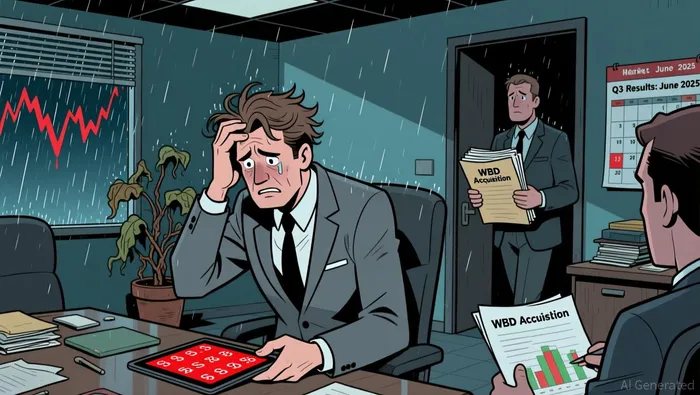
The proposed $82.7 billion cash-and-stock bid for Warner Bros. Discovery has further muddied the outlook. This three-way standoff with a $108.4 billion rival bid from Paramount Skydance introduces regulatory, integration, and financial risks. Analysts warn of potential overpayment, regulatory hurdles, and Netflix's limited merger experience, which could erode shareholder value. Even if the deal closes, integrating Netflix's data-driven approach with Warner Bros.' traditional studio model poses operational challenges.
Conclusion: A Bear Case Built on Structural Weaknesses
Netflix's bear case is strengthened by a combination of overvaluation, content-driven margin pressures, and unresolved corporate drama. While its ad-tier growth and international expansion offer short-term optimism, structural risks-ranging from market saturation to scalability challenges-threaten long-term sustainability. For investors, the key question remains whether the company can balance aggressive content spending with profitability while navigating a fragmented streaming landscape. Until these risks are mitigated, Netflix's premium valuation appears increasingly precarious.





Comentarios
Aún no hay comentarios