
Netflix's $82.7B Warner Bros. Acquisition and Its Implications for Streaming Market Consolidation
The proposed $82.7 billion acquisition of Warner Bros.WBD-- Discovery (WBD) by NetflixNFLX-- represents a seismic shift in the streaming industry, one that could redefine the balance of power in global entertainment. By acquiring WBD's film and television studios, HBO Max, and its vast intellectual property portfolio, Netflix aims to cement its dominance in a market already dominated by the "Big Three" (Netflix, Disney, and Amazon). However, the deal's success hinges on navigating a thorny regulatory landscape and addressing the structural challenges that have plagued past streaming mergers.
Strategic Dominance: A New Era of Scale and Content Control
The acquisition would unite Netflix's 300 million-plus subscribers with HBO Max's 128 million, creating an unrivaled subscriber base and content library. This scale would allow Netflix to outspend competitors on original programming, leverage data analytics across a broader audience, and reduce reliance on third-party content. According to a report by Parrot Analytics, such a merger would "position Netflix as an unassailable leader in the streaming 'Big Three,' with the remaining players-Disney and Amazon-struggling to keep pace."
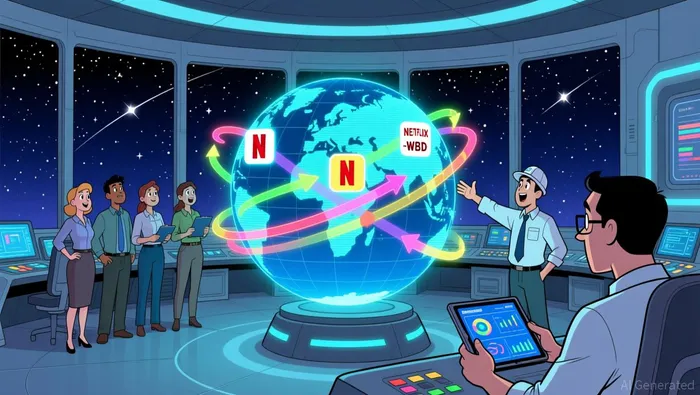 Historical precedents underscore the importance of scale. Disney's 2023 acquisition of Hulu for $8.6 billion enabled it to unify Disney+ and Hulu into a single platform, while Amazon's 2022 purchase of Metro-Goldwyn-Mayer (MGM) for $8.5 billion bolstered its content arsenal as reported by Streaming Media. Netflix's move mirrors these strategies, aiming to consolidate content creation, distribution, and audience reach under one roof. The deal also aligns with industry trends: rising production costs and fragmented consumer preferences have pushed companies toward aggregation to sustain profitability according to Deloitte.
Regulatory Risks: A History of Hurdles
Despite its strategic logic, the Netflix-WBD merger faces significant regulatory scrutiny. The U.S. Department of Justice and the European Commission are already reviewing the deal under the Hart-Scott-Rodino (HSR) Act, with closure expected in 12–18 months as stated in Netflix's announcement. Regulators will likely scrutinize the transaction's impact on competition, particularly given the streaming market's concentration. As noted by The Verge, past mergers involving WBD-such as Discovery's 2022 acquisition of AT&T's Time Warner for $43 billion-have often resulted in rebranding chaos, debt accumulation, and antitrust concerns according to The Verge.
The European Commission, in particular, may challenge the deal. The EU has historically been wary of media conglomerates, as seen in its opposition to Disney's 2023 Hulu acquisition. A report by PwC highlights that "streaming mergers post-2020 have faced increasingly stringent regulatory hurdles, driven by fears of reduced content diversity and market monopolization" as PwC reports. Netflix's acquisition of WBDWBD-- would eliminate a key rival (HBO Max) and further entrench the Big Three, potentially triggering antitrust actions.
Lessons from Past Mergers: A Mixed Legacy
The streaming industry's merger history offers cautionary tales. Warner Bros. Discovery's own 2020–2022 rebranding of HBO Max to Max, coupled with layoffs and debt accumulation, illustrates the operational risks of consolidation as detailed by The Verge. Similarly, Paramount's proposed $8 billion merger with Skydance, while smaller in scale, faces its own challenges in balancing creative independence with financial stability according to Wingding TV. These cases suggest that even successful mergers require careful integration to avoid cultural clashes and subscriber attrition.
For Netflix, the stakes are high. The company's stock-based payment structure-offering WBD shareholders $23.25 in cash and $4.50 in Netflix shares per WBD share-introduces volatility tied to Netflix's stock price as detailed in Netflix's announcement. If the deal faces prolonged regulatory delays or antitrust fines, the cost could balloon, straining Netflix's balance sheet.
Implications for Investors and the Industry
If completed, the Netflix-WBD merger would accelerate the streaming industry's consolidation into a duopoly or triopoly, squeezing smaller players like Paramount+ and Apple TV+. For investors, the deal's success depends on three factors: regulatory approval, integration efficiency, and the ability to monetize combined assets without alienating content creators or subscribers.
However, the broader market risks are clear. As Deloitte notes, "streaming's capital intensity and thin margins make it vulnerable to overconsolidation, which could stifle innovation and drive up prices for consumers" according to Deloitte. Regulators may impose conditions-such as divesting key studios or licensing content to rivals-to mitigate these risks.
Conclusion
Netflix's $82.7 billion bid for Warner Bros. Discovery is a bold bet on strategic dominance, leveraging scale and content to outmaneuver competitors. Yet, the path to closure is fraught with regulatory uncertainty and the ghosts of past mergers. For investors, the deal embodies both the transformative potential of streaming and the sector's inherent fragility. As the industry moves toward a more consolidated future, the outcome of this acquisition will serve as a litmus test for whether regulatory bodies can balance corporate ambition with the public interest.





Comentarios
Aún no hay comentarios