
Netflix's $82.7 Billion Warner Bros. Acquisition: A Make-or-Break Move for Long-Term Growth?
Netflix's proposed $82.7 billion acquisition of Warner Bros.WBD-- Discovery's (WBD) film and streaming businesses represents one of the most audacious bets in modern entertainment history. The deal, valued at $27.75 per WBDWBD-- share (a mix of $23.25 cash and $4.50 in NetflixNFLX-- stock), aims to merge Netflix's global streaming platform with WBD's iconic content library-including HBO, Game of Thrones, and DC Studios-while addressing the latter's debt-laden balance sheet. However, the transaction's success hinges on a precarious balance between strategic expansion and valuation risk.
Strategic Expansion: A Content Powerhouse or a Monopoly?
The acquisition's strategic logic is compelling. WBD's streaming segment, with 128 million global subscribers as of Q3 2025, brings immediate scale to Netflix's existing 260 million subscribers. This expansion is not just quantitative but qualitative: WBD's library includes 10,000+ films and 1,500+ TV shows, many of which are culturally iconic and under-licensed according to Netflix analysis. For Netflix, this represents a shift from organic content creation to consolidating Hollywood's most valuable intellectual property-a move akin to Disney's 2019 acquisition of 21st Century Fox.
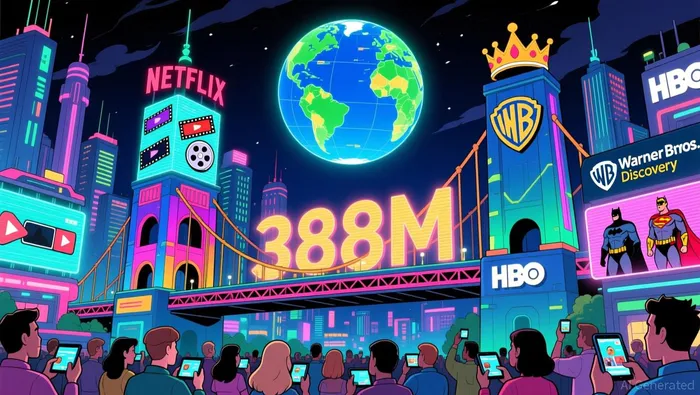 Moreover, WBD's international growth initiatives, such as HBO Max's launch in Australia and planned expansions into Germany, Italy, and the UK by mid-2026, align with Netflix's global ambitions. The combined entity could leverage cross-promotion of live events (e.g., NFL Sunday Ticket) and premium content to drive subscriber retention. Ted Sarandos and Greg Peters, Netflix's co-CEOs, argue this will create "long-term value for shareholders" by diversifying content offerings and enhancing creative opportunities.
Yet, the strategic benefits are not without risks. Critics warn the merger could reduce competition in the streaming sector, particularly as Netflix and WBD would control 60% of U.S. streaming revenue according to Morningstar analysis. This has drawn scrutiny from regulators, with the U.S. Justice Department reportedly considering antitrust challenges as reported by Paramount. Additionally, Paramount's $30-per-share all-cash counteroffer-backed by Larry Ellison's personal guarantee-introduces uncertainty, as WBD shareholders may favor liquidity over Netflix's equity.
Valuation Risk: A Premium Priced for Synergy or Overpaying?
The $82.7 billion price tag equates to a 25x multiple of WBD's estimated 2026 EBITDA, far exceeding the 19.89x industry average for streaming services according to Equidam data. Netflix justifies this premium by projecting $1.5 billion in annual cost synergies from combining operations, which would reduce the effective multiple to 14x 2026 EBITDA as noted by Morningstar. However, such cost savings are speculative and depend on successful integration-a challenge given WBD's recent debt repayment of $1.2 billion and net leverage ratio of 3.3x.
Netflix's own financials add complexity. While the company reported $11.51 billion in Q3 2025 revenue (meeting expectations), its EBITDA of $3.42 billion fell short of estimates, signaling margin pressures. A $527.5 billion market cap suggests investors are betting on the acquisition's success, but this valuation assumes rapid integration and sustained subscriber growth. WBD's streaming segment, though profitable ($1.3 billion EBITDA expected in 2025), still faces challenges from declining third-party licensing revenue as content is retained for in-house platforms.
Regulatory hurdles further amplify risk. The deal's closure is contingent on WBD's separation of its Discovery Global division-a process expected by Q3 2026-and regulatory approvals, which could take 12–18 months. Delays or rejections would force Netflix to either renegotiate terms or abandon the deal, potentially triggering a stock selloff.
The Verdict: A High-Stakes Gamble
Netflix's acquisition of WBD is a make-or-break move. On one hand, it positions the company to dominate the streaming wars with unparalleled content and scale. On the other, the valuation premium, regulatory risks, and integration challenges could erode shareholder value if execution falters. The key question is whether the combined entity can achieve the promised cost synergies and maintain subscriber growth in a saturated market.
For investors, the decision hinges on two factors: (1) the likelihood of regulatory approval and (2) Netflix's ability to monetize WBD's assets without cannibalizing its own brand. If successful, the deal could redefine the entertainment landscape. If not, it may become a cautionary tale of overambition in a high-stakes industry.







Comentarios
Aún no hay comentarios