
Netflix's $5.8 Billion Breakup Fee and the Strategic Rationale Behind Its Warner Bros. Acquisition
Netflix's $72 billion bid to acquire Warner Bros.WBD-- Discovery (WBD) represents one of the most audacious corporate maneuvers in entertainment history. Central to this deal is a $5.8 billion breakup fee-a staggering 8% of the equity value-offered by NetflixNFLX-- to secure regulatory approval, while WBDWBD-- has agreed to a $2.8 billion reverse fee if its shareholders reject the transaction according to reports. This financial commitment underscores Netflix's confidence in the deal's strategic logic, even as it exposes the company to unprecedented regulatory and financial risks. For investors, the acquisition raises critical questions: Is Netflix's bet on dominance in the entertainment ecosystem worth the cost? How do the risks of regulatory scrutiny and debt-laden integration compare to the potential rewards of controlling Hollywood's most iconic franchises?
The Breakup Fee: A Signal of Confidence-or Desperation?
The $5.8 billion breakup fee is among the largest in corporate history, dwarfing the 2.4% average for 2024. This figure reflects Netflix's determination to neutralize regulatory objections, particularly in the U.S. and Europe, where antitrust concerns loom large. According to a report by Reuters, the fee is designed to deter rival bidders and reassure regulators that Netflix is prepared to absorb significant costs to complete the deal. However, as Deadline highlights, the Trump administration's potential influence on antitrust enforcement adds a layer of political uncertainty, with fears that regulatory scrutiny could be weaponized to favor alternative bidders.
Netflix's co-CEO, Ted Sarandos, has framed the acquisition as "pro-consumer, pro-innovation, and pro-creator," emphasizing access to WBD's library of franchises like Game of Thrones, DC Comics, and Harry Potter, as well as its 128 million HBO Max subscribers according to the NY Times. Yet, as Al Jazeera notes, critics like Senators Elizabeth Warren and Pramila Jayapal argue the merger could stifle competition, leading to higher prices and reduced content diversity. The breakup fee, while a bold signal of Netflix's resolve, may also backfire if regulators perceive it as evidence of market dominance rather than consumer benefit.
Financial Risks: Debt, Valuation, and Integration Challenges
The acquisition's financial implications are equally daunting. Netflix's debt load is projected to balloon from $14.5 billion to over $90 billion, with the debt-to-equity ratio soaring to 2.5. To fund the deal, the company secured $59 billion in financing from institutions like Wells Fargo and HSBC, while assuming WBD's $10.7 billion in existing debt according to Yahoo Finance. This debt burden could consume 10–15% of Netflix's 2025 free cash flow, raising concerns about liquidity and flexibility.
The valuation itself has drawn skepticism. At 25 times the estimated 2026 EBITDA for WBD's streaming and studios business, the price tag appears exorbitant even for a company with such a valuable content library. Variety reports that Netflix's stock dipped 4% immediately after the deal's announcement, reflecting investor unease over the high-risk, high-reward nature of the transaction. Integration challenges further complicate the calculus: Merging two corporate cultures, managing creative guilds' resistance, and avoiding the "megamerger curse" of poor execution could erode value over time.
Strategic Rewards: Content Control and Subscriber Growth
Despite these risks, the strategic rationale for the deal is compelling. 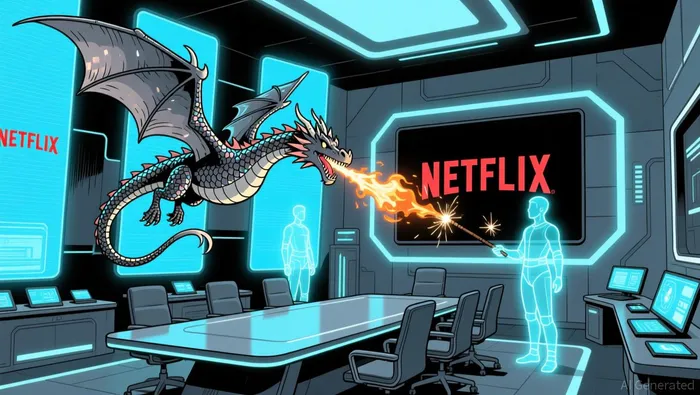 By acquiring WBD's studios and streaming assets, Netflix gains control of a vast content pipeline, including theatrical releases and beloved franchises that could attract new subscribers. The company has pledged to continue releasing Warner Bros. films in theaters-a move to appease exhibitors-and to offer a bundled streaming service that could lower costs for consumers. These steps align with Netflix's long-term goal of becoming the entertainment industry's dominant player, as highlighted by The New York Times.
The acquisition also positions Netflix to counter rivals like Disney, Paramount, and Sony, which may now face a content arms race. With WBD's 128 million subscribers, Netflix could accelerate its global expansion and leverage cross-promotion to boost retention. Analysts at Morningstar note that the deal could generate $2–3 billion in annual cost savings by the third year post-closure, with earnings per share accretion expected by year two.
Regulatory and Competitive Uncertainties
The path to closing the deal, however, remains fraught. Regulatory hurdles are compounded by WBD's pending spinoff of its cable channels (CNN, Food Network) into a new entity, Discovery Global-a condition for the acquisition. Even if these steps are completed, the antitrust review process could drag on for months, with the Biden administration's stance on tech consolidation adding another variable.
Competitively, the deal could trigger a wave of counterstrategies. As The Los Angeles Times observes, rivals like Paramount may accelerate their own content investments or lobby regulators to block the merger. Meanwhile, Hollywood unions and guilds-already wary of corporate consolidation-could push back against reduced creative autonomy under Netflix's oversight.
Conclusion: A High-Stakes Bet on the Future of Entertainment
Netflix's acquisition of WBD is a high-stakes gamble that could redefine the entertainment industry-or leave the company saddled with debt and regulatory backlash. The $5.8 billion breakup fee signals unshakable confidence in regulatory approval, but it also highlights the immense risks of a deal that could reshape market dynamics. For investors, the key question is whether Netflix's strategic vision-of a content-rich, subscriber-driven empire-justifies the financial and operational risks.
While the potential rewards are enormous-access to iconic franchises, a larger subscriber base, and a stronger position against rivals-the path to realizing these benefits is littered with obstacles. Regulatory scrutiny, integration challenges, and competitive retaliation could all test Netflix's resolve. As the company navigates this complex landscape, investors must weigh the allure of dominance against the reality of execution risks. In the end, the success of this deal may hinge not just on the size of the breakup fee, but on Netflix's ability to prove that its vision for the future of entertainment is as compelling as its balance sheet.





Comentarios
Aún no hay comentarios