
Net Interest Margin Expansion in Commercial Mortgage REITs: SOFR Floors and High-Yield Loan Pipelines as Near-Term Catalysts
SOFR Floors: A Shield Against Rate Volatility
SOFR (Secured Overnight Financing Rate) floors embedded in commercial mortgage loan agreements are increasingly serving as a buffer for REITs against declining interest rates. These floors ensure a minimum interest rate, even if SOFR dips below it, thereby stabilizing cash flows. While specific case studies on 2025 loan structures remain scarce, the broader trend of incorporating SOFR floors into newer vintage loans (2024–2025) is well documented. These loans, written at favorable spreads and reset valuations, now constitute a larger share of mREIT portfolios, directly enhancing return on equity according to recent analysis.
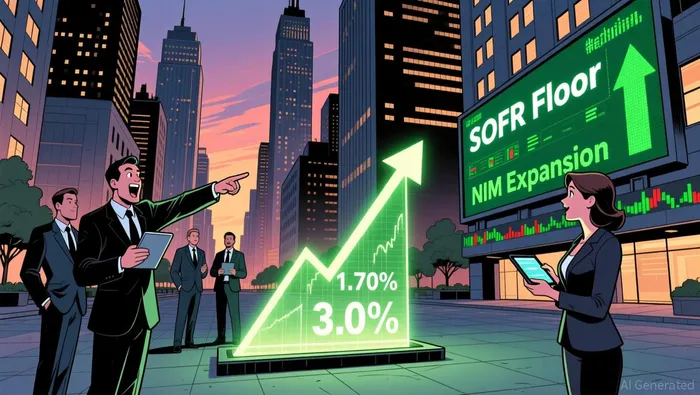
For example, the improved spread between 30-year mortgage rates and two-year Treasury yields-up to 3.0% as of early September 2025 from a low of 1.70% in early 2023-has amplified the effectiveness of SOFR floors. Analysts argue this environment allows REITs to lock in higher margins while mitigating downside risk from potential rate declines.
High-Yield Loan Pipelines: Fueling NIM Growth
The resumption of aggressive loan originations in 2025 has further accelerated NIM expansion. Commercial mREITs are now deploying capital into high-yield loan pipelines, which offer spreads significantly above historical averages. These loans, often secured by commercial real estate with strong cash flow profiles, are structured to capitalize on the current low-inventory market, where demand for credit outstrips supply.
Quantitatively, the sector's return on equity has improved as newer loans account for a larger portion of portfolios. For instance, the improved yield curve-driven by the Federal Reserve's anticipated rate cuts-has created a more favorable environment for reinvestment. Analysts project that this trend will continue, with NIMs expanding by 15–20 basis points in the next 12 months as high-yield pipelines mature.
Near-Term Catalysts: Rate Cuts and Portfolio Optimization
The Federal Reserve's rate-cutting cycle is a critical near-term catalyst. As short-term rates decline, the relative value of fixed-rate commercial mortgages with SOFR floors becomes more pronounced. This dynamic is particularly beneficial for REITs with a high proportion of legacy loans, which now trade at premiums due to their favorable spreads according to market analysis.
Additionally, the sector is witnessing a resolution of problem assets through improved transaction markets. This liquidity allows REITs to deleverage underperforming holdings and reinvest proceeds into higher-yielding opportunities, further amplifying NIM growth as market data shows.
Conclusion
The confluence of SOFR floors, high-yield loan pipelines, and Federal Reserve policy is creating a powerful tailwind for commercial mortgage REITs. As these entities optimize their portfolios and capitalize on structural rate differentials, investors should expect sustained NIM expansion and improved dividend coverage. While risks such as credit stress in commercial real estate persist, the sector's strategic positioning in 2025 suggests a compelling risk-reward profile for those with a medium-term horizon.







Comentarios
Aún no hay comentarios