
Neogen's Q1 2026 Earnings Preview: Assessing Growth Sustainability in a Shifting Regulatory and Market Environment
Neogen's Q1 2026 Earnings Preview: Assessing Growth Sustainability in a Shifting Regulatory and Market Environment
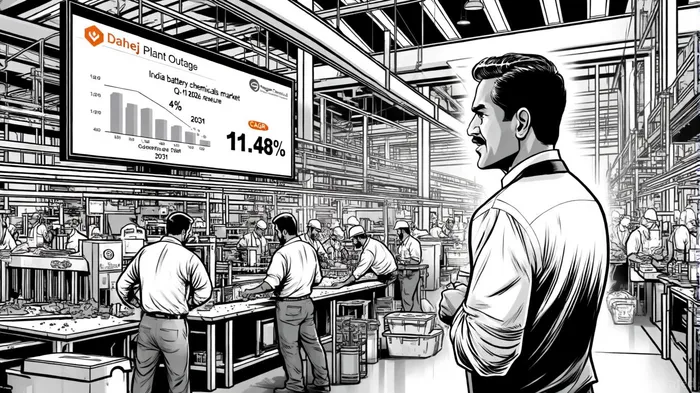
Neogen's Q1 2026 earnings preview reveals a complex interplay of resilience and vulnerability as the company navigates a dual challenge: recovering from the Dahej plant fire while positioning itself in India's rapidly evolving battery chemicals market. For investors, the key question is whether NeogenNEOG-- can sustain its growth trajectory amid regulatory shifts and supply chain constraints.
Financial Resilience Amid Operational Setbacks
Neogen Chemicals reported Q1 FY 2026 revenue of INR 186.7 crores, a 4% year-on-year increase despite the Dahej plant's three-month outage due to a fire in March 2025, according to the Q1 2026 earnings call. Organic revenue growth of 16% (INR 165 crores) underscores the strength of its core business, while inorganic contributions from Neogen Ionics-its electrolyte and lithium salts division-added INR 22 crores, as the earnings call noted. EBITDA rose 2% to INR 31.5 crores, with margins at 18.8% (standalone) and 16.9% (consolidated), reflecting effective cost optimization and product mix adjustments, per management commentary on the call.
The Dahej incident, however, remains a wildcard. The company has received INR 80.55 crores in insurance payouts to date, with claims for business interruption and asset reinstatement still pending, the earnings call said. While production has been shifted to the Patancheru plant, full recovery is expected to take nine to 12 months, per an NDTV Profit article. This operational fragility contrasts with Neogen's ambitious capital expenditure plan: INR 506 crores allocated for a greenfield electrolyte facility using MUIS technology, a program management update discussed on the earnings call.
Regulatory Tailwinds and Compliance Challenges
The Battery Waste Management Amendment Rules, 2025 introduce both opportunities and hurdles. The shift to digital labeling via QR codes reduces administrative burdens for producers like Neogen, while relaxed thresholds for cadmium and lead (≤0.002% and ≤0.004%, respectively) simplify compliance for low-hazard batteries. The Central Pollution Control Board's centralized portal for EPR registration further enhances transparency and aligns India with global standards under the amendment.
Yet, compliance is not without cost. Stricter recovery targets-70% for EV batteries in FY2025-26, rising to 90% by FY2026-27-pressure producers to invest in recycling infrastructure, according to an India Battery Industry report. Neogen's focus on lithium iron phosphate (LFP) and nickel manganese cobalt (NMC) technologies positions it to benefit from India's push for domestic battery manufacturing under the PLI scheme, as highlighted in the India battery material market report. However, its reliance on imported lithium and cobalt exposes it to geopolitical risks and price volatility, the market report cautions.
Market Dynamics: Growth and Geopolitical Risks
India's battery chemicals market, valued at USD 10.45 billion in 2025, is projected to grow at an 11.48% CAGR to USD 20.24 billion by 2031, according to the same India battery material market report. Neogen's strategic partnerships, such as its wholly owned subsidiary Neogen Morita New Materials Limited (leveraging Japanese technology for lithium salts), aim to capture this growth; management emphasized these partnerships on the earnings call. The company's electrolyte production facility, with long-lead equipment already ordered, could become a critical asset as demand for EV batteries surges, the call noted.
However, the sector's dependence on imported raw materials remains a vulnerability. India lacks domestic reserves of lithium, cobalt, and nickel, creating a supply chain bottleneck outlined in the market report. For Neogen, this means navigating a delicate balance between scaling production and securing stable input costs-a challenge exacerbated by global trade tensions and China's dominance in battery material processing.
Sustainability and Strategic Risks
Neogen's sustainability strategy emphasizes environmental protection, social equity, and governance, but its FY2025-26 guidance cuts following the Dahej incident highlight operational fragility, as reported by NDTV Profit. The company's EBITDA margin compression and negative operating cash flow in Q2 FY2026 (due to a $600 million goodwill impairment charge) underscore financial risks, as noted in the Q2 FY2026 earnings report. While its adjusted EBITDA of $40.62 million in Q2 FY2026 is robust, the $271% operating margin deficit raises questions about long-term profitability, the earnings release shows.
Investors must also weigh Neogen's management transition-Anurag Surana's appointment as Chairman in October 2025-against its capital allocation priorities. The INR 506 crores earmarked for the electrolyte plant represents a significant bet on India's EV transition, but execution risks persist. Delays in the Dahej reconstruction or regulatory compliance could strain liquidity, particularly as the company's FY2026 revenue guidance (INR 820–840 million) hinges on a return to normal operations, the Q2 filing indicates.
Conclusion: A Calculated Bet on India's EV Future
Neogen's Q1 2026 earnings reflect a company in transition: leveraging organic growth and strategic investments to offset operational setbacks. Its alignment with India's battery chemicals boom-driven by EV adoption and government incentives-positions it to benefit from a $20.24 billion market by 2031, per the industry market report. However, regulatory compliance, raw material dependency, and the Dahej recovery timeline remain critical risks.
For growth to be sustainable, Neogen must demonstrate agility in adapting to India's evolving regulatory landscape while securing stable supply chains. Its electrolyte and lithium salts ventures, coupled with a diversified production footprint, offer a path forward-but only if execution matches ambition. In a market where geopolitical and environmental pressures converge, Neogen's ability to balance innovation with resilience will define its long-term prospects.





Comentarios
Aún no hay comentarios