
Nebius: Can It Deliver on Its $9 Billion ARR Target Amid Capacity Constraints and Rising Competition?
The AI cloud infrastructure sector is experiencing a seismic shift, driven by insatiable demand for generative AI and machine learning workloads. At the forefront of this transformation is Nebius Group (NBIS), a company that has captured investor attention with its audacious $9 billion annual recurring revenue (ARR) target for 2026. But can it deliver on this promise amid soaring capital expenditures, fierce competition, and the inherent risks of scaling at such a breakneck pace?
Growth Feasibility: A Race Against the Clock
Nebius's current trajectory is nothing short of meteoric. In Q3 2025, its ARR surged to $551 million, up from $249 million in Q1 2025, with management raising its full-year guidance to $900 million–$1.1 billion. This growth is underpinned by a 355% year-over-year revenue increase to $146.1 million in the same quarter. The company's core AI infrastructure business accounts for nearly 90% of total revenue, driven by contracts with tech giants like MicrosoftMSFT-- and MetaMETA--.
To meet its 2026 ARR target, NebiusNBIS-- has embarked on an aggressive expansion plan. It has raised its 2025 capital expenditure (CapEx) guidance from $2 billion to $5 billion, aiming to secure 2.5 gigawatts of contracted power by 2026. This includes acquiring land, hardware, and high-density power infrastructure, with a focus on AI-native solutions such as NVIDIANVDA-- GPU clusters and liquid cooling according to industry analysts. The company's strategic partnerships are equally critical: a $17.4 billion, five-year deal with Microsoft and a $3 billion agreement with Meta are expected to ramp up in 2026, providing a clear revenue runway.
To illustrate the scale of Nebius's ambitions, 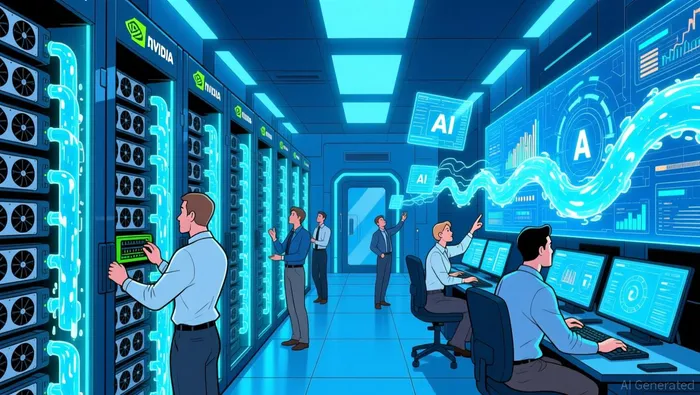 . This imagery aligns with Nebius's current trajectory of aggressive expansion and AI infrastructure investment.
However, the path to $9 billion ARR is fraught with challenges. Competitors like Microsoft and CoreWeave are also scaling rapidly. Microsoft, for instance, plans to double its data center footprint over two years and allocate $30 billion in CapEx for Q1 2026 alone. CoreWeave, meanwhile, faces supply chain delays that could hinder its 2025 revenue outlook. Nebius's differentiation lies in its AI-optimized infrastructure, which offers cost advantages over traditional hyperscalers. Yet, maintaining this edge will require continuous innovation and execution.
Financial Sustainability: A Balancing Act
Nebius's financial health is a double-edged sword. While its gross margins remain stable at 71% and adjusted EBITDA margins improved to 19% in Q3 2025, the company reported a GAAP net loss of $119.6 million for the quarter, nearly tripling year-over-year. This loss is largely attributable to $955.5 million in capital expenditures according to financial reports, underscoring the high burn rate associated with its expansion.
To fund its ambitions, Nebius has diversified its financing strategy. It launched an at-the-market (ATM) equity program for up to 25 million Class A shares and is exploring convertible notes and asset-backed debt secured by contracts with Microsoft and Meta according to company updates. These measures aim to mitigate shareholder dilution while ensuring liquidity. However, reliance on external financing raises questions about long-term profitability. As one analyst notes, "Nebius's ability to convert its contracted power into cash-generative capacity will determine its sustainability".
The broader AI cloud market, though growing rapidly, is not immune to saturation risks. The sector is projected to expand from $102.09 billion in 2025 to $589.22 billion by 2032, with a 28.5% compound annual growth rate. Yet, even in this booming environment, Nebius faces execution risks. Delays in data center construction, supply chain bottlenecks, or macroeconomic headwinds could derail its 2026 target.
The Verdict: A High-Stakes Gamble
Nebius's $9 billion ARR target is mathematically plausible given its current trajectory and contract pipeline. Its strategic focus on AI-native infrastructure, coupled with blue-chip partnerships, positions it to capture a significant share of the AI cloud market. However, the company's financial sustainability hinges on its ability to scale efficiently without overextending.
Investors must weigh the potential rewards against the risks. While Nebius's aggressive CapEx and financing strategies signal confidence, they also expose the company to volatility. The key will be whether it can maintain its cost advantages, execute on its expansion plans, and convert its contracted power into recurring revenue.
In the end, Nebius's story is one of ambition and innovation-but also of execution. As the AI cloud race intensifies, the company's ability to navigate these challenges will define its legacy.





Comentarios
Aún no hay comentarios