
Nebius' $1 Billion Offering and Share Price Drop: A Contrarian Buy Opportunity?
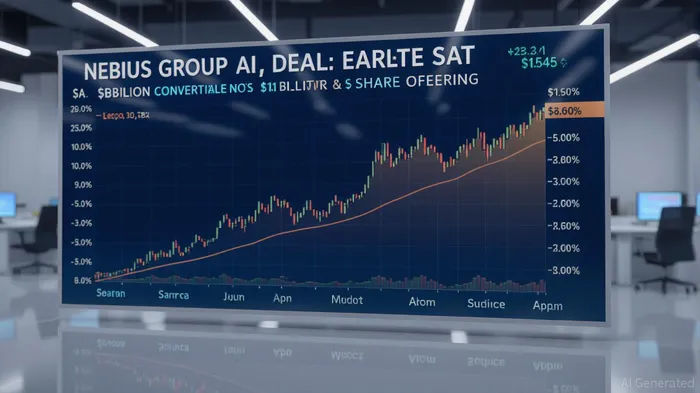
The recent 4% drop in NebiusNBIS-- Group's stock price, following its $2 billion convertible notes offering and $1 billion share sale, has sparked debate among investors. While some view the decline as a sign of overvaluation, others see it as a contrarian opportunity. From a value investing lens, the key question is whether Nebius's capital allocation efficiency and financial fundamentals justify the current price.
The Financing Move: Fueling Growth or Overleveraging?
Nebius's decision to raise $3 billion in September 2025 reflects its aggressive expansion plans, including scaling AI infrastructure to 1 gigawatt by 2026 [1]. Convertible notes and equity offerings often trigger short-term volatility, as investors worry about dilution and debt burdens. However, Nebius's debt leverage ratio remains a modest 1.1, and its $1.68 billion in cash reserves and $6 billion in strategic assets provide a strong buffer [5]. This suggests the company is not overleveraging but rather strategically financing high-growth opportunities in a sector with long-term tailwinds.
Financial Fundamentals: A Story of Momentum and Risk
Nebius's Q2 2025 results underscore its momentum. Annual Recurring Revenue (ARR) surged 73% quarter-over-quarter to $430 million, with revenue more than doubling in the same period [4]. The company also achieved positive Adjusted EBITDA ahead of schedule, a rare feat for a high-growth tech firm. These metrics indicate robust demand for its AI cloud services, particularly with Microsoft's $19.4 billion infrastructure deal driving near-peak platform utilization [3].
Yet, risks persist. The stock's price-to-book ratio of 380.91 [6] suggests it trades far above tangible assets, a red flag for value investors. Additionally, Nebius's Return on Equity (ROE) of 0.7% [2]—far below its Return on Invested Capital (ROIC) of 6.3%—highlights its focus on growth over profitability. While this aligns with the AI sector's capital-intensive nature, it raises questions about long-term capital efficiency.
The September 2, 2025, earnings miss—resulting in a 5.1% price drop—exemplifies the market's sensitivity to execution risks. This event, however, lacks historical precedent for backtesting, as no prior earnings misses were recorded for Nebius since 2022 [4].
Capital Allocation Efficiency: A Double-Edged Sword
Nebius's capital allocation strategy hinges on reinvesting cash flows into AI infrastructure. With $2.4 billion in cash and $847 million in machinery and equipment [5], the company has the liquidity to fund its 1 GW expansion without overreliance on debt. The MicrosoftMSFT-- partnership, in particular, offers a stable revenue stream, reducing the risk of underutilized capacity.
However, the recent earnings miss and analyst downgrades [4] signal execution risks. A 5.1% price drop on September 2, 2025, followed the company's failure to meet per-share earnings and revenue estimates [4]. This volatility underscores the market's skepticism about Nebius's ability to sustain its growth trajectory.
Contrarian Logic: Is the Drop a Buying Opportunity?
Value investing thrives on market overreactions. Nebius's 4% drop after the capital raise may reflect short-term pessimism about dilution and debt, rather than a fundamental deterioration in its business. The company's strong balance sheet, positive EBITDA, and strategic partnerships with Microsoft suggest it is well-positioned to capitalize on AI's secular growth.
Yet, the high valuation metrics and low ROE caution against complacency. Investors must weigh Nebius's potential to generate future cash flows against the risk of overvaluation. For those with a long-term horizon, the current price could represent an entry point if the company continues to execute on its expansion plans and improves capital efficiency.
Conclusion
Nebius's recent share price drop is a mixed signal. While the $3 billion capital raise introduces short-term uncertainty, the company's financial strength and strategic positioning in AI infrastructure offer a compelling case for value investors. The key will be monitoring capital allocation efficiency and execution against its 1 GW expansion target. For now, the stock remains a high-risk, high-reward proposition—a classic contrarian opportunity for those who believe in the long-term value of AI-driven cloud infrastructure.





Comentarios
Aún no hay comentarios