
NCAA Gambling Policy Shifts: Navigating Regulatory Risk and Market Fragmentation in Sports Betting
Regulatory Risk: A Pendulum of Uncertainty
The NCAA's delayed implementation of its revised betting policy-originally slated for November 1, 2025-has introduced a layer of regulatory ambiguity. A 30-day rescission period, triggered by 241 Division I schools (exceeding the two-thirds threshold), effectively kept the ban on betting intact for all three divisions. This reversal highlights the NCAA's internal divisions and the political dynamics of its member institutions, which can abruptly shift policy trajectories.
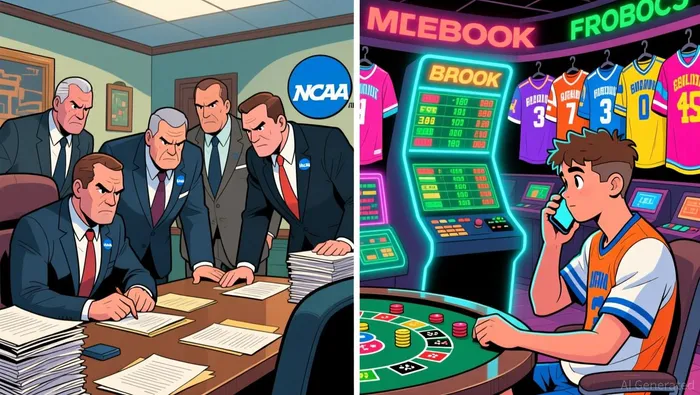 Compounding this uncertainty is the NCAA's dual approach: while it seeks to liberalize restrictions on professional sports betting for athletes, it simultaneously intensifies enforcement against college sports betting violations. In September 2025, the organization announced investigations into athletes betting on their own games and sharing insider information. This duality creates a regulatory environment where stakeholders must navigate both potential liberalization and heightened scrutiny, complicating long-term strategic planning for operators and institutions alike.
Market Fragmentation: State-Level Adaptations and Industry Responses
The NCAA's policy delays have also amplified market fragmentation, as states continue to advance their own sports betting frameworks. With legal betting now available in 38 states and Washington, D.C., regulators and operators face a patchwork of rules that often lack alignment with NCAA guidelines. For instance, while the NCAA hesitates on professional betting reforms, states like Missouri are preparing for market expansion. Caesars Sportsbook, BetMGM, and DraftKings have aggressively positioned themselves in Missouri by securing licenses and launching pre-registration campaigns, leveraging existing casino infrastructure to meet regulatory requirements.
This fragmentation is further exacerbated by the NCAA's emphasis on treating athletes as adults in a commercialized sports ecosystem while maintaining a strict prohibition on college sports betting. According to analysis, such contradictions force operators to invest in compliance mechanisms to avoid exposure to NCAA enforcement actions, even as they capitalize on state-level opportunities. For example, the NCAA's crackdown on misconduct-such as insider betting-requires operators to implement robust monitoring systems, increasing operational costs and regulatory overhead.
Investor Implications: Balancing Innovation and Compliance
For investors, the NCAA's policy shifts underscore the need to balance innovation with compliance risk. The sports betting industry's proactive approach-such as Caesars' NFL flips game and profit-boost tokens-demonstrates how operators are mitigating regulatory uncertainty through customer engagement. However, the NCAA's potential future reforms could either catalyze market growth (if betting on professional sports is permitted) or deepen fragmentation (if enforcement actions intensify).
Investors should closely monitor two key trends:
1. NCAA Policy Evolution: Any resumption of the rescinded rule's implementation could normalize athlete participation in professional sports betting, potentially reducing stigma and expanding market reach. Conversely, further delays may prolong regulatory instability.
2. State-Level Deregulation: As states continue to liberalize betting laws, operators that adapt quickly-through partnerships, localized marketing, and compliance infrastructure-will gain competitive advantages.
Conclusion
The NCAA's gambling policy shifts reflect a broader tension between institutional conservatism and the commercial realities of modern sports. While the rescission of the 2025 rule delay maintains the status quo, the underlying momentum toward athlete empowerment-via NIL rights and revenue-sharing-suggests future reforms are inevitable. For now, investors must navigate a landscape where regulatory risk and market fragmentation coexist, demanding agility and a nuanced understanding of both NCAA governance and state-level dynamics.







Comentarios
Aún no hay comentarios