
NBPE's Share Repurchase Strategy: A Masterclass in Capital Allocation and Shareholder Value Creation
In the ever-evolving landscape of listed private equity, NB Private Equity Partners (NBPE) has made a bold move to supercharge shareholder value. By allocating $120 million for share repurchases over the next three years, the company is sending a clear signal: it believes its shares are undervalued and that returning capital to investors is the most prudent use of its liquidity. This isn't just a one-off splurge-it's a calculated, multiyear strategy designed to capitalize on the sector's persistent discounts and NBPE's strong balance sheet.
A Strategic Bet on Undervaluation
The listed private equity sector has long struggled with wide discounts to net asset value (NAV), a gap that NBPE's board sees as an opportunity. By increasing its buyback authorization to $120 million-up from previous levels-the company is leveraging its $283 million liquidity war chest to systematically reduce shares outstanding. In 2025 alone, NBPE has already repurchased 148,746 shares for $2.9 million, delivering $0.02 per share in NAV accretion, according to the company's buyback announcement. Recent transactions, including the repurchase of 34,596 Class A Shares in September 2025 at prices between £14.26 and £14.58, underscore the board's commitment to buying when the discount to NAV widens, as disclosed in its transaction announcement.
This approach mirrors the playbook of value-conscious investors who thrive when markets overcorrect. By repurchasing shares at a 29% discount to NAV in early 2025, NBPE added $0.10 per share in accretion, per the company's audited results. The board's quarterly re-evaluation of buyback criteria ensures flexibility in volatile markets, a critical edge in an industry where NAVs can swing wildly.
Balancing Buybacks with Dividend Discipline
While share repurchases steal the spotlight, NBPE isn't ignoring its dividend-paying heritage. The board has pledged to maintain its $0.47 per share annual dividend, targeting a 3.0% yield on NAV, as noted in the company's buyback announcement. This dual-pronged approach-combining buybacks with steady dividends-positions NBPE to return $250 million to shareholders over three years. For context, the company has already distributed $420 million since inception, according to its annual financial report.
The synergy between buybacks and dividends is hard to ignore. While dividends reward shareholders directly, buybacks offer a tax-efficient way to return capital, especially when executed at a discount. For NBPE, this strategy isn't just about generosity-it's about optimizing capital structure in a sector where liquidity constraints often depress valuations.
Industry Context: Buybacks as a Sector Lifeline
The broader private equity sector has faced headwinds in 2020–2025, including a tough IPO environment and macroeconomic volatility. Yet disciplined buybacks have emerged as a key differentiator. A literature review of buyback investing finds firms that execute buybacks with "strategic timing and valuation discipline" have outperformed benchmarks. NBPE's co-investment model-where it invests alongside top-tier private equity managers without paying management fees-further amplifies returns. This model has driven 8.0% LTM revenue growth and 13.1% EBITDA growth in 2024, underpinning the company's ability to fund buybacks without sacrificing growth, per its portfolio growth report.
Critics may argue that NBPE's five-year annualized NAV return of 12.5% lags behind the 22.0% of the MSCI World Index, as shown in NBPE's NAV update. But this comparison misses the mark: the MSCI index reflects public markets, while NBPE's focus on private equity inherently carries different risk-return profiles. What matters more is the 6.9% NAV growth in 2024 alone, driven by strong operating results in its portfolio companies, according to the annual financial report.
The EPS and NAV Playbook
Share repurchases are a classic lever for boosting earnings per share (EPS). By reducing the share count, NBPE can lift EPS even if earnings remain flat. For example, its recent buyback of 3,000 Class A Shares cut the outstanding shares to 45,533,911, a move expected to enhance EPS, as explained in the impact of repurchases. While specific five-year EPS data isn't detailed in the sources, the mechanics are clear: fewer shares mean each remaining share owns a bigger slice of the pie.
The NAV story is equally compelling. With $12.3 million spent on buybacks in 2025, NBPE has added $0.10 per share in NAV accretion, according to the audited results. This isn't just accounting magic-it's a tangible increase in the value of each share, especially when combined with the company's $27.53 NAV per share as of 2024, per its price history.
Risks and Realities
No strategy is without risks. The stock has seen a -5.19% YTD return and a -4.59% 12-month decline, reflecting broader market jitters (MarketBeat price history). However, the five-year 51.93% cumulative gain suggests long-term investors have been rewarded (MarketBeat price history). NBPE's challenge will be maintaining its buyback momentum while navigating potential interest rate shifts or portfolio valuation pressures.
Conclusion: A Capital Allocation Masterstroke
NBPE's share repurchase program is more than a reaction to undervaluation-it's a proactive strategy to redefine its value proposition. By allocating $120 million to buybacks, maintaining dividends, and leveraging its co-investment model, the company is positioning itself as a disciplined capital allocator in a sector starved for it. For investors, this means a compelling mix of NAV accretion, EPS growth, and steady income-a rare trifecta in today's market.
As the board re-evaluates its buyback criteria quarterly, one thing is certain: NBPE is treating its shareholders like partners, not afterthoughts. In a world where capital allocation often falters, this is a playbook worth watching. 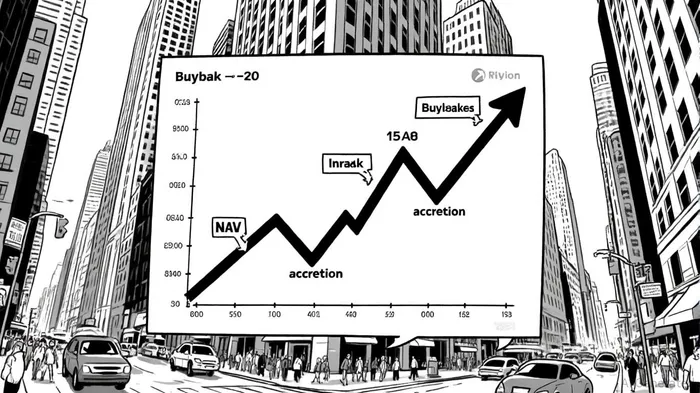







Comentarios
Aún no hay comentarios