
Navigating the Year-End Fade: Strategic Opportunities in 2026 as AI Implementation Begins
The stock market's year-end fade in 2025, marked by a sharp rotation out of AI and Big Tech stocks, has created a unique inflection point for investors. As the January Effect looms in 2026, the interplay between historical market patterns and the maturation of AI implementation offers a roadmap for identifying undervalued opportunities. This analysis explores how sector rotation, driven by macroeconomic shifts and investor sentiment, could unlock strategic gains in AI-driven sectors poised for 2026 growth.
The January Effect and AI's 2025 Sell-Off
The January Effect-a historical tendency for stocks to rebound in January-has long been a barometer for market sentiment. From 1925 to 1980, small-cap stocks outperformed large-cap peers by an average of 4.6% in January, with a 78% success rate. While modern markets have diluted this effect with a 1.2% premium and 62% success rate, the 2025 sell-off in AI and tech stocks suggests a potential rebound in 2026.
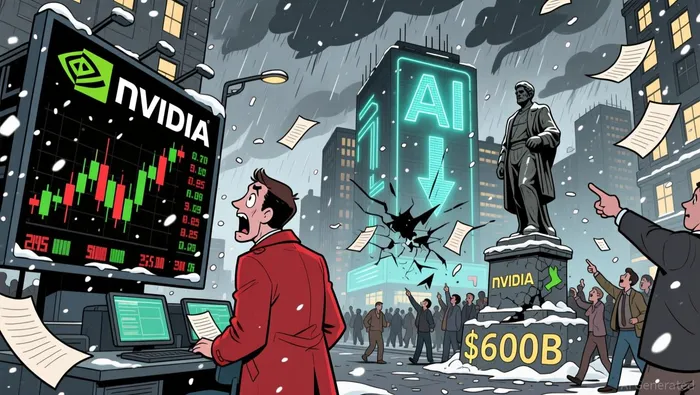
In late 2025, a 13% decline in the Nasdaq 100 was catalyzed by a Chinese AI startup, DeepSeek, which introduced a cost-competitive model challenging U.S. dominance. This triggered a $600 billion market cap loss for NVIDIA and significant declines for MicrosoftMSFT-- and AlphabetGOOGL--. The sell-off reflects investor caution over AI valuations and ROI concerns, particularly as enterprise AI adoption remains fragmented, with only one-third of organizations scaling initiatives enterprise-wide.
Undervalued AI Sectors: Healthcare as a Case Study
Despite the broader sell-off, healthcare has emerged as a leader in AI implementation. By late 2025, 22% of healthcare organizations had adopted domain-specific AI tools-a 7x increase from 2024. Institutions like Kaiser Permanente and Mayo Clinic are leveraging AI to reduce administrative burdens, cut documentation time, and enhance patient outcomes. This sector's tangible ROI and regulatory tailwinds position it as a prime candidate for 2026 growth.
Strategic Rotation: From Overvalued Tech to AI-Driven Infrastructure
The 2025 rotation out of Big Tech into industrials, financials, and healthcare mirrors historical patterns seen in late 2021. This shift was driven by macroeconomic factors, including rising borrowing costs and skepticism over AI's profitability. However, the sell-off has undervalued key players in AI infrastructure and application layers.
For instance, AMD and Micron are well-positioned to benefit from AI-specific GPU and memory chip demand, with the AI infrastructure market projected to reach $758 billion by 2029. Meanwhile, application-layer players like Palantir Technologies (enterprise AI) and SoundHound AI (voice AI) are gaining traction in niche markets.
2026 Investment Themes: Capitalizing on the January Rebound
The January Effect could catalyze a rebound in beaten-down AI stocks, particularly those with clear revenue paths. Small-cap AI plays like nCino and Global-e Online are being eyed for their potential to capitalize on AI-driven productivity gains. Additionally, emerging markets-China, India, and Taiwan-are expected to drive AI adoption, with India's high end-user adoption attracting investments from Microsoft and Google.
In the U.S., sector rotation is likely to favor AI-integrated retail (e.g., Amazon, Mercado Libre) and cloud computing (e.g., ServiceNow), which are poised to benefit from structural tailwinds in e-commerce and workflow automation.
Risks and Considerations
While the January Effect and sector rotation present opportunities, investors must remain cautious. The AI market's competitive landscape is intensifying, with a focus on vertical integration and profitability optimization. Additionally, the January barometer's predictive power is not foolproof, particularly for negative Januarys.
Conclusion
The 2025 sell-off in AI and tech stocks has created a fertile ground for 2026 opportunities. By leveraging the January Effect and sector rotation into undervalued AI implementation plays-particularly in healthcare, infrastructure, and application-layer pure plays-investors can position themselves to capitalize on the next phase of AI-driven growth. As the market recalibrates, the key differentiator will be identifying companies with scalable AI initiatives and clear paths to profitability.





Comentarios
Aún no hay comentarios