
Navigating Volatility: Strategic Entry Points in Leading Cryptocurrencies (BTC, ETH, XRP, SOL)
The New Crypto Landscape: Risk, Reward, and Macro Signals
The cryptocurrency market in October 2025 is a study in contrasts. On one hand, BitcoinBTC-- (BTC) and EthereumETH-- (ETH) have solidified their roles as foundational assets, offering relatively stable risk-adjusted returns. On the other, altcoins like XRPXRP-- and SolanaSOL-- (SOL) continue to deliver outsized gains-but at the cost of extreme volatility. For investors, the challenge lies in balancing these dynamics while navigating macroeconomic headwinds and opportunities.
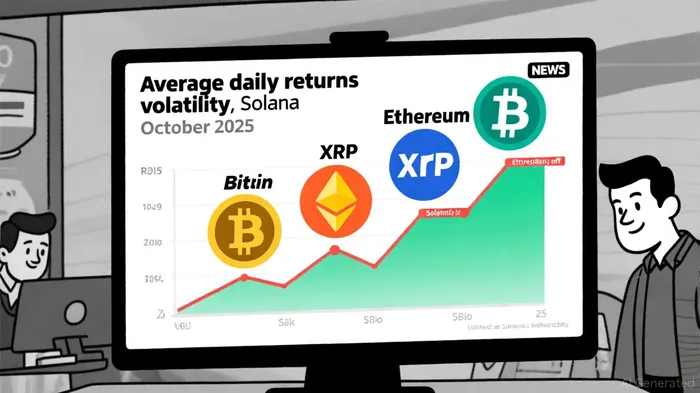
According to a CME Group report, BTCBTC-- remains the least volatile major cryptocurrency, with a daily return standard deviation of 2.91% and an average daily gain of 0.27%. In contrast, XRP's 5.89% volatility and 0.52% average return paint a picture of a high-risk, high-reward asset. Solana (SOL) and Ethereum (ETH) occupy the middle ground, with ETH's 4.10% volatility and 0.24% returns making it a moderate play, according to the CME Group report. These metrics underscore a critical insight: diversification across risk profiles is essential for capturing growth while mitigating downside.
Macroeconomic Catalysts: Rates, Inflation, and Geopolitical Shocks
The October 2025 market crash-triggered by U.S. President Donald Trump's 100% tariff on Chinese imports-exposed the fragility of leveraged positions and the deep interconnection between traditional and crypto markets, according to a Chainup analysis. Bitcoin plummeted 13% intraday, while altcoins like XRP and SOLSOL-- saw losses exceeding 70% in some cases. This event coincided with a broader sell-off in the S&P 500, illustrating how geopolitical tensions can amplify systemic risk.
Meanwhile, the Federal Reserve's hawkish stance-raising rates to 4.00% by Q3 2025-pushed Bitcoin's volatility to 45%, up from 28% in Q2, according to a GATE article. Higher borrowing costs typically drive capital into interest-bearing assets, reducing liquidity for riskier plays like crypto. However, the inverse relationship between inflation and crypto prices is nuanced. For instance, Ethereum's 12% price increase coincided with a 3.8% U.S. inflation rate, suggesting that inflationary environments may still create pockets of opportunity for certain assets (as noted in the GATE article).
Strategic Entry Points: Timing the Market with Macro Signals
For investors seeking entry points, the key lies in aligning risk tolerance with macroeconomic signals. Here's how to approach the four leading cryptocurrencies:
Bitcoin (BTC): The Safe Haven Play
BTC's low volatility and growing institutional adoption make it an ideal entry for risk-averse investors. Despite the October crash, U.S. spot Bitcoin ETFs absorbed $1.2 billion in mid-October, signaling resilience in on-chain demand, per the CME Group report. A strategic entry could focus on dips following Fed rate cuts, which are expected in late 2025 as inflation moderates.Ethereum (ETH): The Balanced Bet
ETH's moderate volatility (4.10%) and correlation with inflation data position it as a middle-ground play. Investors might consider dollar-cost averaging into ETHETH-- during periods of macroeconomic uncertainty, leveraging its role as a bridge between traditional finance and decentralized ecosystems.XRP and Solana (SOL): High-Risk, High-Reward Alts
XRP and SOL offer the highest potential returns but require a tolerance for extreme swings. For example, XRP's 5.89% volatility suggests it's best suited for aggressive traders or those using hedging strategies. The launch of 5x leveraged ETFs by Volatility Shares in December 2025 adds another layer of complexity, enabling experienced traders to amplify gains-but also losses-during volatile periods, as discussed in the GATE article.
Risk Management: Lessons from October 2025
The October crash serves as a cautionary tale about over-leveraging. Over $19 billion in positions were liquidated within 24 hours, highlighting the dangers of excessive leverage in a market prone to black swan events, as the Chainup analysis reported. For new entrants, the lesson is clear: prioritize position sizing, use stop-loss orders, and avoid overexposure to altcoins during periods of geopolitical or macroeconomic instability.
Conclusion: Balancing the Equation
The path to crypto success in 2025 requires a disciplined approach to risk-adjusted returns and macroeconomic timing. While BTC and ETH offer stability, XRP and SOL provide growth potential for those willing to navigate volatility. By aligning entry strategies with central bank policies, inflation trends, and geopolitical developments, investors can position themselves to capitalize on both the opportunities and challenges of this dynamic market.






Comentarios
Aún no hay comentarios