
Navigating Volatility: Strategic Entry Points in Bitcoin and Select Altcoins Amid Market Corrections
The Contrarian Playbook: Utility Over Hype
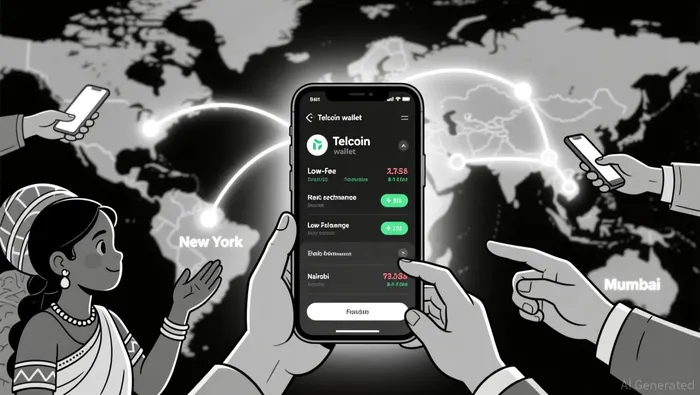
Market corrections often punish speculative assets while rewarding projects with tangible use cases. Telcoin (TEL), for instance, has surged 108% weekly as of November 2025, driven by partnerships with telecom operators to tokenize remittances and reduce cross-border transaction costs. Its mobile-first blockchain infrastructure-integrated with over 150 telecom providers-positions TEL as a bridge between traditional finance and Web3, a narrative that gains strength during macroeconomic uncertainty.
Meanwhile, Starknet (STRK) is capitalizing on Ethereum's scaling challenges. As a zero-knowledge (ZK) rollup, Starknet has slashed transaction costs by 50% and reduced block proof times to under 3 minutes via its S-Two prover. But its most compelling move is the BTCFi initiative, which incentivized $276 million in Bitcoin liquidity deposits by airdropping 100 million STRK tokens to users. This transforms Bitcoin from a "vault asset" into a yield-bearing collateral within DeFi-a narrative that resonates in a low-interest-rate environment.
On-Chain Metrics: Volume, Staking, and Developer Activity
TEL's recent 46% spike on November 12, 2025, followed by a 30% rally the next day, reflects strong retail and institutional interest in its telecom use case according to market analysis. On-chain data shows a 300% increase in active addresses over the past month, suggesting growing adoption beyond speculative trading.
Starknet's metrics are equally compelling. Despite a September 2025 outage, STRK's developer activity has surged quarter-over-quarter with Cairo-based projects rising 40%. The staking of 900 million STRK (20% of circulating supply) further underscores validator confidence, though monthly token unlocks could create near-term volatility according to latest updates.
Strategic Entry Points: Balancing Risk and Reward
While TEL and STRK offer compelling utility, their volatility demands disciplined entry strategies. For TEL, key resistance at $0.0075 presents a high-probability target for short-term traders, while long-term investors may prefer dips below $0.006 to build positions according to recent analysis. STRK's recent breakout above $0.24 suggests a bullish trend, but its reliance on yield incentives means investors must monitor liquidity program sustainability according to market reports.
Critics argue both projects face execution risks: Telcoin's telecom partnerships remain unproven at scale, and Starknet's technical upgrades could face regulatory scrutiny. However, these risks are precisely what make them contrarian opportunities-undervalued by mainstream investors but rich in long-term potential.
Conclusion: The Future of Value-Driven Crypto
As Bitcoin consolidates, TEL and STRK exemplify how utility-driven cryptos can thrive in bearish environments. Telcoin's telecom integration and Starknet's BTCFi innovation address real-world pain points-liquidity, scalability, and accessibility-that institutional capital will eventually price in. For investors willing to navigate short-term volatility, these assets represent asymmetric risk-reward profiles in a market starved of fundamentals.






Comentarios
Aún no hay comentarios