
Navigating Volatility: Strategic Entry Points in Altcoins Amid Bitcoin's Support-Level Battle
Bitcoin's Support-Level Dilemma and Market Sentiment
Bitcoin's current price action underscores a fragile technical structure. According to a report by Investing.com, the asset is approaching the $93,600 support band, with rising volume signaling heightened selling pressure. A breakdown below this level could push Bitcoin toward the $85,000–$86,000 range, a Fibonacci 0.786 retracement level that may attract medium-term buyers. However, the broader market remains cautious, with Bitcoin's dominance (BTC.D) declining from 61.4% to 58.9% in November 2025. This shift reflects capital reallocation into altcoins, though analysts caution that a true altcoin season has not yet materialized.
Altcoin Dynamics: Capital Reallocation and Mixed Signals
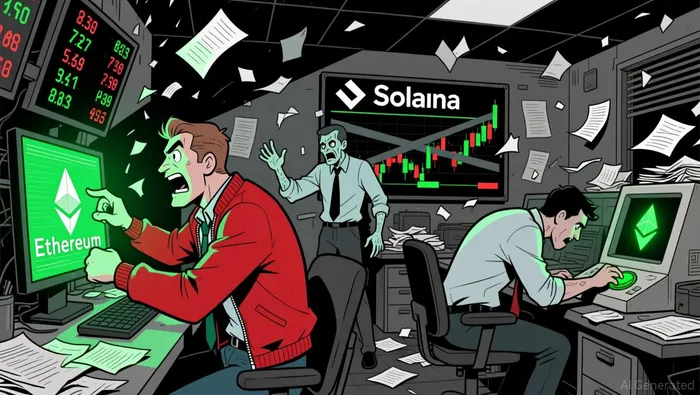
While Bitcoin's dominance wanes, altcoins are drawing incremental attention. For instance, Solana has seen $56 million in ETF inflows in a single day, yet its price remains below key moving averages, and its RSI hovers below 50, indicating bearish momentum. Similarly, EthereumETH-- (ETH) and other major altcoins have underperformed despite Bitcoin's decline, as the market prioritizes deleveraging over speculative rotation.
Steno Research predicts a structural shift in capital allocation, forecasting Bitcoin's dominance to drop to as low as 45% by 2025. This reallocation is driven by factors such as the anticipated rise in the ETH/BTC ratio and the potential approval of U.S. crypto ETFs. Analysts attribute this trend to macroeconomic factors, including the U.S. presidential victory of Donald Trump, which is perceived as more favorable to altcoins than to Bitcoin.
Strategic Entry Points in Altcoins
Identifying optimal entry points in altcoins requires a nuanced understanding of Bitcoin's price action and macroeconomic conditions. According to , a potential inflection point for altcoins may emerge if Bitcoin consolidates above $110,000 and macro liquidity improves. This scenario could catalyze a shift in altcoin momentum by Q4 2025, offering traders a window to enter positions with favorable risk-reward profiles.
For example, large-cap altcoins like Ethereum and SolanaSOL-- could benefit from Bitcoin's stabilization, particularly if institutional adoption accelerates. However, entry points should be validated by technical indicators such as RSI divergence, volume profiles, and VWAP. Traders are advised to avoid overexposure during Bitcoin's support-level breakdowns and instead wait for confirmation of a broader market recovery.
Risk Management: Hedging and Position Sizing
In a bearish environment, risk management is paramount. Position sizing should be strictly controlled, with allocations limited to 1–2% of total capital per trade to mitigate adverse price movements. A core-satellite model, such as the 60/30/10 framework, can further diversify risk by allocating 30% to satellite assets like large-cap altcoins and thematic plays (e.g., DeFi or RWAs).
Hedging strategies are equally critical. Traders can use Bitcoin futures or options to protect against downside risk while maintaining exposure to altcoins. For instance, a long position in Ethereum could be hedged with a short Bitcoin futures contract to offset potential losses if Bitcoin's decline accelerates. Additionally, stablecoins can serve as a liquidity buffer during periods of high volatility.
Institutional-grade strategies extend to real-world asset (RWA) tokenization platforms like OndoONDO-- Finance and Maple FinanceSYRUP--, which offer exposure to asset-backed tokens tied to U.S. Treasuries or private credit. These platforms provide a hedge against altcoin volatility while aligning with broader macroeconomic trends.
Conclusion: Balancing Opportunity and Caution
The current bearish Bitcoin environment presents both challenges and opportunities for altcoin traders. While capital reallocation is underway, the market remains in a deleveraging phase, with altcoins yet to confirm a sustained recovery. Strategic entry points will depend on Bitcoin's ability to stabilize above key support levels and macroeconomic improvements. Meanwhile, disciplined risk management-through position sizing, hedging, and diversification-will be essential to preserving capital and capitalizing on potential rebounds.
As the crypto market navigates this volatile period, traders must remain agile, leveraging technical analysis and macroeconomic signals to refine their strategies. The path to profitability lies not in chasing momentum but in methodically balancing risk and reward.






Comentarios
Aún no hay comentarios