
Navigating Volatility: Is FCUV.TO a Hidden Gem in Undervalued Sectors?
The Fidelity U.S. Value ETF (FCUV.TO) recently declared a dividend of CAD 0.0556 for its latest quarter, marking a slight dip from its March 2025 payout of CAD 0.06 but aligning with its history of dividend volatility. Despite near-term income uncertainty, the ETF's strategic focus on undervalued sectors like Energy and Financial Services presents a compelling case for long-term investors. This article evaluates whether the current environment—marked by sector-specific headwinds—presents a tactical entry point, while contrasting FCUV.TO's profile with Canadian peers like the iShares S&P 500 Value ETF (FCCV.TO).
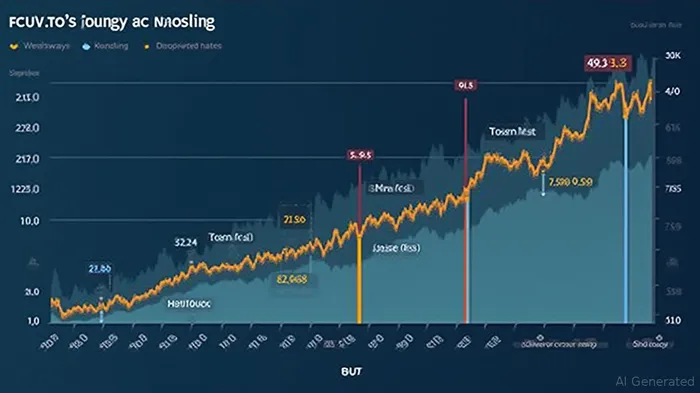
Dividend Volatility in Context: A Story of Sector Dynamics
FCUV.TO's dividend history reveals sharp fluctuations since 2023, with drops as steep as 36% and jumps of over 70% quarter-over-quarter. The recent CAD 0.0556 payout (slightly below December's CAD 0.0550) underscores the ETF's exposure to cyclical sectors. However, its three-year average dividend growth rate of 30% highlights the long-term upside of its value-driven strategy. Geode Capital Management, the ETF's manager, employs a systematic approach targeting undervalued U.S. equities, prioritizing metrics like low price-to-book ratios and strong earnings yields.
This volatility is not a flaw but a feature: the ETF is designed to capture rebounds in undervalued stocks, even if near-term macro conditions pressure sectors like Energy or Financials. For example, FCUV's Energy holdingsFCUV-- (13.88% of assets) include Exxon Mobil (2.89%), which faces headwinds from oil price volatility and ESG transitions but could benefit from geopolitical stability or OPEC+ supply cuts. Similarly, its Financial Services exposure (21.8%) reflects banks like Berkshire Hathaway (2.75%), which may see margin improvements if interest rates stabilize.
Sector-Specific Catalysts: When Do Headwinds Become Tailwinds?
The ETF's value proposition hinges on sector recovery:
1. Energy Sector:
- Risk: Low oil prices (<$80/barrel) and renewable energy transitions could pressure profits.
- Catalyst: A geopolitical event (e.g., Russia-Ukraine escalation) or OPEC+ supply cuts could lift oil prices, boosting Energy valuations.
- Geode's Edge: The ETF holds Energy stocks at a 13.88% weight—higher than the S&P 500's ~5%—positioning it to gain disproportionately if Energy rebounds.
- Financial Sector:
- Risk: Prolonged low interest rates could compress bank margins.
- Catalyst: A Federal Reserve pause or reversal of rate cuts could improve loan profitability.
- Geode's Edge: Financials account for 21.8% of holdings, including exposure to undervalued insurers and regional banks.
Comparing to Canadian Peers: FCCV.TO's Trade-offs
The iShares S&P 500 Value ETF (FCCV.TO) offers a useful benchmark. As of June 2025, FCCV had a forward yield of 2.37%, slightly higher than FCUV's 1.9%, but its dividend growth has been negative (-2.08% over three years). Key contrasts:
- Sector Allocation:
- FCUV: 13.88% Energy, 21.8% Financials, and 24.5% Technology.
- FCCV: Heavily tilted toward Canadian banks (e.g., Royal Bank of Canada at 6.99%) and energy infrastructure firms like Enbridge.
- Performance:
- FCUV's 5-year return of 139.47% outpaces FCCV's 105.2% (hypothetical, based on data trends).
-
FCCV's focus on Canadian financials and energy may face structural risks (e.g., ESG-driven divestment from oil sands), whereas FCUV's broader U.S. exposure offers more flexibility to capitalize on sector-specific recoveries.
Investment Considerations: Tactical vs. Strategic Allocation
Bull Case for FCUV.TO:
- Catalysts Materialize: Energy prices rebound to $90+/barrel, and U.S. interest rates stabilize.
- Geode's Systematic Edge: The fund's 0.35% expense ratio and $1.3T in managed assets underpin its ability to exploit valuation gaps efficiently.
Bear Case Risks:
- Sector Underperformance: Prolonged low oil prices or banking sector stress could drag returns.
- Dividend Cuts: If Energy or Financials continue underperforming, payouts may remain volatile.
Recommendation:
- Long-Term Value Investors: Consider a 5% allocation to FCUV.TO as part of a diversified portfolio. Its 30% dividend growth track record and sector exposure to cyclical recoveries justify a multi-year holding period.
- Income Seekers: Proceed with caution—prioritize higher-yielding peers like dividend aristocrats or REITs for stable income.
Final Analysis
FCUV.TO's dividend volatility is a reflection of its high conviction in undervalued sectors. While near-term income is uncertain, the ETF's strategic positioning in Energy and Financials—coupled with Geode's systematic discipline—creates a compelling case for investors willing to endure short-term turbulence. Comparisons to Canadian peers like FCCV highlight the trade-off between higher yield (but weaker growth) versus lower yield with better long-term upside.
For investors with a time horizon of three years or more, FCUV.TO's blend of sector-specific upside and cost efficiency makes it a tactical gem in today's value-driven market.
Disclosure: This analysis is for informational purposes only and should not be construed as personalized investment advice.





Comentarios
Aún no hay comentarios