
Navigating Volatility: Is the Australian Market Ready for the Next Major Correction?
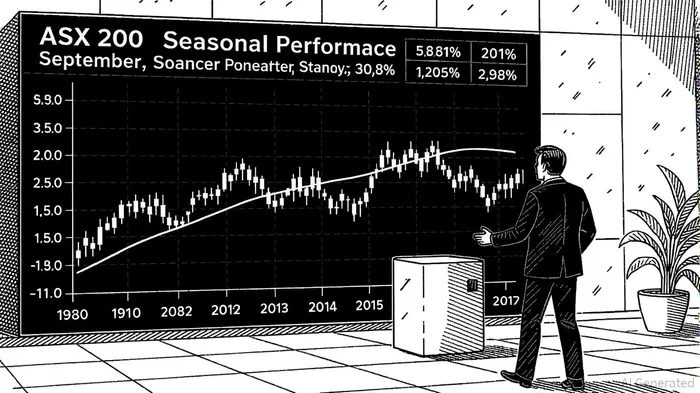
The Australian market has entered a period of heightened optimism, driven by improving business confidence, accommodative monetary policy, and a resilient equity rally. Yet beneath the surface, historical volatility patterns, valuation extremes, and macroeconomic fragilities suggest the market may be ill-prepared for the next major correction. Investors must now grapple with the tension between short-term complacency and long-term risks, particularly as seasonal pressures and structural imbalances converge in Q3 2025.
Business Confidence and the Illusion of Stability
The National Australia Bank (NAB) Business Confidence Index rose to 7 points in July 2025, marking its highest level since August 2022 and a four-month upward trend [1]. This surge reflects optimism in construction and services sectors, yet critical metrics like sales growth, profitability, and employment remain below long-run averages [2]. Inflationary pressures persist, with input and output costs rising and capacity utilization near peak levels. While NAB’s Chief Economist, SallySBH-- Auld, notes “strengthened economic momentum,” the data reveals a mixed picture: services sectors outperforming retail and wholesale, and global concerns yet to dampen local investment [1]. This dichotomy underscores a key risk—businesses may be overestimating their resilience to cost shocks and underestimating the fragility of consumer demand.
Historical Volatility: The September Swoon and Systemic Risks
The ASX 200’s historical tendency to weaken in September—a phenomenon dubbed the “September Swoon”—adds a critical layer of risk. Over the past 40 years, September has averaged a -0.11% return for the index, with gain reliability at just 52.5%. This pattern intensifies in shorter timeframes: the past five years show an average September drop of -2.2% and a gain reliability of 20% [1]. The month’s volatility is amplified by post-summer portfolio rebalancing, fiscal year-end dynamics, and psychological anticipation of weakness [5].
This year’s context is particularly precarious. The ASX 200 surged 14.4% from April to August 2025, but a 1.3% decline in early September aligns with historical trends [2]. Analysts warn that major equity corrections of 3% or more typically occur every 1.5–2 months, and it has been over three months since the last meaningful pullback [2]. Compounding these risks are global factors: trade tensions, U.S. Federal Reserve policy uncertainty, and systemic vulnerabilities like rising corporate debt and speculative asset pricing [4]. The September Swoon is not merely a statistical anomaly—it is a confluence of behavioral, institutional, and macroeconomic forces that could trigger a sharper-than-expected correction.
Monetary Policy and the Complacency Trap
The Reserve Bank of Australia’s (RBA) August 2025 rate cut to 3.6%—its fourth reduction in 2025—has injected liquidity into the economy and driven the ASX 200 to record highs [1]. Governor Michele Bullock emphasized the move was driven by progress toward the 2–3% inflation target, yet the RBA remains cautious about global uncertainties and domestic growth risks [4]. Markets have priced in two further cuts by early 2026, but recent data—such as a strong consumer-led rebound and persistent inflation—could delay this path [2].
While rate cuts have bolstered risk appetite, they also risk fostering complacency. The RBA’s data-dependent approach means future policy shifts will hinge on volatile indicators like CPI and employment data. For instance, Commonwealth Bank economist Harry Ottley notes the RBA is unlikely to overreact to monthly CPI fluctuations but warns a November cut remains probable [5]. This uncertainty creates a fragile equilibrium: investors may overextend in anticipation of further easing, only to face a sudden tightening if inflationary pressures resurge.
Valuation Extremes and the Overconfidence Bias
The ASX 200’s valuation metrics paint a troubling picture. As of August 15, 2025, the index traded at a P/E ratio of 20.55, well above its 5-year average of 14.80–19.11 and significantly higher than its 10-year (16.14) and 20-year (14.68) averages [1]. This overvaluation reflects inflated expectations for earnings growth, which may not materialize given macroeconomic headwinds. Sectoral disparities further complicate the picture: while defensive sectors like utilities and financials trade at stretched multiples (e.g., banks at 15x P/E), cyclical sectors like materials are undervalued by 20% relative to intrinsic value [2].
The price-to-book (P/B) ratio of 3.07 as of September 2025 also signals a disconnect between market capitalization and tangible assets [5]. Such extremes historically precede corrections, as seen in the 1987 crash and 2009 GFC. Investors must recognize that high valuations are not inherently self-sustaining; they require consistent earnings growth and stable macroeconomic conditions—both of which are under threat from inflation, trade tensions, and policy divergence.
Strategic Reallocation: Defensive Positioning in a Volatile Environment
Given these risks, investors should prioritize defensive positioning and long-term reallocation. Key strategies include:
1. Sector Rotation: Shift toward undervalued sectors (e.g., materials, industrials) and away from overvalued defensive plays (e.g., utilities, financials).
2. Quality Over Momentum: Favor companies with strong balance sheets and predictable cash flows, as speculative assets face heightened correction risks.
3. Diversification: Hedge against equity volatility by increasing allocations to bonds, gold, and global equities with lower correlation to the ASX 200.
4. Active Management: Monitor RBA policy signals and global macroeconomic data, adjusting exposure to rate-sensitive sectors accordingly.
The September Swoon, overvaluation, and policy uncertainty collectively signal a market primed for a correction. While the RBA’s easing cycle and seasonal October recovery offer temporary relief, structural risks remain unresolved. Investors who recognize these dynamics now will be better positioned to navigate the volatility ahead.
Source:
[1] NAB Monthly Business Survey July 2025 - Confidence Continues to Lift [https://news.nab.com.au/news/nab-monthly-business-survey-july-2025-confidence-continues-to-lift/]
[2] Australia Business Confidence [https://tradingeconomics.com/australia/business-confidence]
[3] Equity Market Valuation Extremes: Historical Warnings for ... [https://discoveryalert.com.au/news/equity-market-valuation-extremes-2025-investor-implications/]
[4] Global Economic Collapse: 5 Warning Signs to Watch Now [https://discoveryalert.com.au/news/global-economic-collapse-warning-signs-2025-financial-risk/]
[5] Why September Is Wall Street's Worst Month for Stocks [https://stocksdownunder.com/september-is-wall-streets-worst-month/]







Comentarios
Aún no hay comentarios