
Navigating the Valuation Wall: A Strategic Rebalancing in 2026
The U.S. tech sector's valuation wall in late 2025 is both a testament to its enduring growth narrative and a warning bell for investors. With a trailing P/E ratio of 30.8x and a P/S ratio of 8.9x, the sector remains priced for perfection, even as its 3-year average P/E of 44.9x suggests a moderation in exuberance. Meanwhile, subsectors like B2B SaaS, cybersecurity, and semiconductors trade at EBITDA multiples of 11x–12.8x, reflecting a market that still rewards recurring revenue models and AI-driven innovation. Yet, as J.P. Morgan Global Research notes, the AI cycle's capital expenditures and earnings dynamics are reshaping corporate fundamentals, creating a K-shaped recovery where top-tier asset owners disproportionately benefit. This divergence raises critical questions about overextension risks and the need for strategic rebalancing in 2026.
The Tech Sector's Valuation Tightrope
The tech sector's current valuation metrics-while more disciplined than in previous years-still outpace historical averages. For instance, the S&P 500 Information Technology Sector's P/E ratio of 39.78 as of January 2026 is expensive relative to its 3-year average. This premium is partly justified by projected annual earnings growth of 20% and a compound annual growth rate (CAGR) of 9.7% for the broader tech industry through 2030. However, the sector's volatility has intensified, with the VIX spiking to 17.62 in late December 2025 as investors recalibrated expectations for AI infrastructure costs and profitability.
The overextension is most evident in large-cap growth stocks, which faltered in Q4 2025 amid concerns about debt-fueled AI expansion and slowing consumer spending among lower-income households. For example, major AI-linked tech stocks faced pullbacks as market participants questioned whether earnings growth could sustain current multiples. This fragility underscores a broader theme: while tech's fundamentals remain strong, its valuation is increasingly sensitive to macroeconomic shifts and policy risks.
Defensive Sectors: A Counterbalance to Tech's Volatility
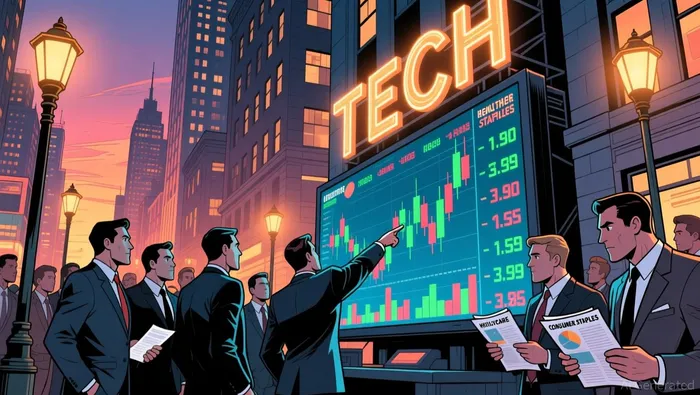 In contrast, defensive sectors like utilities, healthcare, and consumer staples have emerged as compelling alternatives for risk management. As of late 2025, the utilities sector traded at a trailing P/E of 20.39, significantly lower than the tech sector's 40.65. This discount reflects both undervaluation and a shift in utilities' role as AI-driven energy demand transforms the sector. Companies like Vistra and Constellation Energy saw performance gains tied to data center infrastructure needs, yet utilities also faced late-2025 volatility, with some large-cap names experiencing steep drawdowns.
Healthcare, meanwhile, demonstrated resilience, outperforming the broader market in Q4 2025 with an 11.27% gain. Its P/E ratio of 21.37 and defensive characteristics-such as stable cash flows and inelastic demand-position it as a hedge against tech's cyclicality. Similarly, consumer staples, though historically a safe haven, faced headwinds in 2025 due to inflationary pressures. However, its 24.12 P/E ratio and 2.4% dividend yield suggest it remains a viable option for income-focused investors.
Macroeconomic Drivers and Strategic Rebalancing
The 2026 investment landscape will be shaped by three macroeconomic forces: easing interest rates, inflationary pressures, and policy risks. The Federal Reserve's anticipated rate cuts will likely benefit capital-intensive sectors like utilities and real estate, which are sensitive to borrowing costs. Conversely, inflationary risks-exacerbated by sectoral tariffs and global fragmentation-could disrupt supply chains and erode margins, particularly in export-dependent industries.
Policy risks, including sector-specific tariffs and evolving AI governance frameworks, will further complicate sector rotation strategies. For instance, the tech sector's reliance on global supply chains for semiconductors and data infrastructure makes it vulnerable to geopolitical tensions. In this environment, diversification becomes paramount. Morningstar highlights that mid- and small-cap value stocks outperformed growth in Q4 2025, signaling a shift toward stability. Similarly, defensive ETFs with low beta values-such as those focused on utilities and healthcare-are likely to attract capital as investors seek to mitigate volatility.
A Roadmap for 2026: Balancing Growth and Defense
To navigate the valuation wall, investors should adopt a dual strategy: selectively holding high-conviction tech names while overweighting defensive sectors. For example, B2B SaaS and cybersecurity subsectors-trading at EBITDA multiples of 11.5x–12.5x-offer a balance of growth and operational efficiency. However, these positions should be hedged with utilities and healthcare, which provide downside protection and dividend income.
Additionally, diversification into international equities and fixed income will be critical. As BlackRock notes, emerging markets and developed value stocks can offset AI-driven concentration risks. Fixed income, particularly intermediate-term bonds and emerging market debt, offers both yield and stability in a low-inflation environment.
Conclusion
The valuation wall in the tech sector is not a collapse but a recalibration. While its growth story remains intact, the risks of overextension and macroeconomic volatility demand a strategic rebalancing. By rotating into defensive sectors, diversifying across geographies, and prioritizing income-generating assets, investors can position themselves to thrive in 2026's uncertain landscape. As the market navigates the intersection of AI-driven innovation and economic realism, discipline and adaptability will be the cornerstones of success.







Comentarios
Aún no hay comentarios