
Navigating Uncertainty: Strategic Sectors for Market Resilience During U.S. Government Shutdowns
The U.S. government shutdown that began on October 1, 2025, has once again tested the resilience of financial markets. While initial volatility was anticipated, the S&P 500's 0.34% gain on the first day of the shutdown underscored a broader pattern: markets often treat such events as temporary disruptions rather than existential threats, according to a YCharts report. This dynamic creates opportunities for investors who understand which sectors historically outperform during periods of political gridlock.
The Anatomy of Resilience: Sectoral Insights
Healthcare and Utilities as Safe Havens
Essential services remain insulated from macroeconomic turbulence. The Healthcare Select Sector SPDR (XLV) surged 3.09% during the 2025 shutdown, reflecting demand for non-discretionary spending on medical care, the report found. Similarly, the Utilities Select Sector SPDR (XLU) rose 0.96%, as investors sought stability in regulated, cash-flow-generating assets. These sectors' performance aligns with historical trends, where defensive industries outperform due to their inelastic demand.
Government Contractors and Defense Firms
Firms like CACI InternationalCACI-- (CACI), a government services contractor, gained 3.28% as investors bet on post-shutdown catch-up spending, according to the report. Defense manufacturers also held steady, with budgets perceived as politically protected. This suggests that companies tied to non-discretionary federal programs-such as cybersecurity, infrastructure, or national security-can thrive even during shutdowns.
Financials and Small-Cap Stocks: Vulnerable to Uncertainty
Conversely, the Financial Select Sector SPDR (XLF) fell 0.89%, reflecting heightened sensitivity to economic uncertainty and potential delays in regulatory activity, the report noted. Small-cap stocks, represented by the iShares Russell 2000 ETF (IWM), lagged further, as smaller firms face greater liquidity constraints during market stress.
Market Sentiment and Volatility: A Manageable Risk
The VIX volatility index rose modestly, remaining below levels indicative of systemic risk, per the report. Meanwhile, the 10-Year Treasury yield dropped 3 basis points to 4.12%, illustrating a flight to safety amid uncertainty. These signals suggest that investors view shutdowns as short-term events, not long-term threats to economic fundamentals.
Strategic Positioning: Lessons for Investors
- Defensive Tilting: Overweight healthcare and utilities, which historically provide downside protection.
- Government-Linked Exposure: Target contractors and defense firms with contracts tied to non-discretionary spending.
- Avoiding Vulnerable Sectors: Underweight financials and small-cap stocks, which face amplified risks during shutdowns.
As the 2025 shutdown unfolds, the key takeaway is clear: markets reward foresight. By aligning portfolios with shutdown-resistant sectors, investors can navigate uncertainty while capitalizing on structural resilience.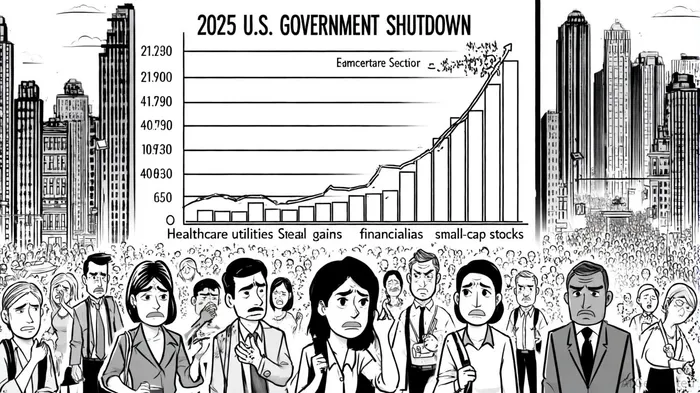





Comentarios
Aún no hay comentarios