
Navigating the Uncertain Labor Market: Implications for Equity and Rate-Sensitive Sectors
The U.S. labor market in November 2025 remains a patchwork of contradictions, shaped by a delayed Bureau of Labor Statistics (BLS) report, a Federal Reserve recalibrating its rate-cutting strategy, and sector-specific trends that defy broad generalization. As investors grapple with these dynamics, strategic asset reallocation has become imperative, particularly in equity and rate-sensitive sectors. This analysis unpacks the implications of the current environment and outlines actionable strategies for navigating the uncertainty.
A Labor Market in Limbo
The November 2025 BLS employment report, delayed until December 16 due to a 43-day government shutdown, has left critical data gaps. October's household survey data was not collected retroactively, while November's collection period was extended to November 30, introducing statistical noise into the estimates. According to the Chicago Fed, a projected unemployment rate of 4.44% for November, up slightly from October, and a hiring rate of 44.85% for unemployed workers, which has cushioned the impact of layoffs.
Meanwhile, the Job Openings and Labor Turnover (JOLTS) data for October reveals a stagnant labor market, with job openings unchanged at 7.7 million and hiring and separation rates largely flat. This "frozen" environment reflects employers' cautious approach- hiring freezes, attrition-based workforce adjustments, and AI-driven productivity gains are replacing traditional layoffs.
Federal Reserve Policy: A Delicate Balancing Act
The Federal Reserve's November 2025 policy meeting culminated in a 25-basis-point rate cut, bringing the target federal funds rate to 3.50%-3.75%-the third such reduction in 2025 according to the Fed's official announcement. This decision, while accommodative, was framed as a "meeting-by-meeting" recalibration rather than a full pivot. The FOMC emphasized elevated inflation (2.8% in September 2025) and the need to assess the "extent and timing" of future adjustments. Chair Jerome Powell underscored a data-driven approach, noting the central bank's readiness to support employment while targeting 2% inflation.
The Fed's internal divisions are evident: while some officials advocate for further cuts in 2026, others caution against overstimulation given persistent inflationary pressures, including those from Trump-era tariffs. This uncertainty has led to a fragmented market outlook, with investors parsing mixed signals from the Fed's policy statements and economic projections.
Sector-Specific Implications and Strategic Reallocation
Healthcare and Industrials: Outperformers in a Shifting Landscape
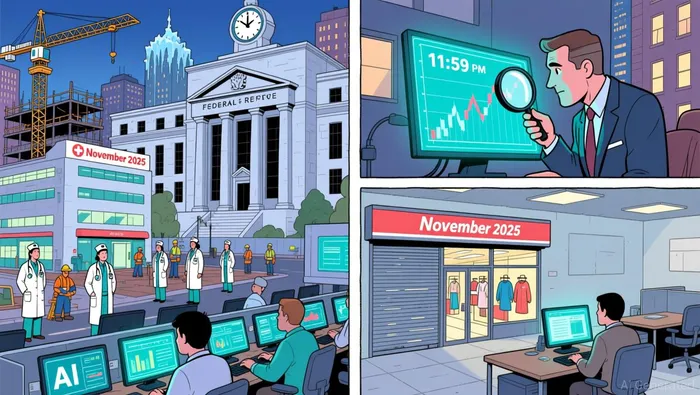
Healthcare employment continues to rise, driven by ambulatory services and hospitals, while industrials benefit from AI-driven productivity and infrastructure spending according to Schwab's outlook. Schwab's December 2025 sector outlook upgraded Communication Services, Industrials, and Health Care to Outperform, citing strong fundamentals and AI adoption potential. Investors are increasingly favoring these sectors for their exposure to long-term growth drivers and lower sensitivity to interest rate volatility.Consumer Discretionary and Real Estate: Underperformers Amid Structural Headwinds
Consumer Discretionary faces headwinds from income inequality and tariff-driven inflation, which disproportionately affect lower-income households. Real Estate, meanwhile, struggles with a mixed office market and high borrowing costs. Schwab and Wells Fargo both downgraded these sectors to Underperform, urging investors to trim exposure.Financials and Utilities: Rate-Sensitive Sectors in Focus
Financials, particularly banks, stand to benefit from lower borrowing costs, while Utilities-traditionally defensive-have been upgraded for their attractive valuations. Wells Fargo recommends reallocating to these sectors, which offer a balance of income generation and downside protection.
Risk Mitigation and Forward-Looking Strategies
 Given the Fed's cautious stance and labor market volatility, investors should prioritize flexibility. Key strategies include:
- Diversifying Across Cyclical and Defensive Sectors: A blend of industrials (cyclical) and healthcare (defensive) can hedge against divergent macroeconomic outcomes.
- Monitoring Real-Time Indicators: The Chicago Fed's Labor Market Indicators and the Beige Book provide early signals of sector-specific shifts.
- Avoiding Overexposure to High-Valuation Tech Stocks: While AI-driven growth remains compelling, valuations have become stretched, making selective rotations into rate-sensitive sectors more attractive.
Conclusion
The November 2025 labor market and Fed policy environment demand a recalibration of investment strategies. By focusing on sectors poised to benefit from AI adoption, lower borrowing costs, and structural demand (e.g., healthcare, industrials), while reducing exposure to underperforming areas (e.g., consumer discretionary, real estate), investors can navigate the uncertainty with greater resilience. As the Fed's December 16 jobs report looms, vigilance and agility will remain critical.







Comentarios
Aún no hay comentarios