
Navigating Turbulence: Sector-Specific Risks in Education Amid Government Instability
The 2025 U.S. government shutdown has exposed the fragility of the education sector amid political instability, creating both immediate turbulence and long-term strategic challenges. As federal agencies furloughed 95% of non-federal student aid employees and paused critical grant-making activities, educational institutions faced operational disruptions and heightened uncertainty. This event, combined with broader financial pressures like declining enrollment and rising costs, underscores the need to assess how government instability impacts equity valuations in the sector.
Short-Term Volatility: A Snapshot of Disruption
The October 2025 shutdown froze civil rights investigations, delayed funding for programs like Impact Aid, and halted research at agencies such as the NIH and NSF[1]. While the S&P 500 initially showed resilience-rising 0.34% on the first day of the shutdown-education-related stocks and endowments faced indirect headwinds. For instance, the Securities and Education Commission (SEC) suspended reviews of registration statements, complicating capital-raising efforts for EdTech firms and for-profit colleges[5]. Defense and healthcare contractors, which rely on federal contracts, also saw mixed performance, with government services firms surging due to expectations of post-shutdown catch-up spending[3].
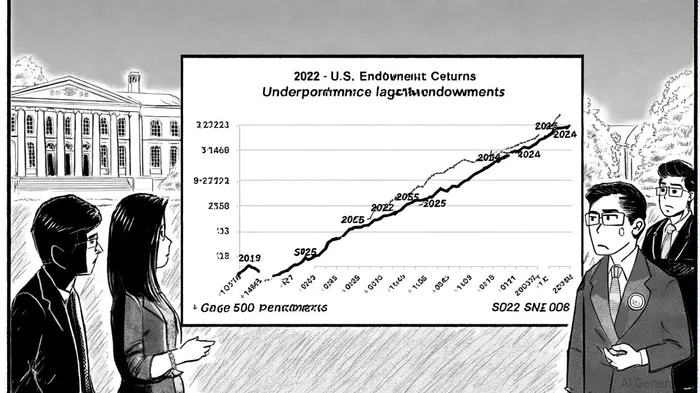
Equity valuations for institutions with large endowments, such as Ivy League universities, further illustrate short-term fragility. Despite an 11.2% average return in fiscal 2024, these endowments underperformed market benchmarks by 15.2 percentage points, partly due to high-cost alternative investments and return smoothing practices[3]. Smaller endowments, with less exposure to private assets, outperformed larger ones, returning 13% in FY2024[3]. This disparity highlights how asset allocation and institutional size amplify volatility during periods of instability.
Long-Term Resilience: Innovation and Adaptation
While short-term disruptions are acute, long-term resilience hinges on strategic adaptation. Institutions like Georgia State University and Purdue University have pioneered innovative approaches to mitigate financial and operational risks. Georgia State's use of predictive analytics and proactive advising has improved retention rates, while Purdue's income-share agreements offer alternatives to student loans[2]. These models demonstrate how data-driven strategies and creative financing can buffer against external shocks.
Endowment management also plays a critical role in long-term stability. However, structural challenges persist. Large U.S. endowments underperformed indexed portfolios by an average of -2.4% annually from 2015 to 2024, with cumulative returns now at 70% of what they would have been in a market-matching portfolio[1]. Proposed federal taxes on endowments and regulatory scrutiny of ESG investments add further uncertainty[3]. Institutions must diversify revenue streams, prioritize liquidity, and adopt agile governance to navigate these pressures.
Policy Shocks and Sector-Specific Risks
The 2025 policy landscape introduced additional volatility. The One Big Beautiful Bill Act (OBBBA) overhauled student loan repayment systems, phasing out income-driven plans and introducing less flexible alternatives[4]. Such reforms force institutions to recalibrate financial aid advising and compliance frameworks, compounding operational costs. Similarly, changes to Title IX regulations and accreditation oversight have created compliance burdens, particularly for smaller institutions with limited resources[4].
For-profit colleges and EdTech firms face unique risks. The sector's reliance on federal aid and shifting regulatory priorities-such as federal rollbacks of DEI initiatives-has already driven valuation multiples to stabilize in a "disciplined" phase by mid-2025[3]. While companies with strong fundamentals may weather uncertainty, prolonged instability could deter investment in innovation and expansion.
Visualizing the Path Forward
Conclusion
The education sector's ability to withstand government instability depends on balancing short-term agility with long-term strategic foresight. While the 2025 shutdown and policy shifts have introduced immediate volatility, institutions that embrace innovation-whether through technology, financial models, or governance-can build resilience. Investors must remain vigilant, factoring in both the sector's vulnerabilities and its capacity for adaptation in an era of persistent uncertainty.







Comentarios
Aún no hay comentarios