
Navigating a Tumultuous Landscape: Can Smucker's Strategic Overhaul Secure Long-Term Financial Health?
The J.M. Smucker CompanySJM-- (SJM) has entered a critical phase of its evolution, balancing the fallout from strategic missteps with a focused pivot toward core strengths. The recent fiscal 2025 results and 2026 guidance reveal both vulnerabilities and opportunities, as the company grapples with declining segments, costly impairments, and the pressure to sustain free cash flow. Investors must weigh whether Smucker's restructuring—driven by divestitures and operational discipline—can offset near-term headwinds and deliver on its financial targets.
Strategic Shifts: Pruning to Grow
Smucker's moves to divest non-core brands like Voortman and Sweet Baked Snacks' value items signal a deliberate shift toward profitability over scale. These decisions, while diluting top-line growth, aim to concentrate resources on higher-margin segments such as U.S. retail coffee, pet foods, and the Uncrustables brand. The 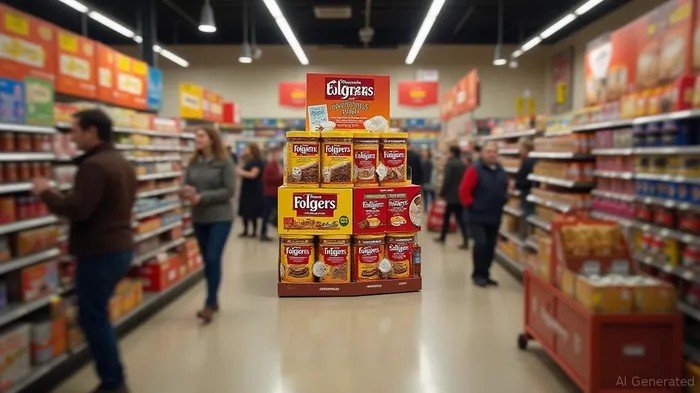 underscores the focus on legacy staples and emerging winners. The company's decision to exit underperforming businesses aligns with broader trends in consumer goods, where portfolio optimization is key to resilience in a slowing economy.
Financial Resilience: Cash Flow Amid the Storm
Despite a reported net loss of $11.57 per share in fiscal 2025—driven by $1.66 billion in noncash impairments—Smucker's adjusted earnings remain intact at $10.12, a 2% increase. The real linchpin is free cash flow, which soared to $816.6 million, up from $28 million in fiscal 2024, thanks to operational efficiency and disciplined capital allocation. This cash engine supports Smucker's fiscal 2026 target of $875 million in free cash flow, a critical metric for debt reduction and dividend sustainability.
The Impairment Overhang and Margin Pressures
The $1.98 billion in total impairments—primarily tied to the underperforming Sweet Baked Snacks segment and the Hostess brand—highlight execution risks and overvaluation in past acquisitions. While noncash, these charges reflect deeper issues: declining volumes in baked snacks and brand dilution at Hostess, exacerbated by inflation and shifting consumer preferences. Meanwhile, input costs, particularly for green coffee beans and pet food ingredients, are squeezing margins. Gross margins for fiscal 2026 are projected at 35.5-36%, down from prior years, as price hikes struggle to outpace rising costs.
2026 Guidance: Balancing Pragmatism and Risk
Smucker's fiscal 2026 outlook is cautiously optimistic: net sales growth of 2-4%, adjusted EPS of $8.50-$9.50, and free cash flow of $875 million. These targets hinge on three pillars:
1. Core Growth: U.S. retail coffee (driven by Folgers and Café Bustelo) and Uncrustables, now a $1 billion brand candidate.
2. Cost Discipline: SKU rationalization in pet foods and marketing reallocation to high-return brands.
3. Debt Management: Using free cash flow to reduce leverage, which stood at $7.04 billion in fiscal 2025.
However, risks loom large. Input cost inflation, particularly in coffee (accounting for ~30% of coffee segment costs), could compress margins further. Additionally, the pet food segment's recovery relies on retailers restocking inventories, a process that remains uncertain.
Investment Implications: A High-Reward, High-Risk Proposition
The stock's 7% pre-earnings dip reflects investor skepticism about Smucker's ability to navigate these challenges. At current levels (~$65), the stock trades at ~9x the low end of 2026 EPS guidance, a discount to its five-year average of 14x. This valuation could reward long-term holders if Smucker executes its strategy:
- Bull Case: Stronger-than-expected volume recovery in coffee and Uncrustables, along with disciplined cost control, could push EPS toward the upper end of guidance. Free cash flow's growth could also attract yield-seeking investors, as the dividend (currently yielding ~3.5%) remains sustainable.
- Bear Case: Persistent margin pressures, a prolonged pet food inventory overhang, or further impairment charges could erode confidence and valuation multiples.
Final Take: A Wait-and-See Stance
For now, Smucker's stock is a speculative play on its turnaround story. Investors should demand visible progress in fiscal 2026:
1. Quarterly sales trends in coffee and Uncrustables.
2. Gross margin stabilization amid input costs.
3. Debt reduction progress and dividend sustainability.
Historical backtests from 2020 to 2025 reveal that even when sales trends met or exceeded guidance, a buy-and-hold strategy underperformed. During these periods, the stock faced significant declines, with an average loss and a maximum drawdown of -35.63%, while a Sharpe ratio of -0.08 underscored the strategy's high risk and low return profile. These results emphasize the challenges in capturing gains through this approach, reinforcing the need for patience and rigorous oversight.
The company's free cash flow resilience is a critical anchor, but the path to earnings recovery is fraught with execution risks. Until Smucker demonstrates consistent traction in its core segments and cost savings, cautious investors may prefer to wait for clearer signs of stabilization. For those with a long-term horizon and tolerance for volatility, the current valuation offers a potential entry point—but only after due diligence on the feasibility of its 2026 targets.
In the beverage and snack aisles, Smucker's legacy brands still command loyalty. The question is whether this foundation can support the company through its strategic overhaul—or if the structural challenges now facing it will outpace its ability to adapt.





Comentarios
Aún no hay comentarios