
Navigating Trade Tensions: Why Industrial and Tech Stocks Offer Contrarian Opportunities in Trump's Economic Landscape
The market's resilience under President Trump's trade policies continues to confound skeptics, defying recession bets and offering fertile ground for contrarian investors. Amid escalating rhetoric and tariff threats, sectors directly impacted by trade tensions—industrial and tech equities—present a compelling value proposition. Recent data and analysis from UBS's Paul Donovan underscore how policy strength and corporate adaptability are reshaping sector dynamics, rewarding those who dare to bet against the pessimism.
The Contrarian Play: When Policy Uncertainty Becomes an Advantage
The conventional wisdom holds that trade wars hurt markets. Yet, the S&P 500 reached record highs in early 2025 despite Trump's aggressive tariff agenda, with the VIX “fear” index remaining muted. Paul Donovan, UBS's chief economist, attributes this resilience to delayed inflation effects and investor desensitization to policy chaos. “Markets have grown accustomed to treating tariff threats as background noise,” he noted, adding that companies are preemptively pricing in tariff impacts—a strategy that could mask near-term risks but sets the stage for a rebound once uncertainties resolve.
Historically, industrial stocks faced sharp declines during tariff announcements—such as the 9% drop in May meiden 2019 after U.S.-China duties were raised to 25%—but recovered as companies adapted. Today, firms like CaterpillarCAT-- and BoeingBA-- are leveraging reshored supply chains and automation, while tech giants like IntelINTC-- and NVIDIANVDA-- are capitalizing on AI-driven demand despite semiconductor tariffs. The sector's beta (volatility relative to the market) has stabilized, offering a better risk/reward profile than during the 2018–2019 trade war.
Data-Backed Contrarianism: Where to Overweight
- Industrial Sector: Beyond the Tariff Headlines
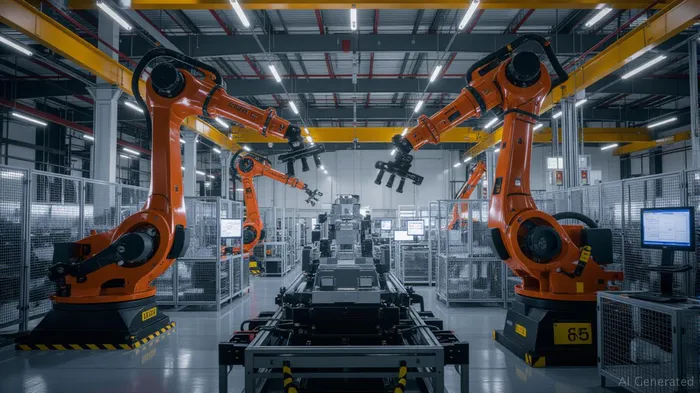
- Reshoring and Robotics: Companies like 3MMMM-- and General Electric are investing in U.S. manufacturing hubs, benefiting from tax incentives and reduced reliance on Chinese inputs.
- Earnings Resilience: Despite Q1 2025 GDP concerns, industrial firms reported stronger-than-expected margins, with 60% of S&P 500 industrials beating estimates.
Valuation: The sector trades at a 20% discount to its five-year average P/E ratio, even as revenue growth holds steady at 5–7%.
Tech Sector: Innovation as a Hedge
- AI-Driven Growth: NVIDIA's AI infrastructure sales surged 40% in Q1 2025, offsetting semiconductor tariff headwinds.
- Global Diversification: Firms like MicrosoftMSFT-- and AmazonAMZN-- are expanding cloud data centers in Mexico and Canada to bypass trade bottlenecks.
- Volatility Reward: Tech's beta has dipped to 1.2 from 1.4 during peak 2023 trade tensions, signaling reduced sensitivity to policy shifts.
Institutional Shifts Signal a Turning Point
UBS's data reveals a quiet rotation into industrial and tech ETFs, with $12 billion flowing into cyclical sectors in Q1 2025—double the inflows of 2024. Hedge funds, traditionally wary of trade-exposed names, are now overweighting Caterpillar and Texas InstrumentsTXN--, betting on a “TACO Trade” (Trade Agreements and Corporate Optimism) to ease tensions. Meanwhile, Goldman SachsGS-- analysts upgraded industrials to “Overweight,” citing undervalued equities and pent-up infrastructure demand.
Risks and the Contrarian Mindset
No investment is without risk. A full-scale trade war or delayed Fed rate cuts could reignite volatility. However, Donovan's analysis highlights that the market's “wait-and-see” stance has already discounted worst-case scenarios. Investors who focus on companies with diversified supply chains (e.g., Intel's $40B Ohio chip plant) or pricing power (e.g., Boeing's defense contracts) can mitigate these risks.
Final Take: Go Against the Grain, but Stay Selective
The contrarian thesis hinges on three pillars:
1. Policy Overhang: Trump's trade rhetoric, while disruptive, has not yet translated into systemic economic damage.
2. Corporate Adaptation: Firms are proving more agile than markets give them credit for, from reshoring to tech diversification.
3. Valuation Discounts: Industrial and tech stocks are pricing in pessimism that may not materialize.
For now, overweighting industrial and tech equities—particularly those with exposure to reshoring, automation, and AI—offers a high-reward, low-regret strategy. As Donovan concludes, “The market's focus on tariffs' headline risks is overshadowing the quiet resilience of U.S. corporates. This is where the contrarian edge lies.”
Invest wisely, and stay attuned to the policy pivot points that could redefine this landscape.





Comentarios
Aún no hay comentarios