
Navigating Tariffs and Transitions: PVH Corp's Path to Profitability and Investment Considerations
PVH Corp. (PVH), the parent company of Calvin Klein and Tommy Hilfiger, has long been a bellwether for the global apparel industry. Yet its Q1 2025 results highlight the precarious balancing act it must perform to sustain profitability amid U.S. tariffs, shifting consumer preferences, and operational transitions. While the company's cost mitigation strategies and brand investments show promise, execution risks and macroeconomic headwinds leave investors weighing whether near-term pain or long-term undervaluation better defines the stock's trajectory.
Tariff Mitigation: Progress, but Not Yet a Cure
PVH's earnings report underscores the scale of the challenge posed by U.S. tariffs, which now threaten a $1.05 per share drag on 2025 EPS. To counter this, the company has leaned into its Growth Driver 5 cost savings initiative, focusing on process centralization, automation, and inventory optimization. Restructuring costs of $13 million in Q1—primarily severance for reorganization—are a sign of the structural changes underway. CFO Zac Coughlin emphasized that these measures, alongside “cut-through” marketing campaigns (e.g., Calvin Klein's Bad Bunny-driven Icon Cotton Stretch launch), aim to offset tariff impacts in the second half of 2025.
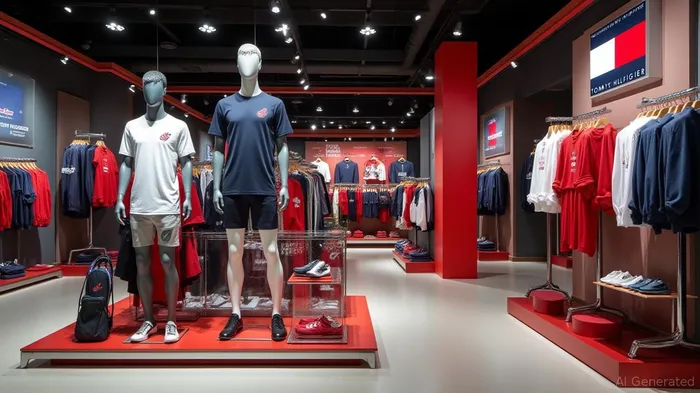
However, the jury is still out on whether these efforts will fully neutralize tariff pressures. Gross margins contracted to 58.6% from 61.4% in Q1, driven by promotional pricing and freight costs, suggesting margin compression persists. Investors should monitor whether Q2's projected EPS of $1.85–$2.00 (non-GAAP) reflects meaningful progress in cost control or merely delayed pain.
Regional Performance: APAC Struggles, but Global Levers Remain
While PVH's Americas and EMEA regions delivered growth, APAC's 13% revenue decline—due to China's weak retail environment and Lunar New Year timing—raises concerns about the sustainability of its Asia pivot. The region's challenges are compounded by the transition of women's product categories from licensing to in-house production, which disrupted revenue streams.
The silver lining lies in PVH's diversified geographic exposure. EMEA's 5% revenue rise (4% constant currency) and the Americas' 7% growth (8% constant currency) suggest the company can offset APAC weakness through regional diversification. Still, investors must assess whether APAC's issues are cyclical or structural. A recovery in Chinese consumer spending—or a shift in product strategy—could reignite momentum there.
PVH+ Initiative: Share Repurchases and Strategic Trade-offs
The $500 million accelerated share repurchase (ASR) in Q1 underscores PVH's commitment to shareholder returns under its PVH+ plan. However, the halt on further repurchases for 2025 signals a prioritization of liquidity preservation amid uncertainty. Meanwhile, the company's inventory surged 19% year-over-year, reflecting strategic stockpiling to improve availability. While this could pay off in restocking demand, elevated inventories pose risks if sales don't materialize—a concern given the 2.8% drop in direct-to-consumer sales.
Valuation: Priced for Pain or a Turnaround?
At current levels, PVH trades at roughly 15x its 2025 EPS midpoint of $10.88. This valuation reflects a market skeptical of its ability to fully mitigate tariffs and stabilize margins. Yet, if the company can deliver on its cost-saving and brand-building goals, the stock could re-rate upward.
Catalysts and Risks: Where the Rubber Meets the Road
- Catalysts: A successful back-to-school season for Tommy Hilfiger, strong holiday performance for Calvin Klein, and margin improvements from Growth Driver 5 could drive upside.
- Risks: Escalation of U.S.-China trade tensions, a prolonged consumer spending slowdown, and inventory overhang remain critical threats.
Investment Stance: Hold for Now, Monitor for a Buy Opportunity
While PVH's long-term brand strength and geographic diversification are undeniable, near-term risks—tariffs, APAC underperformance, and inventory management—argue for a Hold rating. The stock's current valuation may not yet fully account for these challenges, but a meaningful pullback (e.g., 15–20% from recent highs) could present a Buy opportunity, especially if Q2 results show margin stabilization or APAC stabilization.
Investors should remain vigilant on two key metrics:
1. Gross margin recovery (should expand beyond Q1's 58.6% as cost savings materialize).
2. APAC sales momentum (a rebound to flat or positive growth would alleviate a key headwind).
In sum, PVH Corp.PVH-- is navigating a treacherous path where strategic execution could tip the scales from survival to resurgence. For now, patience—and a watchful eye on those catalysts—is the prudent approach.





Comentarios
Aún no hay comentarios