
Navigating Tariff Volatility: Strategic Opportunities in Emerging Market Equities and Currencies Amid Trump's Trade Policies
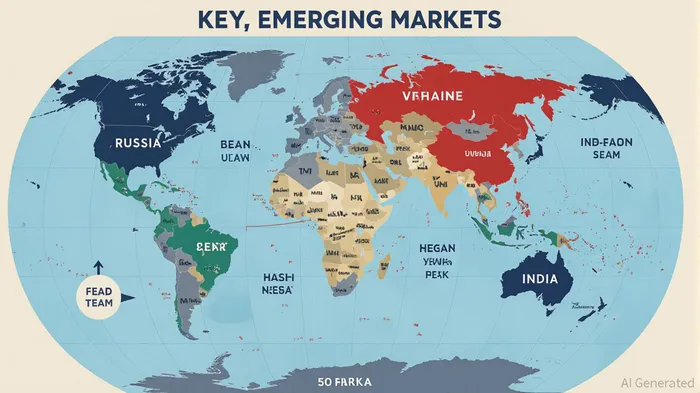
The U.S. trade landscape in 2025, under President Donald Trump's “reciprocal” tariff regime, has reshaped global economic dynamics. With tariffs averaging 10% across all trading partners and spiking to 50% for Brazil, 40% for Laos and Myanmar, and 39% for Switzerland, emerging markets (EMs) face a dual challenge: absorbing trade shocks while navigating Fed easing and geopolitical uncertainties. Yet, within this volatility lie asymmetric opportunities for investors who can identify resilient EM equities and currencies.
The Fed's Easing Cycle: A Tailwind for EM Currencies
J.P. Morgan Research forecasts a 25 basis point Fed easing in December 2025, followed by three more cuts in 2026, totaling 100 basis points. This gradual unwind of U.S. monetary tightening, coupled with EM central banks' aggressive rate cuts, is creating a policy divergence that favors EM currencies. The U.S. dollar, already weakened by moderating U.S. growth and structural fiscal challenges, is expected to depreciate further, with the euro-dollar pair targeting 1.20–1.22 and the dollar-yen hitting 140.
For investors, this signals a strategic shift. EM currencies like the Indian rupee (INR) and Vietnamese dong (VND), which have historically underperformed during U.S. hawkish cycles, are now poised to outperform. However, the benefits are uneven. Countries with trade agreements—such as Vietnam (20% tariffs) and Japan (15% on autos)—are insulated from the worst of the tariff shock, while others like Brazil face a potential 1% GDP contraction.
Tariff Exemptions and Geopolitical Optimism: Asymmetric Risks and Rewards
Selective tariff exemptions and geopolitical optimism create pockets of opportunity. For instance, the EU's 15% tariff on pharma exports to the U.S. avoids singling out the bloc, preserving its competitive edge in healthcare sectors. Similarly, the U.S.-Japan trade deal, which slashes auto tariffs, could boost Japanese corporate earnings by 8–10% in 2026, per J.P. Morgan.
Russia and Ukraine, meanwhile, present a paradox. While Russia's economy remains constrained by sanctions and a 50% tariff on its goods, Ukraine's access to EU fiscal support and its role in global grain markets could drive a 4–5% GDP rebound in 2026. Investors should monitor geopolitical de-escalation signals, as even a partial easing of tensions could unlock $15–20 billion in foreign capital inflows into Ukrainian equities.
Tech-Linked EMs: The New Growth Frontier
The most compelling opportunities lie in tech-linked EMs. As AI and digital infrastructure drive global growth, countries like India, Vietnam, and Indonesia are leveraging their labor pools and tech ecosystems to capture market share. J.P. Morgan notes that AI-related sectors (tech, communication services, and utilities) now account for 40% of S&P 500 performance, a trend mirrored in EMs.
India's pharma sector, for example, is expanding into AI-driven drug discovery, with companies like Cipla and Dr. Reddy's Labs gaining traction in U.S. markets despite the 25% tariff on Russian oil-linked goods. Similarly, Vietnam's semiconductor manufacturing hubs, shielded by the U.S.-Vietnam trade deal, are attracting $5–7 billion in foreign investment annually.
Actionable Strategies for Investors
- Currency Hedging and Diversification: Allocate 15–20% of EM portfolios to currencies with strong policy support (e.g., INR, VND) while hedging against U.S. dollar volatility using forward contracts.
- Sector Rotation: Overweight tech-linked EMs with AI exposure (e.g., India's Nifty Tech, Vietnam's Ho Chi Minh Tech Index) and underweight commodity-dependent economies.
- Geopolitical Arbitrage: Position in Ukrainian equities via ETFs like the iShares MSCIMSCI-- Ukraine Capped ETF (EUKR) and Russian energy plays (e.g., Rosneft) with short-term options to hedge against sanctions risks.
- Tariff Arbitrage: Target sectors with exemptions (e.g., smartphones, pharmaceuticals) and avoid high-tariff industries (e.g., Brazilian agriculture, Indian textiles) unless geopolitical risks abate.
Conclusion: Balancing Risk and Reward
The 2025 trade environment is a high-stakes game of chess. While U.S. tariffs and geopolitical tensions create headwinds, Fed easing and EM policy divergence open doors for selective investments. By focusing on tech-linked EMs, leveraging currency tailwinds, and capitalizing on geopolitical optimism, investors can navigate volatility and unlock asymmetric returns. The key lies in agility—identifying which EMs are adapting to the new trade order and which are being left behind.







Comentarios
Aún no hay comentarios