
Navigating U.S. Tariff Uncertainty: Strategic Plays in Asia's Resilient Tech Supply Chains
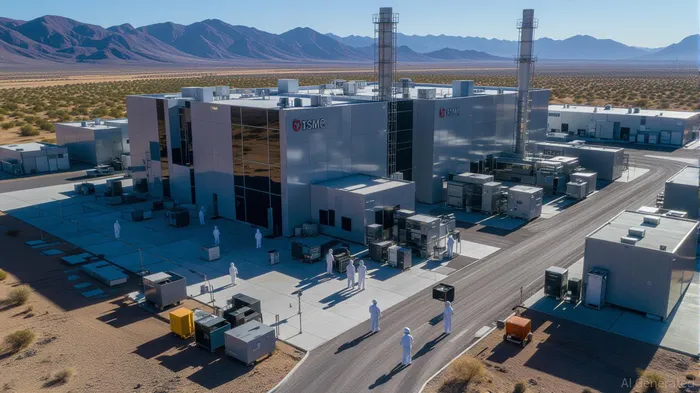
The U.S. semiconductor tariff landscape has become a minefield for global trade, with 100% tariffs on imported chips and a looming Section 232 investigation threatening to upend supply chains. Yet, amid the chaos, Asia's semiconductor and export-driven equities are emerging as fortresses of resilience. For investors, the challenge lies in identifying undervalued players in Taiwan and Southeast Asia that are not only weathering the storm but thriving by aligning with U.S. reshoring strategies and leveraging regional diversification.
TSMC: The Unshakable Titan
Taiwan Semiconductor Manufacturing Company (TSMC) remains the linchpin of the global semiconductor industry, with a $915 billion market cap and 60% of advanced chip fabrication capacity by 2030. Its $100 billion U.S. investment—spanning three Arizona fabs, two advanced packaging plants, and an R&D hub—has insulated it from the 100% tariff threat. TSMC's U.S. operations now account for 28% of global advanced chip capacity by 2032, a strategic pivot that has driven its stock up 120% since 2023.
However, TSMC's valuation reflects its dominance, and its 2025 capital expenditures ($38–$42 billion) could strain margins if tariffs resurge. For investors seeking exposure to U.S.-aligned manufacturing without overpaying for TSMCTSM--, the focus should shift to its ecosystem.
Undervalued Taiwanese Contenders
While TSMC dominates headlines, smaller Taiwanese firms are quietly adapting to U.S. trade dynamics. United Microelectronics Corporation (UMC) and Vanguard International Semiconductor are diversifying their production footprints, with UMCUMC-- exploring U.S. factory collaborations and Vanguard aligning with U.S. supply chain goals. These companies lack TSMC's scale but offer niche capabilities in AI and HPC, with UMC's Q2 2025 revenue rising 31.7% year-over-year.
The key metric here is tariff resilience: UMC and Vanguard's U.S. production plans reduce exposure to the 100% tariff, while their advanced manufacturing processes (e.g., 12nm and 16nm nodes) cater to growing demand in automotive and industrial sectors. Their valuations remain attractive relative to TSMC, with price-to-earnings ratios below 15x, compared to TSMC's 30x.
Southeast Asia's Semiconductor Renaissance
Thailand and Vietnam are rewriting the rules of semiconductor supply chains. Thailand's National Semiconductor Strategy, launched in December 2024, aims to attract $14.4 billion in FDI by 2029, with a 10.5 billion-baht investment by a Taiwanese contract electronics giant to produce high-precision machinery parts. This aligns with the country's Eastern Economic Corridor (EEC) and port infrastructure upgrades, positioning it as a “China +1” alternative.

Infineon Technologies AG's $306 million investment in Thailand's semiconductor machinery, alongside Foxconn's $306 million in two factories, underscores the region's appeal. These projects are not just about cost arbitrage—they're about geopolitical hedging. Thailand's neutral stance in U.S.-China tensions makes it a safe harbor for companies seeking to avoid supply chain disruptions.
The Thai Semiconductor Playbook
Thailand's strategy is a masterclass in policy-driven growth. The BOI's 10-year corporate tax exemptions for upstream semiconductor firms, coupled with workforce development partnerships with institutions like KMITL, are creating a talent pipeline for advanced manufacturing. By 2026, Infineon's Samut Prakan facility will produce power modules for EVs and data centers, a sector projected to grow 15% annually.
For investors, the undervalued gems here are Thai-listed firms like Chartered Semiconductor (Malaysia) and Hynix (Vietnam), which are leveraging U.S. incentives while benefiting from Southeast Asia's lower labor costs. These companies are also less exposed to China's trade volatility, making them ideal for a diversified portfolio.
Strategic Investment Thesis
- U.S.-Aligned Manufacturing: Prioritize companies with U.S. production facilities or partnerships. TSMC's ecosystem, UMC, and Infineon's Thai operations are prime examples.
- Regional Diversification: Southeast Asian firms like Chartered Semiconductor and Hynix offer exposure to the “China +1” trend, with valuations that reflect their growth potential.
- Tariff Resilience Metrics: Focus on firms with U.S. tax exemptions, advanced manufacturing capabilities, and supply chain diversification.
Risks and Mitigation
While the outlook is bullish, risks persist. A hardening of U.S. tariffs could disrupt even U.S.-aligned firms, and Southeast Asia's infrastructure gaps may slow scaling. Investors should hedge with inverse ETFs or short-term options on broader semiconductor indices.
Conclusion
The U.S. tariff saga is not a death knell for Asia's semiconductor sector—it's a catalyst for innovation and realignment. By targeting undervalued equities in Taiwan and Southeast Asia, investors can capitalize on the region's strategic agility and technological depth. The key is to look beyond the noise and focus on companies that are building the next generation of supply chains, not just surviving the current one.





Comentarios
Aún no hay comentarios