
Navigating Tariff Uncertainty and Regional Geopolitical Risks in Asia-Pacific Markets
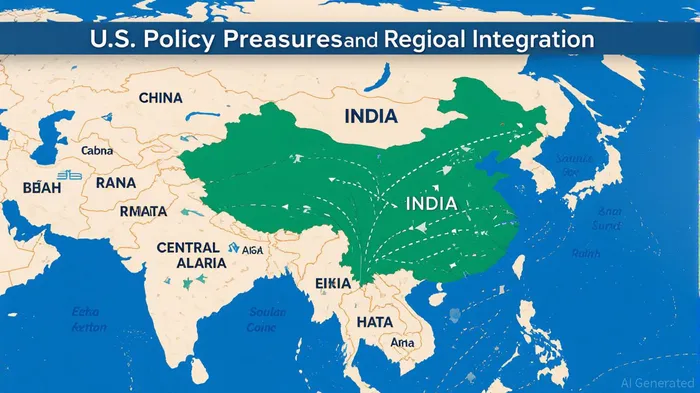
The 2025 Shanghai Cooperation Organization (SCO) summit in Tianjin underscored a seismic shift in Asia-Pacific trade dynamics, as member states recalibrated economic strategies amid U.S. tariff volatility and geopolitical fragmentation. With China and India pledging to restore bilateral trade to $92 billion annually and ease cross-border restrictions on industrial goods, the summit highlighted a deliberate pivot toward regional self-sufficiency [2]. This alignment, however, is complicated by divergent national interests—such as India’s diplomatic tilt toward the U.S. and Pakistan’s unresolved tensions with New Delhi [4]. The SCO’s push for de-dollarization and local currency settlements, including a 15% year-on-year increase in yuan-based transactions with member states, signals a broader effort to insulate economies from Western financial pressures [2].
U.S. tariff policies under President Trump have further accelerated this realignment. Tariffs averaging 19.5% on goods from key Asian exporters have disrupted supply chains, forcing companies to shift production to India and Vietnam. For instance, India’s FDI inflows surged to $81.04 billion in fiscal year 2024–25, while Vietnam’s electronics sector grew 12% year-to-date as firms like AppleAAPL-- rerouted manufacturing to avoid tariffs [2]. However, these shifts introduce new risks: India’s 25% tariff on U.S. goods has weakened its export competitiveness, and Southeast Asian economies face sector-specific vulnerabilities, particularly in semiconductors and textiles [3].
Institutional investors are adopting multi-layered strategies to hedge against these uncertainties. Defensive sectors like utilities and consumer staples are gaining traction, with historical outperformance of 8.9% to 9.9% during crises [1]. Geographical diversification is also critical, with overweight positions in BRICS nations and underweight exposure to U.S.-centric supply chains. Currency hedging via RMB and INR exposure, along with short-duration sovereign bonds, is being prioritized to mitigate dollar volatility [3]. Julius Baer analysts note that while ASEAN equities have benefited from reduced tariff overhangs, transshipment rules and enforcement ambiguities remain key risks [3].
The SCO’s 2025–2035 Development Strategy, which targets $100 billion in cross-border e-commerce by 2030, further reinforces the region’s pivot toward digital and infrastructure-driven growth [2]. This aligns with infrastructure investment trends in Southeast Asia, where public-private partnerships (PPPs) are emerging as a key vehicle for capital deployment [1]. However, structural challenges—such as the SCO’s weak dispute resolution mechanisms and lack of a robust secretariat—threaten to undermine long-term cohesion [4].
For investors, the path forward requires balancing growth opportunities with geopolitical prudence. BlackRock’s Investment Institute recommends shortening tactical horizons and favoring short-term U.S. Treasuries as a safe-haven amid policy uncertainty [4]. Meanwhile, the expansion of private credit in India and Indonesia, driven by liquidity constraints in traditional financing, presents niche opportunities [1].
In conclusion, the interplay of U.S. tariffs and SCO dynamics is reshaping Asia-Pacific markets into a mosaic of resilience and risk. Strategic asset allocation must prioritize regional integration, currency diversification, and sectoral resilience to navigate this fragmented landscape.
Source:[1] May 2025: Impact of U.S. Tariffs on Private Markets and Alternatives [https://caia.org/content/may-2025-impact-us-tariffs-private-markets-and-alternative-investments-asia][2] SCO Summit and the Shifting Geopolitical Landscape of ... [https://www.linkedin.com/pulse/sco-summit-shifting-geopolitical-landscape-eurasia-farhat-asif-phd--kb7ze][3] Focus On US Tariff Impact On Asia [https://www.wealthbriefingasia.com/article.php/Focus-On-US-Tariff-Impact-On-Asia-][4] Assessing the Impact of Escalating Trade Tensions - BlackRockBLK-- [https://www.blackrock.com/corporate/insights/blackrock-investment-institute/publications/us-tariffs-impact]





Comentarios
Aún no hay comentarios