
Navigating Tariff Uncertainty and Q2 Earnings: Strategic Opportunities in a Volatile Market
The global economy is navigating a treacherous path marked by escalating trade tensions, inflationary pressures, and corporate earnings volatility. As U.S. tariffs reach historic highs—averaging 20.6% pre-substitution and 19.7% post-substitution—the ripple effects are reshaping industries, consumer behavior, and investment landscapes. For investors, this environment demands a sharp focus on sectors and companies capable of thriving amid uncertainty.
The Tariff Tsunami: Impact and Implications
The U.S. tariff regime, now the highest since the early 20th century, has created a dual crisis: economic contraction and sectoral imbalance.
- Consumer Prices: Tariffs have driven a 2.1% short-term price surge, equivalent to a $2,800 annual income loss per household. Food, vehicles, and apparel face disproportionate strain, with motor vehicle prices rising 14.1% pre-substitution.
- Global GDP Drag: The U.S. economy is projected to shrink by 0.9% in 2025, while Canada's GDP could drop 2% due to retaliatory measures. China's economy, meanwhile, faces a 0.2% contraction.
- Sectoral Winners and Losers: Manufacturing ekes out a 2.6% output gain, but construction and agriculture slump by 4.1% and 0.8%, respectively. Advanced manufacturing—a pillar of innovation—declines 2.9%, underscoring the uneven recovery.
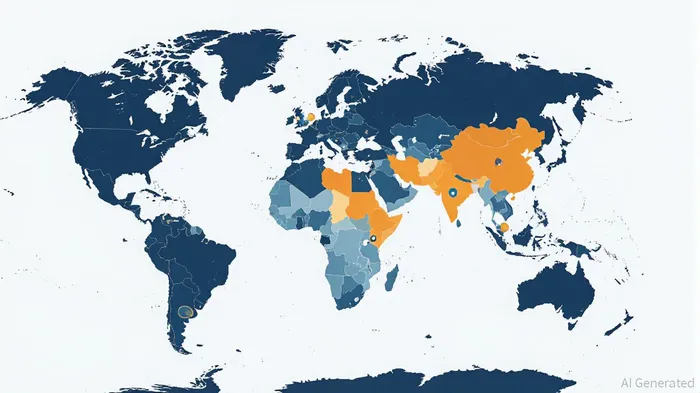
Q3 Earnings: A Tale of Two Markets
Corporate earnings reports reveal stark divergences. While some sectors falter, others exhibit resilience:
- Struggling Sectors:
- Jewett-Cameron Trading (JCTC): A microcosm of tariff fallout, JCTCJCTC-- saw revenue plummet 20.7% to $12.61 million in Q3 2025. Steel and aluminum tariffs, which doubled to 50% in June, forced retailers to delay purchases. Gross margins collapsed to 15%, and the company reported a $0.18 per share net loss.
Supply Chain Stress: Companies reliant on imported metals or Chinese manufacturing face cost inflation and logistical bottlenecks.
Resilient Sectors:
- Tech and Healthcare: Goldman SachsGS-- forecasts S&P 500 earnings growth of 7% to $262 in 2025, driven by these sectors. Tech's ability to pass costs to consumers and healthcare's inelastic demand shield them from tariff volatility.
- Consumer Staples: Defensive stocks, such as food and household goods, outperform as consumers prioritize essentials amid inflation.
Strategic Investment Opportunities
The current environment rewards sector-specific focus and company-level agility:
- Target Sectors with Pricing Power:
- Healthcare: Companies like MedtronicMDT-- (MDT) or Thermo FisherTMO-- (TMO) benefit from stable demand and minimal tariff exposure.
Technology: Firms with diversified supply chains (e.g., AppleAAPL-- (AAPL), which sources components across 20+ countries) or those shifting production to tariff-friendly regions (e.g., Vietnam) are well-positioned.
Look for Operational Flexibility:
Companies like JCTC, while currently struggling, could rebound if they successfully diversify suppliers and pass costs to consumers. Monitor their progress in expanding Lifetime Steel Posts® sales and reducing operational costs.
Avoid Tariff-Exposed Industries:
Auto and Steel: Automakers face 25% tariffs on imported parts, squeezing margins. Avoid companies overly reliant on European or Chinese supply chains.
Monitor Central Bank Policy:
- The Federal Reserve's pause on rate hikes until September 2025 aims to balance stagflation risks. A dovish turn could boost equity valuations, particularly in rate-sensitive sectors like utilities and real estate.
Final Considerations: Playing Defense and Offense
Investors should adopt a multi-pronged strategy:
- Defensive Plays: Allocate to consumer staples (e.g., Procter & Gamble (PG)) and healthcare ETFs (e.g., XLV) to hedge against economic volatility.
- Growth Bets: Invest in tech leaders (e.g., NVIDIANVDA-- (NVDA), MicrosoftMSFT-- (MSFT)) with pricing power and exposure to AI-driven demand.
- Tariff Mitigators: Favor companies with geographic or supply chain diversification, such as IntelINTC-- (INTC), which is expanding chip production in the U.S. and Europe.
Conclusion
The tariff landscape is a minefield for the unprepared but an opportunity for the astute. By focusing on sectors insulated from trade wars and companies with adaptive strategies, investors can navigate this volatility. While near-term uncertainty remains, the path to outperformance lies in resilience and foresight.
Investment Advice:
- Buy: Tech and healthcare leaders with global supply chain flexibility.
- Avoid: Auto and commodity-heavy firms until tariff clarity emerges.
- Hold: Defensive staples as a portfolio anchor.
In a world of rising trade barriers, the winners will be those who can bend without breaking.







Comentarios
Aún no hay comentarios