
Navigating Tariff Uncertainty: How the U.S.-EU Trade Deal Shapes Market Opportunities
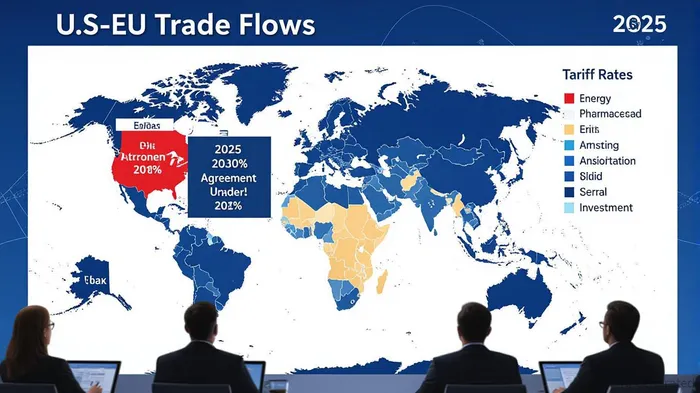
The U.S.-EU trade deal, finalized in July 2025, has recalibrated the global economic landscape, offering both clarity and complexity for investors. While the agreement averted a potential trade war by capping EU exports to the U.S. at a 15% baseline tariff (down from Trump's 30% threat), it also introduced sector-specific risks and opportunities. For investors, this represents a pivotal moment to reassess strategic sector rotation and risk management in a high-uncertainty environment.
Strategic Sector Rotation: Winners and Losers
The deal's terms have created divergent outcomes across industries. U.S. energy and automotive sectors stand to benefit significantly. The EU's $750 billion energy purchase commitment—focused on LNG, oil, and nuclear technology—positions American energy producers like ExxonMobil (XOM) and Chevron (CVX) as clear beneficiaries. Similarly, the elimination of EU tariffs on U.S. car imports (from 10% to 2.5%) bolsters automakers such as Ford (F) and Tesla (TSLA), offering them a more competitive edge in the European market.
Conversely, European automakers face headwinds. The 15% U.S. tariff on EU car exports, while lower than the previous 27.5%, still threatens margins for firms like Volkswagen (VOW3.DE) and Stellantis (STLA.EU). This has spurred a potential shift in capital toward U.S. electric vehicle (EV) infrastructure and battery technology stocks, as European firms pivot to mitigate exposure.
The pharmaceutical sector remains a wildcard. While the U.S. agreed to limit tariffs on EU pharmaceuticals to 15%, unresolved tensions and separate negotiations leave room for volatility. Companies like Pfizer (PFE) and Sanofi (SNY) may need to hedge against regulatory shifts, but their critical role in global supply chains ensures long-term resilience.
Risk Management in a High-Event Environment
The deal's implementation has introduced new layers of uncertainty. For instance, steel tariffs remain at 50%, and ongoing negotiations on wine, spirits, and agriculture could disrupt sectors reliant on these goods. Investors must adopt a dynamic hedging strategy, particularly in commodity-linked assets and export-heavy industries.
Diversification across geographies and sectors is key. The EU's $600 billion investment pledge in U.S. semiconductors and infrastructure offers a counterbalance for European investors, but they must also consider currency risk—the euro-dollar pair's recent strength to 1.175 could amplify exposure for multinational firms.
Actionable Insights for Investors
- Overweight U.S. Energy and Automotive: Allocate capital to energy producers and EV infrastructure, leveraging the EU's long-term procurement commitments.
- Underweight European Automotive Exposure: Reduce holdings in European automakers, which face margin compression from U.S. tariffs.
- Hedge Pharmaceutical Portfolios: Use derivatives or diversify into generic drug manufacturers to mitigate regulatory risks.
- Monitor Sector-Specific Tariff Adjustments: Stay attuned to ongoing negotiations on agriculture and wine, which could trigger sectoral pivots.
Conclusion
The U.S.-EU trade deal has reshaped the investment landscape, offering both tailwinds and turbulence. While the agreement stabilizes transatlantic trade, it also underscores the need for agility in sector rotation and risk management. Investors who proactively adjust their portfolios to align with the new tariff realities—while hedging against unresolved uncertainties—will be best positioned to capitalize on the opportunities emerging from this landmark agreement.
As markets continue to digest the deal's implications, the next few months will be critical for refining strategies. The key lies in balancing optimism for near-term gains with prudence against lingering risks—a hallmark of successful investing in a high-event world.





Comentarios
Aún no hay comentarios