
Navigating Tariff Uncertainties: Strategic Opportunities in Resilient Sectors
The global trade landscape in 2025 is marked by a seismic shift driven by U.S. tariff pressures and strategic realignments. While the immediate impact of protectionist policies often sparks concern, a closer look reveals underappreciated industries and geographies poised to thrive in this new environment. For investors, the challenge lies not in resisting the tide of change but in identifying where opportunity blooms amidst disruption.
Semiconductor Manufacturing: The Onshoring Revolution
The U.S. semiconductor industry is a prime example of how tariffs and fiscal stimulus can catalyze resilience. The CHIPS and Science Act of 2022, coupled with 2025 tariff pressures, has spurred over $100 billion in domestic investments, with companies like Intel (INTC) and GlobalFoundries (GFS) leading the charge. These firms are not only capitalizing on federal subsidies but also benefiting from import restrictions that shield them from Asian competitors. The sector's growth is further bolstered by global alliances, such as the U.S.-EU partnership to secure supply chains.
Investors should monitor companies that align with the "friendshoring" strategy, particularly those with strong government contracts or partnerships in critical technologies. The semiconductor sector's long-term potential is underpinned by its role in AI, quantum computing, and next-generation infrastructure.
Steel and Aluminum: The Foundation of Resilience
The 25% tariffs on steel and aluminum have created a protective barrier for U.S. producers like Nucor (NUE), Cleveland-Cliffs (CLF), and U.S. Steel (X). These companies have leveraged the policy to raise prices, expand production, and secure market share. The result? A 2% increase in domestic steel production—a trend reminiscent of the Trump-era tariffs.
The sector's appeal lies in its inelastic demand and the growing emphasis on domestic infrastructure projects. With energy infrastructure in Texas and renewable projects increasingly relying on U.S.-made steel, this industry is a cornerstone of the "reshoring" narrative.
Textiles and Logistics: Niche Markets and Tariff-Exempt Gains
High tariffs on Chinese and Bangladeshi imports have given U.S. textile manufacturers a pricing edge, particularly in workwear and sustainable fashion. While automation limits job growth, regions like the Carolinas are seeing a revival in textile jobs. Meanwhile, logistics firms like Caterpillar (CAT) and Deere (DE) are thriving by producing tariff-exempt machinery. The proposed 100% tariffs on Chinese containers are pushing companies like FedEx (FDX) to restructure supply chains, accelerating nearshoring trends.
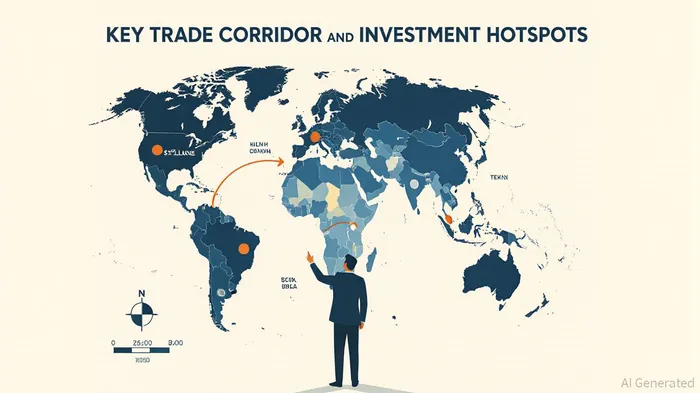
Geographies on the Rise: The Global Realignment
Vietnam: A Strategic Manufacturing Hub
Vietnam's 2025 trade deal with the U.S. (20% tariffs on exports, 40% on transshipped goods) has solidified its role as a manufacturing alternative to China. Despite higher tariffs, the country's strategic location and growing FDI inflows make it a compelling bet. Vietnamese manufacturers are diversifying supply chains into Indonesia and Malaysia, creating a ripple effect for ASEAN economies.
The UK: A Gateway to Diversified Markets
The U.S.-UK trade framework has reduced tensions and opened new market access for British goods. With tariff-free quotas for beef and reduced taxes on 100,000 cars, the UK is positioning itself as a bridge between the U.S. and Europe. Investors should watch for UK-based companies expanding into U.S. markets, particularly in financial services and advanced manufacturing.
Southeast Asia and Africa: The New Frontiers
While countries like Cambodia and Lesotho face high tariffs, the broader regions of Southeast Asia and Africa are emerging as hubs for regional integration. The African Continental Free Trade Area (AfCFTA) and ASEAN's internal trade networks are gaining momentum, offering opportunities in diversified manufacturing and sustainable agriculture. Botswana and Kenya, with stable political environments, are attracting FDI in mining and tech.
Conclusion: Investing in Resilience
The 2025 tariff landscape is not a barrier but a catalyst for innovation and realignment. Investors who focus on sectors like semiconductors, steel, and logistics—along with geographies like Vietnam and the UK—can capitalize on the structural shifts reshaping global trade. These opportunities are underpinned by fiscal stimulus, strategic partnerships, and a growing emphasis on supply chain resilience. For those willing to look beyond the noise, the path to long-term gains lies in aligning with the forces driving the next era of economic transformation.





Comentarios
Aún no hay comentarios