
Navigating the Tariff Tsunami: Sector-Specific Risks and Opportunities Ahead of July 9
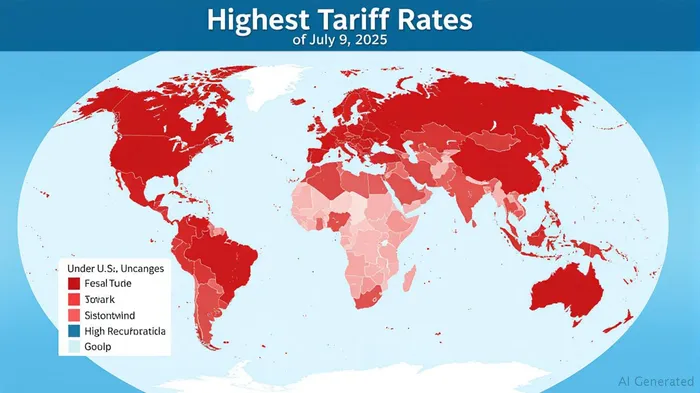
The July 9, 2025, tariff deadline marks a pivotal moment in global trade, as the U.S. enacts sweeping reciprocal tariffs and sector-specific levies under its "America First" agenda. With countries like China, Vietnam, and EU members facing rates exceeding 30%, industries such as automotive, luxury goods, and energy stand at the crosshairs. This analysis dissects sector vulnerabilities and identifies equities positioned to thrive—or falter—in the coming storm, while emphasizing the urgency of portfolio realignment before the deadline.
Automotive: Compliance as the New Currency
The automotive sector faces a stark divide: U.S. manufacturers adhering to the USMCA (United States-Mexico-Canada Agreement) will enjoy duty-free status, while non-compliant imports face a 25% tariff wall. Companies with production chains aligned to USMCA's stringent rules of origin—such as General Motors (GM) and Ford (F)—are shielded, whereas global competitors like ToyotaTM-- or BMW risk margin erosion.
However, the UK's special treatment offers a silver lining. Its automotive tariffs drop to 7.5% under a tariff-rate quota, enabling U.S. buyers to source vehicles at a discount. Investors should favor U.S. automakers with cross-border supply chains and monitor the U.S.-UK Economic Prosperity Deal, which may further ease steel/aluminum costs for aerospace and automotive firms.
Luxury Goods: The European Sell-Off and U.S. Rebound
European luxury brands—think LVMH or Kering—are vulnerable to tariffs ranging from 20% to 50%, depending on their country of origin. This creates a window for U.S. luxury players like Coach (COH) and Ralph Lauren (RL) to capture displaced demand. Additionally, companies with U.S. manufacturing hubs or supply chains outside the tariff zones (e.g., Vietnam's reduced 20% rate) will outperform.
Energy and Critical Minerals: Betting on U.S. and Asian Suppliers
The energy sector faces dual pressures: sanctions on nations importing Venezuelan or Iranian oil, and Section 232 investigations into critical minerals like lithium and cobalt. U.S. shale producers, such as Devon Energy (DVN), and Canadian oil sands firms gain an edge as buyers pivot to avoid sanctioned suppliers. Meanwhile, the export controls on Chinese rare earths and tungsten (effective February 2025) favor companies in Australia or Africa. The VanEck Rare Earth/Strategic Metals ETF (REMX) offers exposure to this theme.
Steel and Aerospace: Domestic Winners, Global Losers
With U.S. steel tariffs at 50% for non-UK origins, domestic producers like Nucor (NUE) and Allegheny Technologies (ATI) stand to gain as import substitution accelerates. The aerospace exemption for UK manufacturers (under the WTO Agreement on Trade in Civil Aircraft) also shields players like Boeing (BA), which sources critical components from the UK. Investors should avoid European steel exporters and focus on U.S. firms with low foreign exposure.
Safe Havens: Gold and Bonds as the Anchor
Amid this volatility, gold (GLD) and long-term Treasuries (TLT) emerge as critical ballast. The Federal Circuit's stay on tariff-related legal challenges until July 31 reinforces uncertainty, making safe havens a must-have for portfolios.
Final Call to Action
The clock is ticking. Before July 9, investors should:
1. Rotate into USMCA-compliant automakers (GM, F).
2. Short European luxury stocks and favor U.S. alternatives (COH, RL).
3. Add REMX to capitalize on critical mineral demand.
4. Hold NUE and BA for steel/aerospace resilience.
5. Allocate 10–15% to GLD/TLT to hedge against tariff-driven market swings.
The tariff regime is not just a trade policy—it's a seismic shift in global supply chains. Those who act swiftly to align with U.S. priorities and diversify into defensive assets will navigate this tsunami unscathed. The window to position is closing fast.
Data queries are illustrative and should be cross-checked with real-time sources.





Comentarios
Aún no hay comentarios